 an hour ago
Venice Commission respond to amendments to Law Reform for Prosecutorial Council
Periskopi(5 years ago)
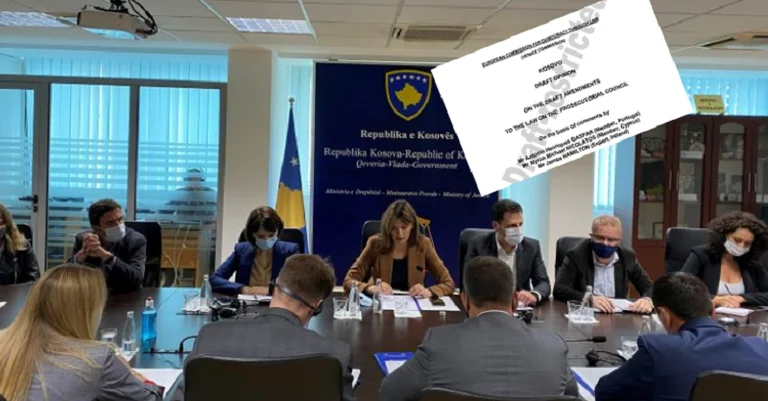
(5 years ago)The Venice Commission has already prepared a Project Opinion on the draft amendments to the Law for the Kosovo Prosecutorial Council, which Justice Minister Albulen Haxhiu had requested. In this draft yet unpublished opinion, provided by Infocus newspaper, the commission's recommendations come as a slap on the government, [...]
In this draft unpublished opinion, which has provided it from Infocus newspaper, the commission's recommendations come as a slap on the government, after the Venice Commission's conclusions find government amendments would put the Kosovo Prosecutorial Council and its mechanisms at risk and ahead of political influence.
In the conclusions of the draft opinion that editorials possess, a series of suggestions for the ministry and government in general have been given, noting that some of the amendments should be revised, and some must be abandoned overall, because as such, they put before exposure to political influence the Kosovo Prosecutorial Council.
The central element of reform, respectively, is the new balance between members of prosecutors and not prosecutors at the KKP. Prosecutors elected by their colleagues represent an essential part of this body (three members from seven)”, the Venice Commission's conclusions reported.
The commission's conclusions also say that the reform should not lead the Kosovo Prosecutorial Council to submission by the ruling majority and that this Justice Ministry proposal increases the risk of direct political influence on the KKP, suggesting that the election of ordinary majority members should be replaced with a proportional system.
“However, reform should not lead to KKP submission to the ruling majority. The draft amendments propose that all port members be elected in simple majority in the Assembly. This proposal increases the risk of unfair political influence on the KKP and should be revised: simple majority choice should be replaced with a proportional election system, or the appointment of several port members by independent foreign institutions or civil society. It is necessary to ensure that the basic KKP component is sufficiently pluralistic, so that members appointed with the ruling majority votes cannot rule alone”, the Venice Commission's draft opinion correctly.
The conclusions of this commission require clear definition of the respective areas of the General Prosecutor's competence, and that the procedure of selecting the members of the port from a parliamentary commission is complex and unclear, so it recommends the complete abandoning of this procedure, the newspaper Infocus writes.
“The General Prosecutor must remain a member “ex offline” KPK's (with the corresponding regulation of the KKP composition, if necessary); law should more clearly define the respective spheres of PP and KPK competence;
Even the procedure for pre-election members by a parliamentary commission is complex and, at the same time, unclear. This opens the door to manipulations, that is, the Venice Commission recommends abandoning the entire procedure”, the conclusion said.
The Venice Commission also says that the prosecution members' selection procedure gives much power to the KKP Electoral Commission, where members do predominate, not prosecutors, and that if any filters are needed, it should be composed of prosecutors.
“in a similar way, the procedure of pre-election of prosecutorial members gives much power to the KKP election commission, where members dominate, not prosecutors. If a kind of filter body is needed, it should be composed of prosecutors, or at least most prosecutors”, the Venice Commission's draft opinion says.
Commission says allowing The renewed KKP to function with only non-professor members risks the prosecution's independence, so it needs to be revised, adding that replacing members currently in office with new members should be done only in extraordinary cases and with justification if it leads to major improvement of the current system, in particular in its depoliticisation.
“Passive divisions predicting early completion of mandates of all current KKP members, and allowing The renewed KKP to operate only with non-prosecutor members in its composition, are dangerous for the prosecution's independence and should be revised. The new KKP can start functioning only when all members are elected.
The replacement of members currently in office, with new members, can be made in extraordinary cases and justified only if it leads to a major improvement in the current system (in particular, depoliticisation). If this is not the case, the current members, or at least some of them, should be allowed to continue serving on their mandates”, the recommendations of the Venice Commission, which is still unpublished.











