43 minutes ago
Why is Kosovo's north a haven of criminal groups?
Periskopi(5 years ago)
(5 years ago)Eight years since Kosovo and Serbia have agreed to the integration of Serbian justice and security institutions from northern Kosovo to the central system, black “list” of the United States contains names from this part of Kosovo. Being a person in the “blacklist” implies applying US sanctions against [...]
Being a person in <x0-list black” implies applying US sanctions against him. Sanctions block individuals' property, while American citizens forbid their cooperation.
People from the north of Kosovo have been placed on the US blacklist, because, as it is said, they have participated in corrupt networks linked to transnational organised crime.
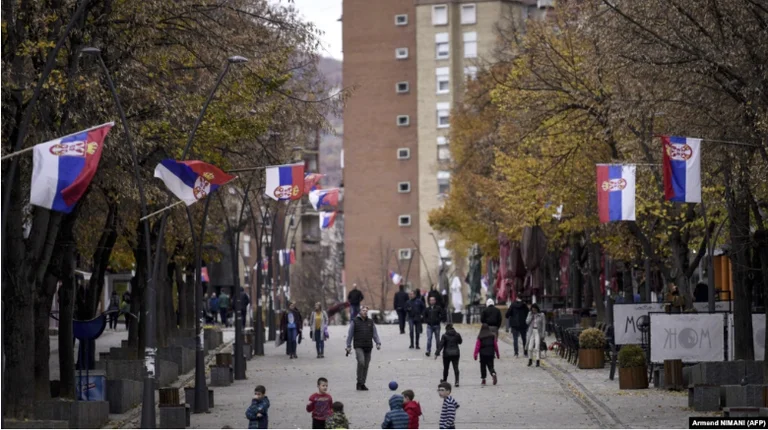
Kosovo's north consists of four Serb majority municipalities, bound territorially: Northern Mitrovica, Zvecani, Leposaviqi and Zubin Potoku.
They are starting to operate in the Kosovo system in 2013, following the signing of the Brussels Agreement for normalising relations between Kosovo and Serbia.
Veselinovic and people around him
Ehat Miftaraj, from the Kosovo Institute for Justice, believes that Kosovo institutions have not done their job properly, which, as it says, has confirmed the US Treasury Department blacklist published on 8 December.
Speaking to Radio Free Europe, Miftaraj says the criminal group, which is included in the US blacklist, is known throughout Kosovo.
According to him, he does business very easily”, because “has the protection of politicians and justice institutions”.
The message that the US has wanted to send to Kosovo institutions is that they are not doing their job, have not investigated or prosecuted [the members of the criminal group]”, Miftaraj says.
He adds that countries that are unable to fight corruption are under the control of criminal groups.
The US has identified businessman Zvonko Veselinovic as leader of the criminal group from northern Kosovo, while sanctioning dozens of other related names.
In 2011, the mission NATO in Kosovo, KFOR has identified Veselinovic as one of the riot organisers in the north.
Co-operation of Criminal, Political Groups
Verolub Petronic, security expert from North Mitrovica, who is also chairman of the organisation “Human Center Mitrovica”, tells Radio Free Europe that criminal groups from the north of Kosovo have been greatly strengthened.
Long ago, he says, those of “have crossed borders”. Their co-operation with political interest groups is widely known, Petroniq says.
The crime-related “Business has increased so much in terms of money that now both Serbia and the Balkans are small to it”, Petroniq says.
In the US Treasury Department's statement, issued on December 8th, the organised crime group reportedly conspired with various politicians for mutual favour, including the bribery of Kosovo security officials, to allow smuggling operations between Serbia and Kosovo in early 2019 and to bribe Kosovo's border officials to allow the smugglers safe passage at the end of 2017.
Petronic believes that Serb and Albanian criminal groups co-operate and adds that justice institutions in Kosovo have had to react and implement the law in northern Kosovo.
One of the ways to rescind north”, Petroniq says, is through the Serbian List ʹthe leading party of Kosovo Serbs, which has been formed with the support of Belgrade and Serbia's current president, Aleksandar Vuciq.
Petronic stresses that political will is necessary for something like that.
Serbian List Answer
Since Serbian List deputy leader Milan Radoicq is on the US blacklist, his party has said on December 9th that the baseless “charges against Serbs from the north are a co-ordinated” campaign, which, according to him, targets the “execution of unity and protection of our people in these” spaces.
Radoic has become deputy chairman of the Serbian List in 2018, a few months after the assassination of opposition politician from Northern Mitrovica, Oliver Ivanovic.
Milan Radojic and Zvonko Veseljinovic are mentioned in the documents of Kosovo's justice institutions in connection with Ivanovic's murder.
In the indictment, they are referred to as “leader of a criminal group”, who has repeatedly made efforts to put North Mitrovica under his control.
However, the charges against them have never been filed because they have not been available to the judiciary.
An arrest warrant has been issued for Radocicin, but it is withdrawn in March of this year without any explanation.
Veselinovic and Radoic are also known for the justice organs in Serbia since 2011, when charges have been filed against them for embezzlement of 32 trucks from the Hypo Alpe Adria Leasing company.
The incident has been established at the Special Court in Belgrade, at the time the dialogue for normalising relations between Kosovo and Serbia has begun.
Both have been acquitted in 2016.
Bojana Pavllovic, from the Crime and Corruption Research Network in Serbia KRIK, says Kosovo has failed to extend control in the north and that Serbia, to keep its control in that part, has collaborated with <x0 people with suspicious biographies”.
She says these persons have great influence on the Serbian List, which is close to Aleksandar Vuciqi's Serbian Progressive Party.
Pavllovic says that former Kosovo Prime Minister Ramush Haradinaj has met with Milan Radojici, and that the CRIK has also published photos in which Radojciq appears in the company of Kosovo politician Behxhet Pacolli.
“Money does work, some things in this sense are done by closed doors, outside the” institutions, Pavllovic tells Radio Free Europe.
According to her, Kosovo institutions have no will to resolve the crime issue.
Kosovo north as source of instability
On the US blacklist is former head of Kosovo Police operations in the north, Zelko Boyic, due to his connections with Zvonko Veseljinovic.
Bojq has long been on the run, as the Kosovo Prosecution has linked him to the murder of Oliver Ivanovic.
Besa Ramaj, a security expert, says Kosovo's north, in the post-war period, has always been the source of instability.
She believes all this relates to dialogue between Kosovo and Serbia for normalising relations. According to her, the final agreement between the two sides is necessary for the region's stability.
Ramaj views US sanctions as a positive step, meaning that it will no longer tolerate destabilisation of the situation.
Serbia's “government still has great influence there [in the north] and uses it as an advantage to advance its agenda. I'm sorry for the citizens who live in that part. We need a more aggressive campaign for the European road of Kosovo and Serbia, so that dialogue can run its course towards the end and mutual recognition to be reached”, Ramaj says.
Kosovo officials have welcomed US sanctions against the group of Serbs from the north of Kosovo, while Serbia's president, Aleksandar Vuciq, has said that his country's competent authorities will investigate whether there are “heavy charges”.
Kosovo Prime Minister Albin Kurti has warned 10 December of mobilization in the fight against criminal groups, “irrespective of ethnicity”