8 minutes ago
Kosovo's new ambassador to Germany, Ajjeti: We must change narration for Kosovo
Periskopi(5 years ago)
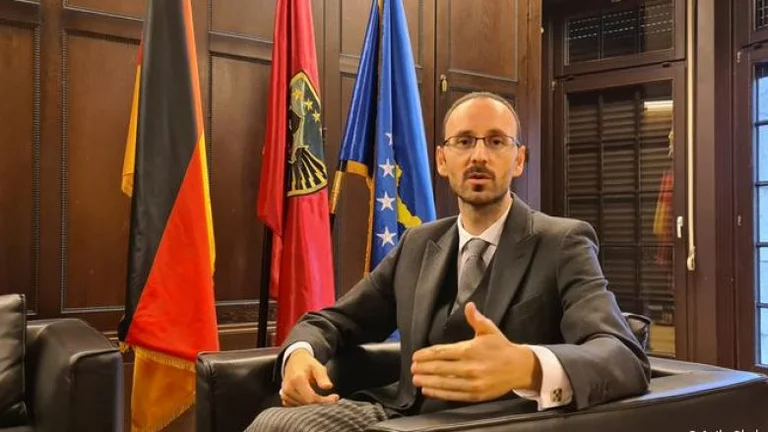
(5 years ago)Kosovo's diplomatic service in Berlin has been named Faruk Ajeti. On Monday he handed over the credentials to President Frank Walter Steinmeier. In an interview with DW, Ajjet talks about his work priority. You had just started a successful scientific career. Was it an easy decision to return to diplomacy? Ajeti: U [...]
Kosovo's diplomatic service in Berlin has been named Faruk Ajeti. On Monday he handed over the credentials to President Frank Walter Steinmeier.
In an interview with DW, Ajjet talks about his work priority.
You had just started a successful scientific career. Was it an easy decision to return to diplomacy?
Ajeti: I thought over when they offered me this task, in the sense of the responsibilities waiting for me in Berlin and putting aside my scientific career, but serving Kosovo is a vital privilege and every sacrifice is worth it.
You come straight from Vienna, where they worked as a diplomat at the Kosovo Embassy by 2020. What's the difference between Vienna and Berlin?
Ajeti: Compared to Vienna, Berlin is obviously one of the European decision-making centers and has a heavy political weight. Germany is also the world's fourth and first economy in Europe, part of the EU, NATO, G7 and any mechanism of global importance. Here we have a huge grant in number, with over 400,000 members. So the challenges are greater and the responsibility is greater.
What is your strategy to make the best use of diaspora potential?
Ajeti: In the first place is economic potential. We as embassys, along with the five consulates we have all over Germany, will support any business that seeks to invest in Kosovo. The law on strategic investment guarantees this support. But cultural, sports, scientific exchanges are also important in the field of education. We will knock on all doors that will help us build an economically strong Kosovo and with a consolidated democracy.
Now we have a new German government, which since the coalition agreement has been positioned for visa liberalisation for Kosovo citizens, to support the normalisation of Kosovo-Serbia relations, and to accompany Kosovo towards EU integration. What more can be expected from Germany?
Ajeti: It's lucky for me to start my mission with the new German government. It is the first time the German government has spoken in such detail about the Western Balkans since the governing plan. And that fact gives me a lot of optimism that at my meetings we can talk about concrete projects. I also noticed this at my meeting with President Frank Walter Steinmeier, who is a very good connoisseur of Kosovo and the region. So relations are excellent, thanks to a job done by my ancestors, but also by exiles since the 1990s with the government in the Islamic Republic of Kosovo, if not before. But we need a stronger commitment of Germany in the process of normalising Serbia-Kosovo relations. So we need Germany's political power to translate even more into practice and play a leading role within the EU, why not perhaps even have a German envoy. Germany has an active continuation of its successful engagement in Kosovo and the Balkans. I also think that the revolution created incorrectly in the West should be changed, and unfortunately in Germany that without Serbia there can be no solution in the Balkans.
What can you do as ambassador in this regard?
Ajeti: I will use all my argumentive strength to explain that such a arrogance so far has not helped us solve problems. So, the wrongly created norm that Serbia is the key state in the Balkans and that without it it it does nothing, it is historically wrong, virtually unstable and dangerous for the future. In contrast, Belgrade is a source of destructivity, both in Kosovo, Bosnia and Herzegovina, Montenegro and earlier in northern Macedonia. Such horrors that privilege Serbia are destined to fail, and I believe that history has taught us very well. I will ask that attention be directed to those who play a constructive role: It was not Serbia, but the Albanian factor, whether in Kosovo, northern Macedonia, or in Albania and Montenegro. To change this migration, you need to speak not only to the executive but also to the lawmakers. The visa issue is similar. Even though the German government has now decided since the coalition agreement that it will strongly seek visa liberalisation, I think even German lawmakers, who have ties to their colleagues in Europe to lobby for visa liberalisation, need to be more senbilized. The time has come for Kosovo citizens to be treated, as they deserve, as Europeans. /dw/