a minute ago
Kosovo, only in region without gold reserves
Periskopi(5 years ago)
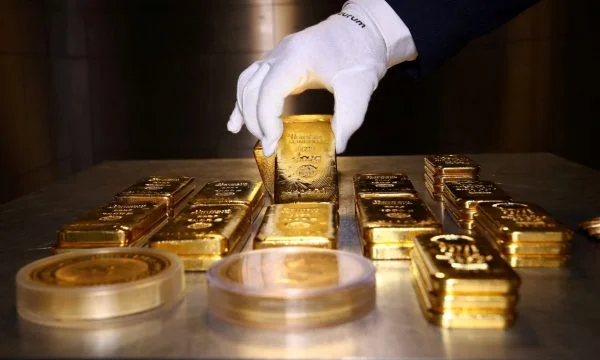
(5 years ago)Kosovo is the only state in the region, which has no gold reserves. The Kosovo Central Bank, in a written response to Radio Free Europe, has confirmed that “currently does not hold in its portfolio international reserves in gold and other precious metals”. Meanwhile, in the mirror of financial means [...]
The Kosovo Central Bank, in a written response to Radio Free Europe, has confirmed that “currently does not hold in its portfolio international reserves in gold and other precious metals”. Meanwhile, in the financial tool mirror released by this bank, some 1 billion of 847 thousand euros are found as capital reserves.
Gold, like wealth, has greater liquidity and stability of prices and states that do not want to accept any high risk, are instructed to store gold in their reserves as their financial assets.
Free Europe has been addressed to the Government of Kosovo, respectively, the Ministry of Finance, with the question of why Kosovo has no gold reserves and whether there is any plan to create such reserves. But, so far, this ministry has not returned answers.
Shatri: The country's poor capacity for gold reserves
Haki Shatri, former finance minister in the Government of Kosovo, tells Free Europe Radio that there are many reasons why Kosovo has failed to create gold reserves.
According to him, Kosovo has emerged from the war in 1999, without inheriting such reservations from the former Yugoslavia. According to him, Kosovo, initially, in the first five years after the war, had invested in the creation of institutional infrastructure and the creation of preconditions to form the state, with a very formal budget of about 300m euros. Following the proclamation of independence in February 2008, investments needed to build capacity for law enforcement and construction of tax and customs institutions.
The reason why we do not have (gold reserve) is initially poor capacity and low access to more. If we had more reservations, then instead of saving them in currency, the state would have turned them into gold reserves, if it were estimated that the performance of the price of gold when bought is favourable. But it also depends on the market price movements”, says Shatri.
Bektash: Kosovo has not yet received gold from former Yugoslavia
In addition to lack of gold reserves, Kosovo does not even have its national currency and has the euro in use. In the absence of national currency, Montenegro also uses the euro, while other countries released from the former Yugoslavia have their national currency.
Majid Bektashi, professor of economics at the University of Pristina, in a conversation with Radio Free Europe says the lack of national currency is argued with the lack of gold reserves.
According to him, the Republic of Serbia is the heir to the former Yugoslav system. As Bektash says, the states that have emerged from the former Yugoslavia have inherited parts of property of over 200 tonnes of gold that were the reserve of the former joint state. But Kosovo is still not recognised by Serbia and, as he says, financial and economic success has not been conducted between the two countries. Consequently, Kosovo has not inherited part of the gold wealth the former Yugoslavia has had and its successor, Serbia.
“Until political problems end, we cannot begin to lock in economic and financial success with Serbia. The other reason why we're the only country that doesn't have gold reserves has to do with the specific restrictions the Central Bank has had in the given period. Although, according to one formula, all developed states store their reserves by one-third to distribute risk- in dollars, euros and gold. We're the only ones who have euro”, Bektas says.
Unpowered to Create Gold Reserves
Former Minister Shatri suggests that given the country's major demands during its citizenship construction, in front of its budget, not large, the inability to create gold reserves should not be blamed on anyone.
And you can't blame either of the governments or that one because it's not dependent on them. It's just that there wasn't any possibility, and that's our potential”, Satri estimates.
He adds that it remains only to hope that Kosovo will not be faced with any crisis, where gold reserves would be necessary.
Professor Bektash points out that states of the Western Balkan region, in recent years of financial crisis, have significantly increased gold reserves. But, he suggests that even if Kosovo eventually began to secure gold reserves, actually it is not the time for such a thing.
The price of gold has now reached for an ounce (31.03 grams) of over $1,700, is at great risk that at this price, which probably in the future if the financial crisis and the energy crisis, which has engulfed not only the region but the world ) can decrease”, Bektash points out.
Currently, Serbia's gold reserves are 37.2 tons. Northern Macedonia has 6.9 tonnes of gold reserves, Bosnia and Herzegovina has 2.9 tonnes, Albania has 2.8 tonnes. Meanwhile, Montenegro has 1.9 tonnes of gold reserves, but they are earmarked for loans.
Serbia returns gold reserves from banks abroad
Recently, Serbia has restored all gold reserves, which it has stored abroad. Currently, 37.2 tonnes of gold -- as much as Serbia has reserves -- is worth 1.9 billion euros.
According to the National Bank of Serbia, the reason for the return of gold bars from the vaults in Switzerland and England is that “in an environment of increased global uncertainty, she wanted to further increase the security and access of its gold”.
However, this bank has not clarified the concrete danger involved.
Economics issues in Serbia recogniser Sasa Djigovic tells Radio Free Europe that Serbia has enough currency reserves without counting gold.
In case of real major disorders, the price of gold goes up by waves and you're safer, because you can sell certain amounts. Gold serves for difficult moments when global economic situations are unfavourable or in the event of possible political pressures and sanctions, so that you do not raise your reserves anywhere outside the country”, he says.
Gold is traditionally stored in foreign bank safes, while in times of instability, countries attract it to ensure they can use it in case of crisis. Now, according to economist Sasa Djogovic, it can be linked to the pandemic of the Corona virus.
“The main global concern currently is pandemic, how long it will last, and can new forms (unedemia) cause new shifts in the market, which can lead to a decline in economic flows. In those cases, the price of gold would rise again”, Djogovic says.
Who has the largest gold reserves?
World central banks currently hold more than 35,000 tons of gold.
According to reports by the World Gold Council of Gold Council, which takes notes according to countries, the United States has the largest gold reserves of 8,133 tons, which is about 78 percent of the country's total currency reserves.
Next comes Germany with 3,359 tonnes and Italy and France with more than 2,000 tonnes of gold.
Significant amounts of gold in the past decade have bought Russia and China, which take fifth and sixth place on the world list.
Russia's Central Bank currently owns 2,292 tons of gold, which increased the amount of reserves to more than 20 percent. Russia further increased its acquisitions in 2018, after investments in US bonds were reduced to minimum after Washington imposed sanctions on that country due to the annexation of the Ukrainian Crimea Peninsula, Reuters writes.