an hour ago
EU inpower in Kosovo dialogue- Serbia
Periskopi(5 years ago)
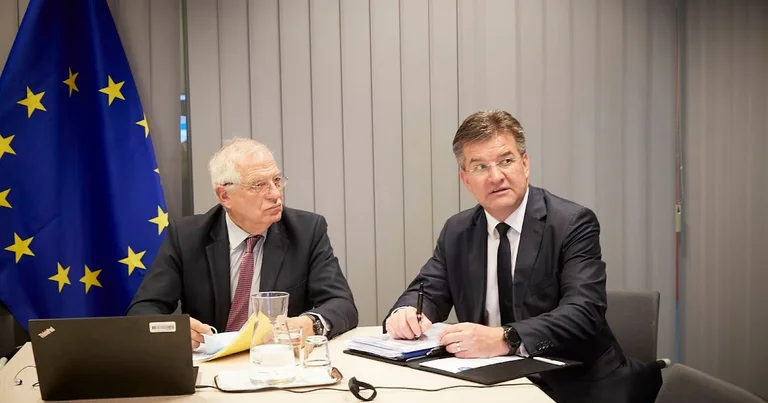
(5 years ago)European diplomacy chief Josep Borrell's statement that Kosovo should establish the Association of Serb-dominated municipalities, broadcast the European Union's position as asymmetry in relation to Kosovo under dialogue with Serbia, and is taking over non-active competencies, assessing the connoisseurs of political developments in Kosovo and Serbia, Agon Maliqi [...]
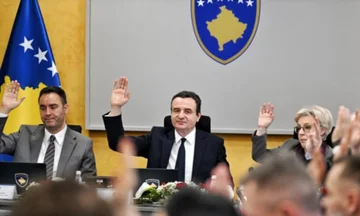
At a joint media conference with Borrell in Brussels on December 7th, Kosovo Prime Minister Albin Kurti said there are 33 agreements that have been reached in Brussels, but Belgrade insists on implementing only one -- that of association, but which, as he said, the Kosovo Constitutional Court has assessed as an unconstitutional agreement.
But, Borrell, insisted that this was one of the agreements reached in Brussels between Kosovo and Serbia and that as such it should be respected, praising the Association Agreement as the most important. He stressed that the Constitutional Court ruling does not rule out the establishment of association.
“So, I'm sorry, but we need to ask for implementation of this” agreement, Borrell said.
The establishment of association is envisioned with the 2013 Brussels Agreement reached between Kosovo and Serbia. Two years later both parties have also agreed on the principles of its establishment.
The association is designed to round up about ten municipalities in Kosovo, where the majority of the population are Serbs, who are North Mitrovica, Klokoti, Partesh, Ranillug, Gracanica, Zvecani, Zubin Potoku, Novoberda, Leposaviqi and Shtrpca. The association is designed to have organizational organs and structures. Under the agreement, the association is meant to have a coalition as a supreme body, comprised of representatives appointed by members elected by the municipalities in attendance. Under the deal, the association aims to represent the collective interests of those municipalities, in particular in the field of education, health, urban and rural planning, as well as the economy.
The Constitutional Court of Kosovo on December 23rd 2015 had ruled that the Association of Serb majority municipalities be founded as envisioned with the first Brussels Agreement, reached in April 2013, between Kosovo and Serbia.
However, the Court had found that general principles of association are not entirely compatible with the spirit of the Constitution. In fact, it is questionable that the association is not based on multiethnicity, but unites municipalities in which an ethnic community is a majority.
Maliqi: EU with asymmetric position and favourable to Serbia
Political development acquaintance Agon Maliqi, editor and co-founder of blog “Sbonker” tells Radio Free Europe that the EU leaves to understand that it does not see the fact that the Association Agreement cannot be treated as disconnected from a comprehensive agreement.
Meanwhile, as he says, the EU does not have instruments to impose on reaching such an agreement, but also on the implementation of existing up to date agreements. For more, according to him, Borrell's statement ignored the fact that the EU is putting pressure on the weaker side, in this case Kosovo.
“Absolutely, the EU's position at this stage is asymmetric and favourative to Serbia, because in the absence of binding instruments ʹ any kind of binding instrument even towards Serbia ʹ and lack of any kind of integration process, pressure is directed towards the weaker side. The EU's position is asymmetric also for the fact that five states do not recognise Kosovo, and this is reflected in orientation in a range of pressure towards Kosovo, at a time when there is no meaning and no process”, Maliqi points out.
He adds that the EU's position has been known. However, according to him, it does not excuse Kosovo, which does not have a strategy to overturn this asymmetry, bringing the US into play. But, Maliqi says it is clear that there is currently no common commitment and agenda of Kosovo and the US to change this situation.
Janjiq: The foundation or not of Association is not Borrell's job
Dusan Janjaq from the Forum for Ethnic Relations in Belgrade tells Radio Free Europe that in dialogue between Kosovo and Serbia in Brussels, the EU's role is supportive and facilitating, but by no means imposing or an arbitrator.
According to him, since 2014, when the first EU mediator in this dialogue, Robert Cooper no longer had that role, the EU had already shut down the Office for Agreements Implementation. According to him, there are even no reports that took place every six months where the facts and arguments regarding the progress or difficulties of the process could be seen.
Borrell's insistence on forming the Association of Serb majority municipalities, Janjzic sees as mixing into something that does not belong to the chief of European diplomacy.
It is not his job to assess whether it is Belgrade's right request. He certainly does not know that the working group that must draft the statute (of Association), which the group consists of representatives of the four Serb majority municipalities, has never handed over that statute to the EU. That is a good reason for the Kosovo side. So he's uncompetive about it, and all right, because he doesn't have to know everything. But the problem is that the one leading the dialogue before him (EU special envoy for Kosovo-Serbia dialogue Miroslav Lajcak) does not brighten his leader. Their problem is that they don't have the real mirrors, and they don't care about the development of the” dialogue, says Janjic.
Displays without readiness for dialogue
So far, under the dialogue mediated by the European Union, Kosovo Prime Minister Albin Kurti has met twice with Serbia's president, Aleksandar Vuciq. Their last meeting was held on 19 July, but the parties failed to achieve any concrete results.
Since then, a meeting of Kurti and Vuciqi had become impossible due to the Serbian side's insistence on the formation of the Serb majority municipalities' association, while the Kosovo side had rejected that condition.
Prime Minister Kurti, at a news conference on December 5th, said the possibility of having a meeting in Brussels with Serbia's president, Aleksandar Vuciq, has been discussed in the second week of December.
On December 6th, European Union spokesman Peter Stano indicated that at this moment there is neither Pristina nor Belgrade's readiness to engage constructively in dialogue.
Serbian President Vuciq, on December 7th, said Serbia wants to continue dialogue with Kosovo, but that Pristina is one that does not want the dialogue to continue.
The same day, in Brussels, the European Union's representative for foreign affairs and security, Borrell said, however, there is no readiness of the parties to engage in dialogue.
“Viti is not yet finished and we will do everything we can to organize this meeting if we see there will be readiness. But we can't force anyone”, Borrell said.
EU, “saw instruments for pushing ahead of dialog”
Analyst Maliqi estimates that statements by political leaders in Kosovo and Serbia, but also by EU officials, show the symptoms of impasse in the stalemate of the dialogue process and the lack of political will for this process.
According to him, Serbia is awaiting elections that will be held next year, meanwhile in Kosovo -- the new political elite that is in government -- has remained hostage to statements it has given in the past, including for Association, which it has said will not form.
Neither does Kosovo nor Serbia, nor the instruments to push the process forward in this case, this is worth more to the EU. Therefore, the meetings that are being held are more of a kind of ad to preserve the image of a process, which, in fact, has died clinically”, Maliqi says.
“The north editor, subdirecting the ongoing”
The issue of the Association Agreement, according to Dusan Janjiqi, serves as the cause to postpone the dialogue process as much as possible. According to him, by the time the dialogue facilitated Borrell's predecessor, Federica Moghrini, the process had gone down and continued further on the course of movement because of daily policy games.
As he says, association is one of the mechanisms for the protection of the Serb community and one of the mechanisms for regulating the status of this minority within Kosovo. According to Ynjiqi, the Kosovo side has been barricaded after this topic, because it wants to secure another status -- that is, Kosovo's accession from Serbia.
Janjak says Serbia's insistence solely on forming association, and not on resolving other issues, has a different background.
Because even in the middle of the mediator, but also of Vucinqi and Serbia, there is the idea that the north will be divided... Under khrogoz, neither one nor the other do believe in the normalisation agenda. They dare not say they do not want to go to Brussels, while believing in any final solution, whatever it may be. For Kurti, this is about joining Albania, meanwhile, this is about Vuccina, as says (inner Interior Minister Allexandar) Voulin, Serbia and Albania's agreement to divide Kosovo. So that's how far we've reached”, Janjiq says.
The necessary US role in Kosovo dialogue- Serbia
Both connoisseurs and political developments, Maliqi and Janjiq believe that only the United States of America can influence the process of dialogue taken towards finding a solution to the Kosovo-Serbia conflict.
Maliqi estimates the US will probably revive the dialogue process. But, according to him, the lack of a joint US agenda and the Government of Kosovo remains a problem.
The key to unlocking dialogue, but even turning pressure towards Belgrade, lies in the Pristina-Washington relationship, without which there will be no more serious US engagement”, Maliqi points out.
Meanwhile, Janzic estimates that as long as the current format of dialogue exists in Brussels, there will be no concrete results for normalising Kosovo-Serbia relations.
“Change (format) cannot be expected from Borrell and Lajcak, due to harmonisation mechanisms in the European Union. We can only expect the change from Washington, but only next year. It doesn't seem to be in the order of the day for them this year”, says Janjaq.
Maliqi and Jainqi estimate that by the end of this year there may be any meeting of Kosovo and Serbia's high-level political representatives, but without any benefit. Until after parliamentary elections in Serbia in the spring of next year, they do not expect to have any concrete moves that would mark progress in the dialogue process.