an hour ago
A cop who lost his leg to a QKUK infection
Periskopi(5 years ago)
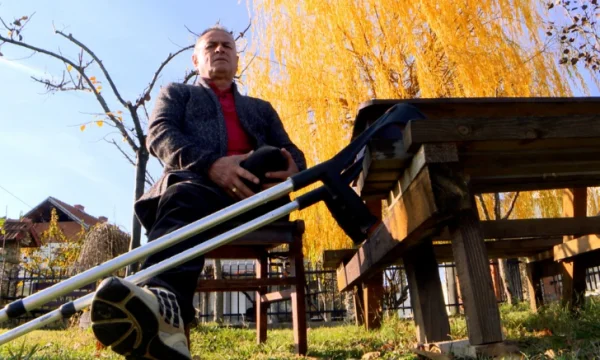
(5 years ago)For over three years now, Remzi Rasica of Vushtrria lives on amputated feet. He broke his left leg in June 2018 while working in his backyard. The 59-year-old policeman doubts that during treatment at the Orthopedic Clinic at the University Clinical Centre (QKUK), his leg had been infected. “I have been operated, [...]
The 59-year-old policeman doubts that during treatment at the Orthopedic Clinic at the University Clinical Centre (QKUK), his leg had been infected.
I've been operated, like, four or five hours ago. They took me to my room. I heard a doctor, he said himself, but I don't know who he is... I'm scared, she doesn't get infected. Why, I don't know. I just heard it with my ears, he said: Isalla is not infected”, he tells Radio Free Europe.
He says doctors themselves who had him under surveillance recommended after the operation that he go to an emergency clinic specialising for infections, offering him explanations only through a sheet of release.
Similar documents were issued by the College of Orthopedic Doctors, saying the patient needs treatment abroad.
Despite Radio Free Europe's efforts to negotiate with doctors and directors of the Orthopedic Clinic, who may be aware of the occasion, they refused to speak.
After leaving the Orthopedic Clinic, Remziu moved to a specialised clinic for infections in Ohrid, North Macedonia.
Tens of Operations in Turkey
Remziu indicated that he had stayed at a clinic in Ohrid, North Macedonia for more than two weeks. However, over two weeks of testing there brought no change. And, the treatment route continued at a Turkish hospital.
Two months [in Turkey] have struggled, couldn't... After two months, I don't know exactly 50 to 60 days, the doctor came in and said, "I'm sorry, do you want to live without feet or die on foot? I said no, I want to live. And I'm telling you, I can't wait to take off my leg because I'm tired of”, he tells me.
I'm sorry, I need four more fingers, and I don't understand, because he told me you're infected again. I said, can you tell me, I want to know how it got to the infection. The first time, he said, when you've been operated, you've been infected with your foot”, he says.
Remziu says that no one ever received an answer because of the infection.
A week before I get released from the hospital, a doctor was young, very good, very grateful... He said: If you were to stay at the hospital there [in Pristina], you wouldn't be alive”, your 59-year-old shows.
Three years after the accident, Remzi Rasica, the father of four, says that she is waiting to place the prosthetic instead of her left leg and go back to work as a policeman.
Over 350 patients infected during 2020
During the past year, at the Old Clinic of Orthopeda, where Remzi Rasica says she was infected, she is believed to have contracted indoor infections.
According to a report by the CKUK's Internal Infection Control Team, 11 patients have contracted infection in this clinic during 2020.
According to the leader of this team, infected psychologist Hatage Gashi, 356 patients in total are infected with various QKU clinics last year.
Gashi tells Radio Free Europe that one of the most frequent infections is Sepsa. The table is a major form of infection spread through the blood and can cause long - term damage to the lungs and other organs.
“Arsyet is many. Disrespecting measures to prevent internal infections, given our conditions in our clinics... If hygienic measures are not respected by staff, washing and disinfecting the hands, skin and mucoes that are able to come into contact with the patient, unless the best ventilation of jobs, cleaning and disinfecting of the working spaces, unless good sterilization of medical equipment is done, all these are factors that contribute to the appearance of a hospital infection”, Gashi says.
The highest-risk clinic, according to Gashi, is that of Central Intensive Medicine. In 2020, 417 patients, 155 or over 37 percent of them, have been admitted to this clinic.
There are patients... besides the overall, immune-compromising situation, here's the length of the patient's stay in the clinic one of the factors that contribute to the spread of internal infections in them. These infections are carried... Mostly, the main route of spread is through direct contact”, Gashi says.
Patients are also infected with other clinics. Of the 1,74 accepted patients, 150 of them have had indoor infections at the Plastic Surgery Clinic of 406 patients, 35 of them have been with internal infections, until another 5 patients have contracted infections at the Nephrology Clinic.
Infectia Gashi says such infections have very high costs of recovery and increase mortality.
On the other hand, the chairman of the Kosovo Medical Oda, Plerat Sejdiu, tells Radio Europe free of charge that doctors suffer every year.
“Summerca [of infections] is in the operating room and these are closely related to the process of vaccine against hepatitis and various infections that are done with tangible things. A very large percentage of the cruel conditions in our hospitals. We have a factor that's completely corrupting, which is the flow of patients' families inside the”, says Sejdiu.
In its 2020 report, the Inspication Control Team has recommended a series of measures to reduce the risk of infection, including increased hygiene rates, central climateization in operating halls, and standard waste management.
During 2020, about 129 thousand patients have extended to the 37 clinics of the University Clinical Centre in Kosovo. / REL