an hour ago
What does the Social Package contain in the $1 trillion infrastructure signed by Joe Biden?
Periskopi(5 years ago)
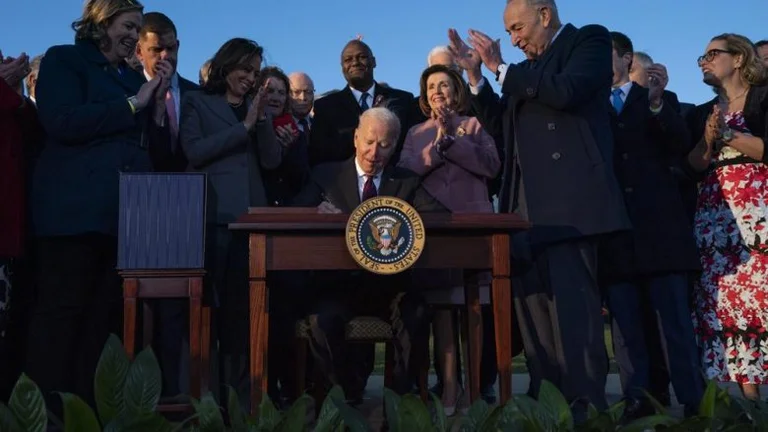
(5 years ago)US President Joe Biden has signed a $1 trillion Social Pack to support the overcoming of infrastructure difficulties. During the signing of this agreement, Beden has stated that this financial infusion of roads, bridges and ports will change the lives of the American people for the better. However, after that signing, it is expected to return to negotiations [...]
US President Joe Biden has signed a $1 trillion Social Pack to support the overcoming of infrastructure difficulties.
During the signing of this agreement, Beden has stated that this financial infusion of roads, bridges and ports will change the lives of the American people for the better.
After that signing, however, it is expected to return to negotiations on the wider social package of $1.85 trillion.
My message to the people is that America is being resurrected again and your life will change for the better”, Biden said, writes Telegrafi.
He hopes to use this Pako to restore its popularity, which has weakened amid rising inflation and inability to fully manage public health and economic risks from the COVID-19 pandemic.
With this agreement, the US president is expected to fulfill his promise of national unity and a commitment to transformative change.
With this, we are focused on the realization of promises. I ran for president because the only way to move our country forward, in my opinion, was compromise”, Biden added.
What does the Social Package contain in infrastructure?
This Social Pack contains eight subcategors to cover, starting with infrastructure and environmental projects.
Most of the money will be earmarked for electricity, or for $73 billion worth, followed by investment in the railway network in the $66 billion amount.
$65 billion will be divided into the general generation network, while $47 billion will be for climate change.
Environmental projects will have a cost of $21 billion, while lead reduction projects will be paid to the value of $15 billion.
In this Paco, especially important are electric cars, where they are projected to divide $7.5 billion.
One importance is to untapped rural areas, where $2 billion will be divided.