8 minutes ago
Serbia insists next week in Brussels to discuss association
Periskopi(5 years ago)
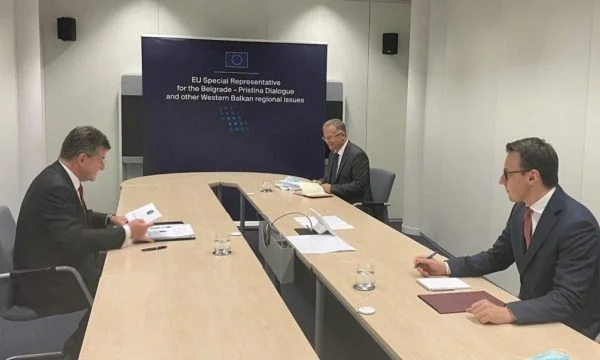
(5 years ago)Kosovo Government officials and Belgrade authorities have confirmed their participation in the meeting in Brussels under the Kosovo dialogue Serbia on 16 November, which the European Union has warned. European Union officials have said the new round of meetings of chief negotiators is expected on 16 November. [...]
European Union officials have said that the new round of meetings of Kosovo and Serbia's top negotiators is expected on 16 November to take place to discuss the implementation of agreements reached so far, open issues and the way forward in dialogue.
Recognitions of political developments in Kosovo estimate that dialogue between Kosovo and Serbia in Brussels has recently not marked any progress and that it has stalled at the technical level, given that there has not been a relatively long summit of political representation.
Going to Brussels with different approaches to topics
From the office of Kosovo Prime Minister Albin Kurti, in a written reply, they have told Radio Europe free of charge that Kosovo's Deputy Prime Minister for European Integration, Development and Dialog, Besnik Bislimi, will participate in the initial meeting to be held on November 16th this year in Brussels, within the framework of Kosovo-Serbia dialogue at the top negotiating level.
The arguments at the bilatheral meeting will be the issue of the missing, energy and free movement. The date for the possible meeting for leadership-level dialogue depends on the course of the process and agreement on the issues at the chief negotiator level”, the Kosovo Prime Minister's Office for Radio Free Europe says.
On the other hand, the Office for Kosovo of the Government of Serbia has confirmed to Serbian news agency Tanjug that the director of that office, Petar Petkovic, who heads Serbia's negotiating team in dialogue with Kosovo, will participate in the planned dialogue in Brussels for 16 November, and that under the previous agreement, the main topic will be to be the Association of Serb Major municipalities.
Petkovic, in recent days, has issued a series of press statements criticising Kosovo authorities for refusing to negotiate the formation of Serb majority municipalities.
But Kosovo authorities have dismissed the possibility that they will discuss the issue of association.
Lushak: No preliminary political reconciliation, no talks on association
Jehona Lushak-Sadriu, professor at the Political Sciences Department at the University of Pristina, in a conversation with Radio Free Europe says that generally, meetings of Kosovo and Serbia's negotiating teams in Brussels are continuing, but it is now evident that there is no reconciliation between the parties for key topics and high-level representation meetings have stalled.
I think that association is political and, first of all, after there are technical meetings, is political access to association and there can be no solution and no reconciliation, unless there is a preliminary political reconciliation”, says Lushaku-Sadriu.
Popov: Chat Simulation
The director of the Centre for Regionalisation from Serbia, Allexander Popov, estimates the warning for continuing dialogue in Brussels is only “sim” of talks between the two sides and considers that Kosovo and Serbia, in fact, do not want dialogue.
According to him, it confirms the events of the past two months, when Kosovo authorities sent police units to the country's north for the implementation of reciprocity for the plates, meanwhile, Serbian authorities sent military forces to the border with Kosovo.
Another action by the Kosovo authorities in the north, with the argument for fighting organised crime, had sparked dissatisfaction among the Serb population, which is majority in that part of Kosovo.
The two sides find a reason for the dialogue not to happen. Perhaps a high-level meeting will be held again, a meeting between Kurti and Vuciqi, but I don't believe there will be a positive result, unless something changes in the European Union and the US approach to use several opportunities to exert pressure on both sides”, Popov noted.
Earlier, the Kosovo government and the president of this state, Vjosa Osmani, have said Kosovo will not implement the Association Agreement, as it is contrary to the Kosovo Constitution.
But, president of Serbia Aleksandar Vuciq, on November 10th, told reporters that Kosovo will form association as it is negotiated in Brussels, or as he pointed out, thank you, you have your job, in our work, maybe we meet a day of”.
European officials have dismissed claims that dialogue has been blocked due to disagreements for implementation of the Association Agreement.
Lushaku-Sadriu suggests that unless there is an agenda and there is no discussion on the main topics, it cannot be said that the Kosovo- Serbia is making a move forward
Escobar Pass
Currently, in the region, US Deputy Assistant Secretary of State for Europe and Eurasia, simultaneously envoy for the Western Balkans Gabriel Escobar, who has visited Bosnia and Herzegovina and is visiting Montenegro. But, within this visit of the region, neither Kosovo nor Serbia are foreordained.
Lushaku-Sadriu stresses that non-accession to Kosovo and Serbia of diplomat Escobar can also be seen as a message for the two countries' failure to make progress in the Brussels dialogue.
“Normically that can be a clear message to Serbia and Kosovo. It could be due to implications regarding progress in dialogue. But there may be other reasons, which are in the interest of the United States and that these two states, actually have failed to reconcile or have attitudes in harmony with American positions”, Lucaku-Sadriu points out.
Kosovo and Serbia, under the EU's mediation, have reached the agreement on establishing the Association of Serb majority municipalities in 2013.
Two years later, the two countries have reached an additional agreement on its establishment, but the Constitutional Court of Kosovo has found that the principles for it are not in line with the Constitution of Kosovo, even though it has said they could be harmonised with a legal act of the Government of Kosovo.
In fact, it is questionable that the association is not based on multiethnicity, but unites municipalities in which an ethnic community is the majority. There are a total of ten Serb-run municipalities in Kosovo.