5 minutes ago
Remote clashes between Kosovo, Serbia for Association
Periskopi(5 years ago)
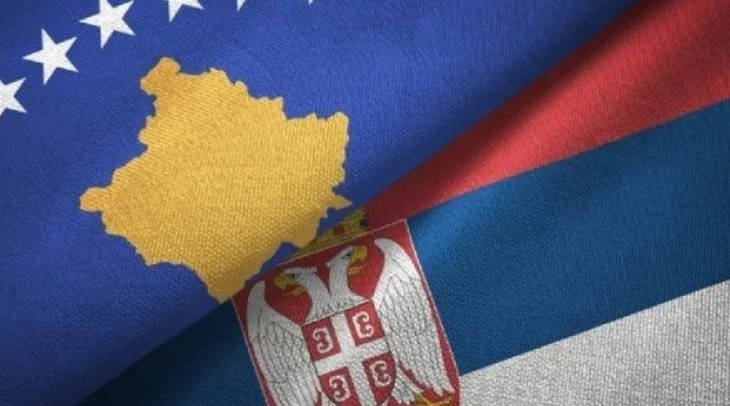
(5 years ago)President Vuciq expects answers from the EU concerning President Vjosa Osmani's statement that there can be no constitutional changes to the Association of Serb municipalities. The issue of the Association of Communities with the Serbian Majority is again slamming Kosovo and Serbia with the possible consequence of the further impasse of dialogue on normalising [...] relations.
The issue of the Commission Association with the Serbian Majority is again slamming Kosovo and Serbia with the possible consequence of the further stalled dialogue on normalising the relations mediated by the European Union.
It was Kosovo President Vjosa Osmani's latest statement, which prompted the reaction of Serbian President Aleksandar Vuciq. For a local channel 10 television, Vjosa Osmani said that “is not our interest in creating something against the constitution or any other pre-couple of the Serbian state. Such association may have the maximum competence of an NGO.” According to her, Serbia is constantly risking regional stability.
Osmani: Serbia has no interest in final agreement with Kosovo
For the president of Kosovo, Serbia with Russia “risks not only regional stability but also stability in Kosovo, Northern Macedonia, Montenegro and many other states, it is natural for the EU to react because you have Russian weapons on the border with Kosovo and Serbia, and for all of these the EU never reacted. ”
It has voiced distrust of the Serbian stance. “Serbia has no interest in signing final agreements with Kosovo”.
And as far as the EU is concerned, it was always more insistent that we implement the association of municipalities: ”, while in terms of the time when I am governing, the United States has not submitted any particular request. We have mutual reports with the United States, where only the facts prevail and we will in the future explain that an association with such competencies is monoethnic that is contrary to American interest in Europe”, President Osmani said.
Vuciq expects reaction from EU following Osman statements
Following Osmani's statements, Serbia's president, Aleksandar Vuciq, who said he expects answers and response from the EU regarding Osman's statement, under which the Kosovo Constitution will not be changed due to the establishment of the Serb Major Party Association in Kosovo”.
This is a matter for the EU. If they don't want to change the Constitution, then we understand their message. We will expect the EU's response”, Vuciq said, adding that Pristina's” refusal to implement what has pledged with Brussels agreements speaks more about Pristina than about Belgrade”.
New crisis?
Even the director of the so-called office for Kosovo in Serbia's government, Petar Petkovovic, reacted following statements by President Vjosa Osmani:
Through a media communique, he said that “Vyosa Osmani is trying to provoke a new crisis with inflammatory rhetoric”. “The publication of the Association of Serbian Councils with executive power is not only a duty under the Brussels Agreement, but also Pristina's, so it is clear that by not respecting the agreements of Brussels and its institutions, Vjosa Osmani actually puts hatred of Serbia ahead of any other motive and that she is not interested in seeking the missing, normalising relations and building mutual trust through dialogue”, Petkov said.
The chairman of the Parliamentary Commission for Kosovo in Serbia's Parliamentary Assembly, Milovan Drescu, has threatened that “unless the Association of Serbian Communities is formed, the Serbian List will withdraw from the provisional self-government institutions in Pristina”. The Serb list has 10 deputies in the Kosovo assembly and is part of Prime Minister Albin Kurti's government.
Prime Minister Kurti himself, at a media conference following the budget's adoption, said a next meeting between him and Serbia's president, depends on facilitators of the dialogue, respectively.
“The meeting could happen somewhere in the second half of November as far as representatives of our two states are concerned, while in terms of heads of state there is no date for this, but it depends largely on facilitators consciously from EU High Representative Josep Borrell and his Emisari Miroslav Lajcak”, Kurti said.
Association Building Agreement
In 2013 Kosovo and Serbia, under the EU's mediation, had reached and signed the agreement to establish the Association of Communities with the Serbian Majority. Two years later the two countries reached an additional agreement on establishing association, but the Constitutional Court of Kosovo found, that the principles for it are not in line with the Constitution of Kosovo, but, the court said, they could be harmonised with a legal act of the Government of Kosovo.
The issue of the Serb-run municipality Association is long debated in Kosovo.
Demush Shasha, executive director of the Kosovo Institute for European Policy, EPIK, has told DW in a recent interview, that international agreements on Kosovo always have to have political consensus within Kosovo. The lesson from the 2013 Association Agreement is how Kosovo should behave in its international subjectivity exercise. In 2013 the burden of establishing association has not been taken by the X Government or the Y Government, but has taken the Republic of Kosovo as a legal subject on the international stage. ”
According to Analisit Demush Shasha, any failure to live up to international obligations will have consequences on Kosovo's reputation and credibility. It requires policy to understand, that “decisions cannot be made by any immediate majority, but each time must reflect the consensual will of the political spectrum. Such an approach every time ensures the continuation of our international obligations. In fact, this is also a constitutional requirement, according to Article 18.1<18x1>.
The establishment of association will still remain a theme at the table under the dialogue for normalising Kosovo-Serbia relations, Shasha says. He believes that “this issue will not be an isolated agreement, but part of the comprehensive agreement on normalising relations, where association will only be one element of the” agreement. / DW