5 hours ago
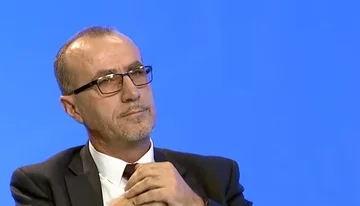
Professor Enver Hasani: Kuku for the fate of Kosovo, U.S. gas refusal by Kurti is very serious

Periskopi(5 years ago)
(5 years ago)In a long writing published in Koha Ditore, former Constitutional Court Chairman Enver Hasani has asked Kosovo's prime minister to change his approach to Kosovo's central ally, the United States of America. Hasan has especially dealt with the mockery that Mr. Kurt has done it in the direction [...]
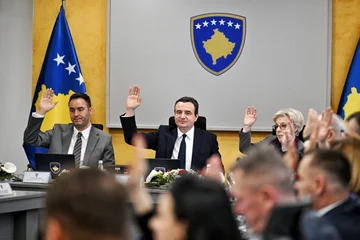
Hasan has especially dealt with the mockery that Mr. Kurt did it in front of our biggest ally on several occasions.
He mentions “Amelica, Amelika”, said by Kurti in a mocking manner as he faced charges of being anti-American. And also “The White House, Yellow House, Red House” said in the Kosovo Assembly.
A kind of insignificant frustration that caught me in two cases in question was more about an internal regret that I felt about the condition and spiritual level of the ridiculer, not about any implications that could follow concerning Kosovo's position in the region and beyond. It says Mr. Hasan for these cases, I follow Periscope.
The most serious thing has been to him on the subject of the American gas project for clean energy.
“There was no breaking alliance with America for either pipe,” ] had Prime Minister Kurti's cynical words.
But, in writing titled “Gypat”, Enver Hasani expresses his deep concern for Kosovo's fate following the government's decision to remain the only country in the Balkans that has no access to the American gas project.
The following is the complete writing of Mr. Enver Hasani titled “Gypat”.
The hooks!
That is because any American and western failures to transport strategic energy sources into space designed as strategic by the Russians are not just a cardinal failure in American foreign policy, deviation from the strategic plan for the energy security of Allies, the risk of Israeli security and others in the Middle East, and, in the end, serious impasse in the policies of the Chinese imperial project. That's why Albin has to stop digging into the bowels of Americans and their allies!
The first two jokes: “Amelika ) Amelika” and “White House of the Red House”!
The key to the great powers has occurred throughout history. It is made by great powers, which among themselves have mutually exchanged and ridiculed properties and policies of respect. The Cold War is remembered for such a thing when Russians through the mouth of their first UN representative, Andrei A. Gromiko, had placed a record twenty-six veto in Security Council resolutions and decisions, as far as remembered as “Nyet Man” (“the non-comman”). These “jo” expressed the refusal of any gene coming from America.
The history of international relations in antiquity is filled with such mutual ridicule between states and royal courts but also within the state itself. Emperor Caligula had entered the Senate with his horse - a mockery with the level of misery of representatives of the Roman people. For those of us who have lived communatism, we remember such an effort by Enver Hoxha, who filled us with poor energy and hope, when he called Sinan Hasani “as a barked dog, that he was paid by Yugoslavs”, and that second one was immediately returned to her sweater by saying that “Enver had become like the sludge goat”. Or something like that! It doesn't really matter if I have remembered exactly what the Albanian dictator has been mocking in the direction of the Kosovo mini-Serb of Yugoslav communism, Sinan Hasani. What matters is the metaphor of sentences and the discretion of top state officials throughout history, in their efforts to convey messages of determination and vision, the bravery and wisdom unique against the receptiveness of the derogatory, contemptuous and derogatory message.
Kosovo did not just remain receptive to the mockery, but also became its producer. We are well reminded of ridicule like: “Amelica-Amelica” and “The White House of the Red House”, with which the neutralisation of the internal political opponent was aimed, without even thinking a second of the harmful effect it could have on Kosovo and its image in the world. These two ridiculers replaced the latest mockery with gas tubes, which became the metaphor of a taunt of Americans and their foreign policy, in fact mocking the global geostratency of the U.S. State, their current major strategy in force. All of a sudden, it's if Prime Minister Kurti has been a mechanic that he's insulting the dignity of the American state. We who teach our students rights and international relations in the tenth week present the lecture on state dignity and show that the dignity of the state enters the freedom and rights of sovereign and independent states, each member state of the international community, not only the superpowers what our unique ally is. It was agreed, even small Kosovo, without power in this world, that enjoys the right to state dignity with a sense of demand for the state of the individual to respect as defined by international law.
Ballle with gas pipes, Croatian writer Miroslav Krelezha
I don't even know why, but the first two ridicules, that were covered by the pipe, sort of slipped away and didn't bother me very much. A kind of insignificant frustration that caught me in two cases in question was more about an inner regret that I felt about the condition and spirituality of the author of ridicule, not any implications that could result from Kosovo's position in the region and beyond. This pipe work, meanwhile, in its entire dimension, captured my mind and my intellectual concentration, becoming an embarrassment to the fate of the country and those who come afterwards. This is because it was now about a mockery that goes beyond its author's gullibility: with it I was publishing my country's official view of foreign policy orientation and our report with the Allies. The latter represent the companions of any geostrategic equation on Kosovo's position in the world.
When I heard the ridicule with gas, I remembered well-known Croatian writer Miroslav Krelezha, who once told Serbs, seems to me from a meeting in Sarajevo, that they, like Serbs, should not dig much into the bowels of Albanians. That's because, as he said, “knows what Serbs can find in there”. Sirs, I don't think it takes great philosophy to understand, they have the shape of tubes and, in fact, they're kind of a tube in the human body.
Roads and pipes as measurable foreign policy indicators
The roads that countries have connected, roads on land and water are signs and signs of a time's foreign policy. This is because they talk about the international relationships of time, nature, and their nuts. They point to ideological and religious movements, cultural and political influences, above all, showing, without any equivocal, geostrategic orientation of those powers that have dictated their construction and direction. Just remember here are streets like Via Egnatia and Silk Road. The latter linked the Mediterranean with East Asia.
The first, Via Egnatia, was built in the second century to connect the Roman Balkans with Byzantines to be born later, respectively.
A quick Bible reading will show that the Bible geography described in the “Ephesians” has nothing to do with a description of the early phase of the spread of Christianity toward Rome. The latter later became the center of Christianity and its official religion, taking it to the defense with all state power, but after three centuries of persecution of Christians.
Marco Polo's notes, in the same way, don't talk about business and cultural influence, as you might get the impression of their first reading, but of the geopolitical conjunctures of the time he lived. Those conjuktures, later known as “Silk Street”, may look like trade routes for the naive. For those who see and understand it well, however, they are deeply geopolitical indicators.
That's so today and it's evidenced by the actual Chinese imperial policy, known as <x0-rrip and soil”, that runs the earth what has once been called the “Rrudge of the Silk”, but now with the opposite direction the influence of the Chinese East towards the Eurasian West. In addition to the Chinese case, in the Balkan container with Kosovo as a reference point, a similar trace can be seen in the “Road of the Nation”, which, when released in Serbia, wins another epithet. Like any political project, this road is exploited by civilians and businesses for their mainly commercial benefits. Its genetics, however, has geostrategic roots and is derived from geopoliticalism in the region that was shaped after Kosovo's Lufjet (1998-1999). Didn't Faik Konica say in an interview in the United States after Albania's fascist occupation that the “roads Italy built are now under way to facilitate my king's departure, but to attack the neighbors of Albania” (like).
Street sisters, gas trajectories, who now penetrate European soil, have mostly Russian origin, to then rival them from the streets of gas originating from Western countries and consortiums. These two have been reactions to the Russian gas and political projections that stand in its favour. So far there have been no match points between Russian roads and western gas routes, except in the Nagorno Karabah region, occupied by Armenians at the start of democratic processes after the breakup of the former - BRSS. Azerbedgean's quick victory has struck many. The biggest habitat, however, has been with the Russian and American inaction about the conflict, as is common when there is friction between great powers. The reason! ? Nothing but the fact of American interests in that part that borders on Iran, their number one political enemy in that part of the world (even because China, among other things, has the strongest point of support for its imperial policy rivaling the West). The American interests do not stop in Iran, but continue further in the Balkans, to be related to the gas that was called Russian gas in Kosovo, in a very naive and wrong way: this is about a fragment of the great “-tradition of the American” in this part of the world, a fragment that relates to the global project starting in Baku of Azerbejan.
The starting point of this great strategy has been Nagorno Karabah's retake. This has made the Caspian Sea gas safer, opening up the possibility of even a shorter route to its carrying into the Mediterranean, without counting here the rivalisation of Iran's eventual ambitions to infiltrate the future in the same gas market (through constant support and partnership with China). Whoever understands what their military engagement in Syria means that American efforts are focused on making rationalised foreign policies with limited resources aimed at meeting national interests in an optimial manner, and finding less and less expensive roads, but, above all, perfunctory energy for national interests. This makes up the American priority in the Mediterranean basin and its parsipina in its northwest. There is no other way to neutralise Europe's dependence on Russian gas and energy bulimism that the Russians are applying from time to time and that, in the wake of the crisis, they can make their foreign policy standard.
Albin Kurti, don't dig into your guts!
Companies and shareholders standing behind the Caspian gas are originally from the US and its strategic allies. We do not intend to stress how much the pipes have cost to carry that gas to the Mediterranean and how long it lasted on these tubes. What we want to point out is that making fun of ourselves is not a sin! However, this does not end here, because when that source of energy starts its journey to the Albanian lands, snooping from northern Greece towards Kosovo, it intensifys its identification with “large strategy of our main ally and shapes its state dignity pillar in this part of Europe. This is so, because any American and western failures to transport strategic energy sources into space designed as strategic by the Russians are not just a cardinal failure in American foreign policy, deviation from the strategic plan for allied energy security, the risk of Israel's security and others in the Middle East, and, in the end, serious impasse in the policies of the Chinese imperial project. That's why Albin Kurti must stop digging into the bowels of Americans and their allies!
The author is the first president of the Constitutional Court and professor of both Law and International Relations.