 an hour ago
Expected agreement with Serbia to be reached during my mandate
Periskopi(5 years ago)
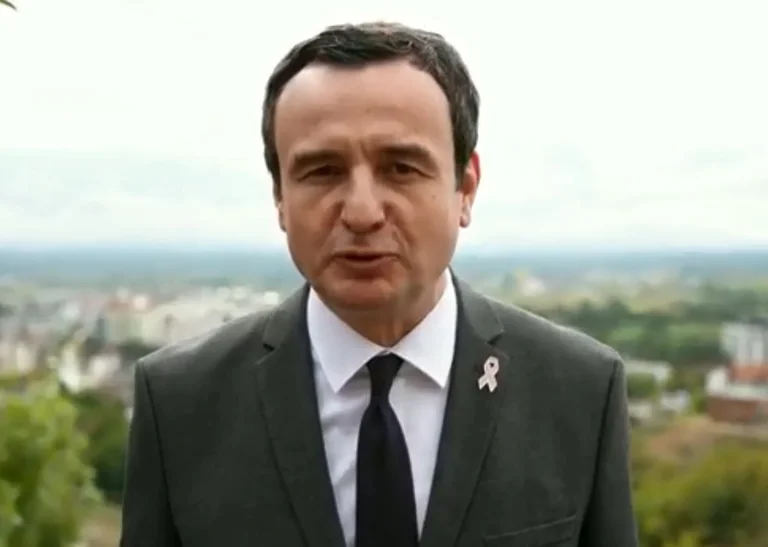
(5 years ago)Kosovo Prime Minister Albin Kurti, in an interview given for Radio Free Europe, says his Vetevendosje Movement is analyzing the causes of the local election outcome. After the second round of these elections, held on November 14th, Vetevendosje ended with leadership in four municipalities of 38 total. This result, [...]
After the second round of these elections, held on November 14th, Vetevendosje ended with leadership in four municipalities of 38 total. That result, according to Kurt, is disappointing.
Regarding dialogue with Serbia, Kurti says he is ready for this process, but adds that the upcoming meeting with Serbia's president, Aleksandar Vuciq, will depend on dialogue at the negotiating level.
Speaking of the possible agreement with Serbia on normalising relations, he says it should have mutual recognition at the centre.
According to Kurti, concern is also the fact of Serbia's <x0-militarisation”.
Radio Free Europe: Mr. Kurti, the Vetevendosje Movement, in recent local elections has taken leadership in four municipalities out of 38 total. How did you comment on this result?
Albin Kurti: We have expected that we will have better results and, therefore, the result is not satisfactory. Now we're doing this kind of internal analysis of structural and organizational defects, which are certainly the result of the disappointing outcome. But on the other hand, there is also the fact that there was a very large kind of union, a co-ordination of all others against the Vetevendosje Movement. I believe these two factors have determined a poor outcome for us. But where we are the opposition, we will make good and powerful opposition, and where we are in government, we will make good governance effective.
Radio Free Europe: Can you explain more of the flaws you are mentioning?
Albin Kurti: First of all, I've already held a meeting of the 12 candidates we've had in the run-off, both those who won, and those who haven't won. We are awaiting an election staff report in the Vetevendosje Movement, on whose basis we will then discuss the leadership. What I can say is obvious, is [the fact] that the Vetevendosje Movement, in recent years, has grown dramatically in the last four years. We have neither structure nor organization, which is suitable for size nor functional for compounding, to respond to such growth. So the October 6th, 2019 elections and the February 14th elections, 2021, have greatly enhanced our support as Vetevendosje Movement and have failed to hold internal elections and create structures that would be adequate for the situation. This is obvious, but of course there are other defects we'll have to deal with.
“
Radio Free Europe: Some political analysts, but opposition members have said the result of local elections reflects a kind of punishment of Vetevendosje Movement by voters. Do you think there was such a punishment?
Albin Kurti: I don't think there's been punishment from voters. I think there might have been concessions on our part, of our structures. But I believe that citizens do not want Vetevendosje Movement any less. On the contrary. In this year's October 17th elections, we were made with the final vote at the country's first level, as we have been in parliamentary elections. So in 2017 we were at the third level, in the third range of local elections. Now we're first there. However, local elections, unlike parliamentary elections, are another type of game and electoral rules. It's kind of like tennis, where you can make a lot of money, but you can lose your set. We too, with the total population vote, are the first in the Republic for local elections, although we will have mayors in only four municipalities.
Radio Free Europe: Do you feel that even your candidates have played a role?
Albin Kurti: Of course, but candidates are selected by a kind of cooperation between our centers, our branches and the leadership of the Movement. Maybe he could have better, but I'm convinced that these 12 candidates we had in the run-off couldn't have been better selected. But there has been enormous co-ordination of others against the Vetevendosje Movement. This does not have much to do with local power and visions for municipalities, but it has much more to do with a kind of resistance to central power, which has emerged from the February 14th elections, which continue to be a kind of opposition trauma.
Radio Free Europe: You mentioned that you would make opposition where it is needed at the local level. But, how is it expected to be co-operation with elected mayors from the central level, from you as prime minister?
Albin Kurti: I will surely cooperate with all heads. They'll have a lot of work to serve citizens, as far as their institutional duties are concerned, the public service that the municipality resident has to take. But it is also intended to cooperate with them in combating crime and corruption. This is extremely important because there can be no development if there is corruption, if there is crime, if there are abuses. Therefore, especially in the field of fighting crime and corruption, I will seek co-operation with the mayors and will oversee them carefully.
Radio Free Europe: You've mentioned one more issue, what you've called the construction mafia, and the crime and corruption that happen at the local level. Will there be pressure on the leaders elected by the Vetevendosje Movement in these municipalities to become a stronger fight in this direction?
Albin Kurti: If it were the heads of the Vetevendosje Movement, then of course I would be more confident, that resistance to the construction mafia, that wants our cities to turn into construction shipyards for washing dirty money... It would be greater that kind of faith I would have in successful resistance. Now I have to engage more, but there won't be a state retreat against any individual or group. So the state will be stronger than any individual and than any group in order to have rule of law and democracy. I want to believe that together we will get out, but of course it will also depend on the mayors themselves to what extent they will be on the level of duty. So constitutionality, legitimacy, rules, public interest, not others.
There is a “agreement without mutual recognition at center”
Radio Free Europe: We are moving to the topic of dialogue with Serbia. It was one of the central themes of your government. How do you see the dialogue on normalising relations with Serbia will continue?
Albin Kurti: We are talking about future dialogue with Serbia, the next chapter of dialogue. When we have come to government, there has been no dialogue, it has been interrupted and cannot say that dialogue with Serbia has shown results in the past few years not only because it had been diverted to the issue of Kosovo's territorial division, which was wrapped up in the reconstruction exchange ambalah.
There's a lack of progress and it hasn't started with us, much earlier there's been a lack of progress, except we've put it on the anchor that much of the lack of progress comes from the wrong approaches. So, they signed harmful agreements on Kosovo that even the Constitutional Court -- such as what it was -- could overcome. In that sense, we need a new chapter, we need a new approach, and for us it should be principled with citizens as beneficiaries and with mutual recognition at the center.
There is a recent tectonic shift for good, since in the past decade it is considered that Kosovo makes concessions because it eventually gains recognition from Serbia. So dialogue and recognition are put into a diachronic report, laid out on time, where knowledge comes to the end of Serbia's end indefinitely. Now we have a shift from the context of time to that, let's say, spatial, where mutual recognition is at the heart of the agreement and that's what all friends and partners of the Republic of Kosovo, of our independent state say.
So the agreement will not only be mutual recognition, but there is no agreement without mutual recognition at the centre. So, not in the end, in the sense of time, but in the center, in the sense of the space of the things that involve that agreement.
If there's a topic that we're immediately willing to engage in finding out as quickly as possible is that of the undiscovered, violent missing because there's more family anxiety than their grief.
The meeting with Vucicin depends on “dialog of chief negotiators”
Radio Free Europe: EU foreign policy chief Josep Borrell has warned that a meeting between you and Serbia's president, Aleksandar Vuciq, is expected before the end of the year. Will you attend this meeting and what is expected to happen?
Albin Kurti: We should see first how these talks are going this week between the two chief negotiators. On the one hand is Deputy Prime Minister (Bessnik), Bislimi, on the other side is the representative of the Government of Serbia (Petar Petkov), and then we will be able to say what is the prospect of a future meeting, with which, of course, it should be known what the aim of such a meeting is. I don't say no to a meeting in principle, but of course I have to know the elements of that next meeting.
The government of the Republic of Kosovo, I as prime minister have expressed our readiness and concern for comprehensive agreements, for constructive meetings, for principled talks, and if we are to cool for them in Brussels, of course we will participate as we have been twice.
Radio Free Europe: You said it too, but the EU has consistently insisted that a final agreement should happen as soon as possible. Do you expect this could happen within your mandate as prime minister?
Albin Kurti: I can't predict when it will happen, but if we remember that the mandate of the American president, (Joe) Biden, the mandate of European Commission deputy chairman Borrell and my mandate will approximately have the same length, it is expected that in the context of these mandates, which in time are more or less the same, we will conclude the comprehensive agreement with Serbia. So in us there is will and interest, whether there is readiness for Serbia.
The normalisation of reports between Kosovo and Serbia is much more dependent on Serbia's readiness to change its approach and self.
Serbia's Militarization, “very worried about us”
Radio Free Europe: When we are at Serbia's readiness, one of the biggest blockades of this dialogue is the Association Agreement. You have said that you do not accept a single-ethnic association, yet it has become clear from Serbia that they are demanding that the association be founded according to the agreement made in Brussels. Even from the EU, respect for agreements reached so far has been required. How will you plan to overcome this obstacle? Would they have accepted renegotiation for this agreement?
Albin Kurti: The talks between Kosovo and Serbia, the dialogue between our two states, is not the dialogue on Kosovo's status, nor the internal issues of Kosovo, but the status of our reports. So Kosovo is an independent and sovereign state, with territorial integrity, with many problems, one of the main ones is Serbia. So Kosovo is not a problem, Kosovo has problems and Kosovo's problem is Serbia. We are not the only problem, we have numerous problems and one of them -- perhaps the main one -- is Serbia.
But dialogue is not meant to question Kosovo itself, but to normalise reports with Serbia. And to normalise the report with Serbia, I believe that Serbia must change much more. It must be democratised, it must have rule of law, it must be confronted with the past and we should have a kind of symmetry of reciprocity of minority rights.
Throughout the Western Balkans, six countries still unintegured in the European Union have different national minorities that do not have roughly equal rights, that I am saying identical ones, will create tensions that could cause conflict.
Thus, the rule of the law against corruption and crime, democratisation against autism, confrontation with the past against war criminals, and also reciprocity of rights against the dominance of shovinist and hegemonic nationalism are formulas for the entire Balkans in general and in particular in our report with Serbia.
See, Serbia currently spends more on army than other Western Balkan states combined. Bosnia and Herzegovina, Montenegro, Albania, Kosovo and Northern Macedonia together do not spend on the military as much as Serbia spends alone. It is not doing so for Hungary and Romania, and that militarising of Serbia is very distressing to us.
My impression is that Serbia increasingly resembles Germany between the two world wars after the end of the Republic of Vajmar. The first decade of this century in Serbia we had a Serbian version of the Republic of Vajmar, which began with former Serbian prime minister who killed him, Zoran Djindjic concluded with former president, Boris Tadic, and since then we have a period in which Serbia is like Germany between the two world wars, but after the end of the Republic of Vajmar with militarism is the main state and institutional push.
Radio Free Europe: Mr. Kurti, you are constantly saying that Serbia is the main problem, yet Kosovo is being asked a kind of compromise to continue in foreign policy, to achieve even recognitions that have not been achieved so far. How do you see the continuation of this process? We're also interested in knowing how you view U.S. engagement, especially recently, with sending emissary Gabriel Escobar. Do you see an offensive of American diplomacy in dialogue as a kind of impetus for reaching compromise?
Albin Kurti: We always welcome American engagement in the Balkans, but for the shape and intensity of that engagement, the United States itself. They're the world superpower, which decides this. In various stages it has been different because their policies are sovereign. On the other hand, I am here as prime minister of the Republic of Kosovo, not to think about compromises Kosovo should make, but to strengthen the state of Kosovo.
Economic growth in this year will be at least 9.9 percent, according to the Central Bank of Kosovo, while we have received the economy by contraction of 3.1 percent last year, according to the World Bank. One third have increased budget revenues, greatly reduced government spending, and approved the budget for 2022 at the Government meeting, which is 8.7 percent higher than mid-year budget revision. Economic circulation has increased by 30 percent, exports have increased 68 percent. We have problems with Serbia, but, at the same time, we have to live and strengthen ourselves.
In the sixth month of this year, we had 230 million foreign investments, which is 33 percent more than last year and 109 percent more than 2019 and 89 percent more than the 2010- 2020 average foreign investment. Since declaring independence, this year in the first six months, we have the largest number of foreign investments and their highest value in Kosovo.
Radio Free Europe: I'd like to spend some time in one of the crisis or the biggest crisis Kosovo is going through, but the world also has the coronary pandemic. If we take it with the total number of the population in Kosovo, the vaccine amounts to a little over 40 percent of the population vaccinated. How do you think you reach the target of vaccinating most of the population and how do you think you can convince citizens who are reluctant to vaccinate?
Albin Kurti: We have already lifted the obligation of appointment for vaccine and have created the possibility of vaccinating children between the ages of 12 and 15. If we look at the population over the age of 16, with at least one dose of anti vaccine - CO VID is vaccinated 64 percent of the population, while with two doses of 56 percent of the population ever over 16 years old. We've been approaching the figure of 1.6 million doses administered. We're doing everything possible to make this grow. In the last 30 days, generally, we have a single death rate. In the last two weeks, the number of infections has dropped by two thirds, and I believe these are good news for Kosovo, which is at the top of the Western Balkans in terms of management with pandemic, remembering that when I came here to the office on March 23rd of this year, there were zero vaccines, zero contracts for vaccines and zero contract negotiations.
Radio Free Europe: However, we are witnessing that because of the reluctance to take the vaccine and conspiracy theories that have spread, many vaccines have been wasted because citizens have refused to take. Do you think that you've done enough in campaigning to convince citizens of the vaccine and to remove the theory of vaccine damage?
Albin Kurti: We've done everything we know. We have to find perhaps new forms to make citizens aware of this, but we will not be able to have the level of vaccination both in the past and because of a kind of satisfaction that exists, but also because a considerable number of citizens of the Republic of Kosovo are not residents of the Republic of Kosovo. So, when we talk about statistics, Kosovo continues to have a new population age, but at the same time continues to have continued migration, whatever we were released, and independence was declared. So when we talk about population percentages, like a little bit like the percentage of exits to elections, it's actually higher than the figure before the percentage.
Radio Free Europe: Beyond the vaccine we witness increasing numbers with COVID-19 across the region. Although Kosovo now stands well, health experts have warned that this situation could be imported to Kosovo as well. What are your plans now, especially on the eve of the winter season, to avoid a heavier wave of COVID-19?
Albin Kurti: We will now have the minister of health, with which we will sit together and make a new plan for the road ahead, especially for the winter season and, in this way, I believe we will continue to be in charge, keep the low numbers of new infections, keep the numbers of new vaccines ever higher. If another wave comes in the region and Western Europe, it is expected that we too will have difficulties. But with the will and knowledge we have and with the experience we already possess, I am optimistic.
Radio Free Europe: In the countries of Europe, for example, some drastic measures have been imposed in Austria for unexplored persons as an attempt to reduce increasing numbers. Do you as a government plan to have specific measures in the future for unaccompanied individuals, such as isolation?
Albin Kurti: We have not anticipated such a drastic measure and the epidemiological situation in our country, recommendations of the National Institute of Public Health do not give us the opportunity to go towards such severity. I cannot predict what it will be like in the future. This could change. But you should remember that our decisions as governments even when they are political have a scientific substance inside. So the National Institute of Public Health, which significantly gives direction to action that the government of Kosovo makes.











