 an hour ago
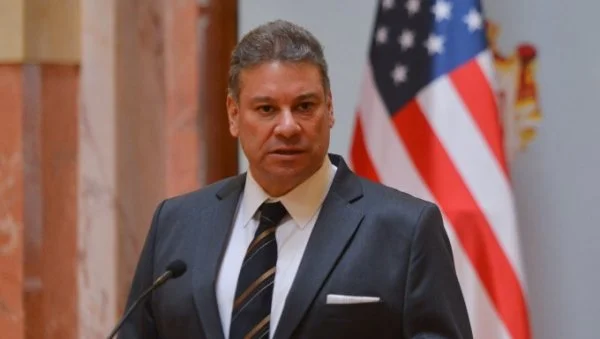
Escobar: US-Serbia relations are complicated
Periskopi(5 years ago)
(5 years ago)Our relations with Serbia are neither good nor bad, said Gabriel Escobar, US special envoy for the Balkans. What complicates this relationship may well be suggested by the major open issues that have surfaced again in relations between official Washington and Belgrade, which, [...]
What complicates this relationship may well be suggested by the key open issues that have surfaced again in relations between official Washington and Belgrade, which, along with the US's strongest engagement in Balkan, initiated under the administration of new President Joe Biden.
The chatpers of Euronews Serbia, who talked about relations between Belgrade and Pristina, highlighted four open issues, which are largely interlocked the issue of the US and EU connection in action in the region, which Escobar himself clearly stressed, saying Serbia has US support while it is on the European road, the Kosovo issue and relations with Russia and China that come out of it, and in the end, resolving the issue of brothers killed Bytyci as a bilateral point. Which the United States has been insisting on for a long time.
Two things were crucial to interpret that America's role in the Balkans had become more active. One refers to the fact that the change of administration in Washington has led to a kind of diplomatic reorganisation that ultimately implies the appointment of Christopher Hill as the new ambassador to Belgrade and the other the escalation of the eleven-day crisis in northern Kosovo, when administrative crossings were blocked due to the license dispute.
It was in that crisis that co-operation between the United States and the EU came into focus. The main mediator of the agreement between Belgrade and Pristina, which ended the crisis as before, was the European Union, but Escobar himself participated in the negotiations in Brussels, just in the final phase.
The EU-US alliance was <x0volos” later in an official statement following a meeting between US Secretary of State Anthony Blinken and EU High Representative Josep Borrell, noting that the US and the EU have agreed to further strengthen common engagement in the Western Balkans in supporting the region on its European path.
The final message came from Escobar, who in an interview for Aljazeera Balkan, where in question whether Serbian President Aleksandar Vucic had Washington's support, replied: “He has Washington's support as Serbia continues on the European path, this is Serbia's. Our declared goal and partnership with both Serbia and all the countries of the region. That's our purpose. ”
Kosovo issue
The Kosovo issue is one of the key issues in Serbia's relations with both the United States and the EU. Washington is Kosovo's most important international partner when it comes to independence and it is the American administration that has the greatest impact on Kosovo's decisions, especially in times of crisis.
It is not surprising, therefore, that the US's most intense commitment to resolving the crisis in northern Kosovo was evident, but also the American administration's movements showing their most direct commitment to negotiations between the two sides in Brussels. In this regard, the possibility of the United States naming their special envoy for dialogue is also under consideration.
Specifically, the United States and the EU announced on October 20th that they were hired to further strengthen their joint engagement in the Western Balkans in support of the region's progress on its European path.
Washington and Brussels have placed particular emphasis on dialogue between Belgrade and Pristina and tensions in northern Kosovo that occurred during September and October. The two sides stressed the importance of the EU-mediated dialogue, saying it was “a key mechanism for resolving the overall normalisation of relations between Serbia and Kosovo”.
Escobar himself said earlier that the United States will use every opportunity to help and support the EU's efforts to reach an agreement to normalise relations between Belgrade and Pristina”, including co-operation between it and Lajcak in talks with leaders and parties in dialogue.











