an hour ago
CNN: A Dangerous Crisis in the Balkans Is the West going to do anything to stop another war?
Periskopi(5 years ago)
(5 years ago)Bosnia and Herzegovina is on the verge of what analysts warn of as the country's most serious crisis since the end of the war in 1995, where thousands of people were killed and terrible acts of ethnic cleansing were committed during the war, CNN writes. The international community's High Representative in Bosnia, Christian Schmidt, warned [...]
The international community's High Representative in Bosnia, Christian Schmidt, warned earlier this week that the US-brokered peace agreement signed at the end of the war risks collapse unless actions are taken to prevent Serb separatists heading towards secession.
Milorad Dodik, the Serb leader in Bosnia's three-person presidency, has over time repeatedly threatened to secede from the rest of the country, since the war is composed of two autonomous regions linked by a central government. However, it is introducing legislation that would separate Republika Srpska from joint state institutions such as armed forces and judicial bodies.
“This is equal to the secession without declaring it”, Schmidt told the UN Security Council, which met this week to reauthorise the long mission of the European Union-led peacekeeping force, EUFOR.
In a country where ethnic divisions between Serbs, Bosniaks and Croats led to war crimes committed in recent history, this level of tension is making observers very nervous.
“There is no doubt that this is by far the most dangerous crisis since 1995, and that it could lead to another <x1 war, said Ismail Cidic, president of the Bosnian Avoki Centre, an independent NGO that protects a free Bosnia and Herzegovina, sovereign and democratic.
Why is it happening now?
Sectary tensions between communities have continued since the end of the war and the signing of the US-brokered Dayton Agreement.
The treaty ended the three-and-a-half-year war by dividing the state along ethnic lines in Republika Srpska and the Federation, which is separated from Bosniaks and Croats. Both regions are linked together by a three-person presidency, international envoys and a central government.
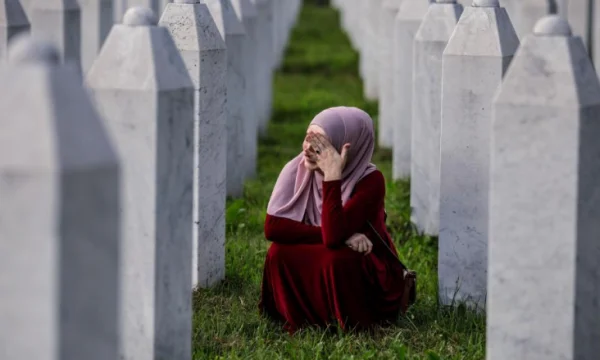
No peace treaty can eliminate the killings, systematic rapes and other horrors that people experienced during the war, but an incident remains in memory more than others -- the Srebrenica massacre that took place between July 11th and July 22, 1995.
Thousands of Muslim men and boys were killed by Bosnian Serb forces. Their leaders were later convicted of war crimes, and the massacre has been known as genocide by the international community. However, not all Serbs are willing to accept this.
Among them is Dodik, who has been particularly irritated by the recent introduction of a law by the Office of the High Commissioner that could issue prison sentences for anyone denying the genocide.
Early this year, he said about the law: “This is the nail in the Bosnian coffin... Republika Srpska has no choice but to begin... dissolving”.
How much could the situation get worse?
Observers fear that even if Dodik does not go towards secession, his actions can be seriously destabilising and causing violence, forced migration and terrible misery for ordinary people, CNN reports, it broadcast Telegrafi.
“Citizens throughout Bosnia and Herzegovina ʹ including the entity of Republika Srpska fear violence”, said Arminka Helicic, a politician of Bosnian origin, who is now a member of the Chamber of British Lords and former special adviser to the British Foreign Secretary. A further move towards the secession is likely to lead to a response. There is no way that the breakup of Bosnia and Herzegovina is done peacefully”.
Heather Stiff, an adviser at the RAMP Project, an organisation specialising in migration policies, warns that <x0] violent conflict would lead to a refugee crisis and displaced people in the 1990s and 2000s we saw people fleeing Bosnia to neighbouring countries like Montenegro”.
The impact would certainly be felt beyond the borders of Bosnia and Herzegovina.
Jasmin Mujanoviq, author of the book “Hunger and Fury: The Crisis of Democracy in the Balkans” said it would be a “disaster for the European Union and the Atlantic Community more widely, as it would be another security crisis in an extremely unstable situation in Southeast Europe”. He noted that with the already existing security crises in Ukraine, Belarus, Syria and Afghanistan “a significant deterioration in Bosnia's security and stability is something that the EU and the US can hardly afford”.
As is often the case in geopoliticals, an eye attack for the West provides an opportunity for rivals like Russia and China. A senior EU official told CNN of their concern about how the situation could be exploited.
We're stuck between a stone and a difficult place. The international community cannot act by victimising Serbs, as it pushes them and Serbia further into Russia's wings. But the Balkans are on the EU threshold. Increasing Russian influence in the region gives them another basis and platform for influence, if they want to destabilise things further”.
Who should be blamed?
Many from the West accept it privately that so far they have failed to take action and that it may now be too late. Numerous sources in the EU, NATO and the wider European diplomatic community expressed regret over the historic failure of the West to impose sanctions or to act differently against those who light the flames in Bosnia and Herzegovina.
“Dodik and its click of separatists and deniers of genocide have constantly calmed down for 15 years by the international community. He's been talking about the issue, moving away about the secession since 2006”, Helic said.
Mujanovic said that while neighbouring Serbia and Russia are the key “architects of this crisis”, he believes that “the rejection of the international community in particular, NATO states to act decisively to overcome this in the early years” has braved Dodik and his supporters. Mujanovic particularly noted the EU, which he said had been the extremely helpless “” due to its internal dispute, making the bloc “at this point in many ways a non-fictor”.
What can be done about the matter?
The international community has a clear mandate to protect peace in Bosnia”, Cidic said. “Any escalation of violence in Bosnia could hurt them extremely as they cannot face a conflict supported by Russia, combined with Chinese and other interests, at the borders of NATO”.
But will the West do anything? A NATO official told CNN: “We urge Russia to play a constructive role in the Western Balkans. We regularly see Russia doing the opposite. NATO works to promote stability, security and co-operation in the region. Any external intervention in domestic democratic processes is unacceptable. .”
Of course, NATO can only act according to the orders of its member states, and there is no indication that something will come soon beyond harsh words.
The UN Security Council cannot act without Russia, which at the beginning of this week voted to keep peacekeepers in Bosnia and Herzegovina only if the High Representative's name is removed from the text of the resolution, undermining the credibility of that office, CNN writes, Telegrafi.
However, there are reasons for hope. Mujanovic says EU member states can set aside mutual sanctions against” Dodik and his friends, whom he believes would have some influence.
But diplomacy did not work in the 1990s, and Cidic does not believe it will now work. This failed diplomatic approach resulted in over 100,000 deaths and over 1.1 million refugees”, he said.
This most difficult approach can be sanctions, combined with dealing with separatist movements as a “security challenge<x1 European>, Helic said. We need to get this back. The sooner we do that, the better and easier it is. We don't want to wait for years like the 1990s. ”
It is difficult to see that the situation in Bosnia and Herzegovina is improving in the near future. However, with enough political will, powerful actors can prevent it from slipping back into violence.
The question is whether powerful Western countries are too distracted to pay sufficient attention to a state that is not at the top of their priority list now and whether they are willing to act, if they can see they are too late.