an hour ago
American Professor: Dialogue aimed at creating association would make things worse
Periskopi(5 years ago)
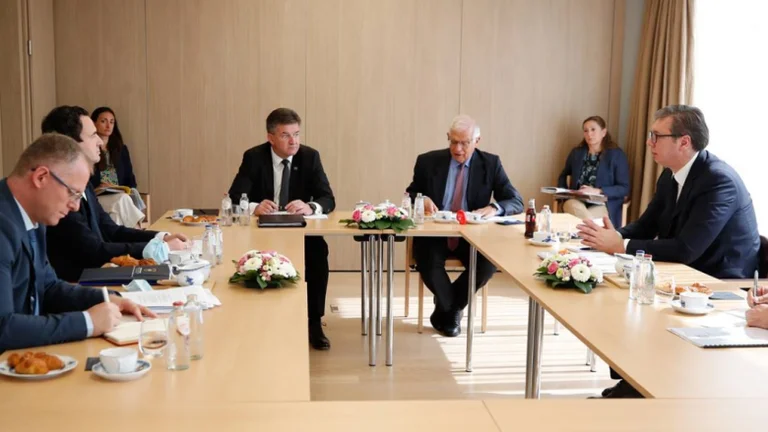
(5 years ago)The good news for the so-called EU-bound dialogue is that it has achieved nothing significant. Its primary goal of establishing an Association of Serbian municipalities integrated into Kosovo institutions would only exacerbate things, says David B. Kanin, legalist at prestigious American University, Johns Hopkins. [...]
Kanin, who served as senior analyst at the Central Intelligence Agency for three decades, was a member of the US team in peace talks in Kosovo, in Rambouillet, thinks that Kosovo would do well to get rid of this dialogue, or at least put it into second plans, while Pristina may think to be oriented towards the rest of the Albanian universe.
Kosovaress: Professor Kanin, you have an excellent experience with developments in the Balkans, by the time you were active, the Balkan region was at war. Although many years have passed since your commitment, the region still remains politically unstable as well as in terms of security. From your experience, can you please tell us where the problem lies that the Balkans are unable to find peace?
Kan: The Balkan region, like the Middle East, is largely an earlier part of the Ottoman Empire that has never found a lasting stability since that Emperor lost control of it. Since 1878, various versions of “West” have imposed on the region alleged final status that lasted for a while, and then collapsed. In my opinion, the current version of Western surveillance is following the same pattern. Nothing is located south of Sava. Borders, the structure of settlements, economic sustainability, and the struggle between formal political structures (ironed from the West) and informal religious-based networks, so central to every aspect of life, remain open. The results of the 20th century's heated and cold wars resolved many of these issues in most of Europe, but not in the Balkans.
Post-Yugoslav diplomacy produced a ceasefire in Bosnia and Kosovo, and eventually produced a solution to the name issue in what is now called the Republic of Northern Macedonia. So far, none of the participants in the 1990s wars wants to turn into armed conflict. However, the idea that there is only one road ahead that includes the supposed universal neo-Iolumental values of transparency, rule of law, democracy and multicultural integration is the secular and desirable teleology. The quarter-year effort to resolve existing disputes, and create functional states and societies on the basis of liberal institutional ideology continues to fail.
Kosovaress: Recently there has been a major tension in Bosnia and Herzegovina, as Bosnian Serb leader Milorad Dodik threatens with boycotting the Federation of Bosnia state institutions, and the purpose of the move is already known. How do you evaluate these developments?
Kan: Current tensions so far fall within the structure of behavior among the constituent, hostile, mutually hostile communities of the first Bosnia since the 15th century, which stood outside a larger imperial or Yugoslav market. This strange construction was condemned since eastern by US-led diplomacy, which forced an dysfunctional policy against Washington's Bosnian clients, while giving Slobodan Milosevic a clear diplomatic success of the 1990s.
No wonder Bosnian Serbs insist on maintaining the Dayton agreement as achieved, while American diplomats are at war with provisions of an agreement that Washington forced Alija Izetbegovic to accept. successive Western failures to impose political and constitutional reform, and the inability to do anything useful under the Dayton Constitution rules, leaving RS as a single stable part of the current Bosnia. This is not a judgment of the ethical or moral value of that entity, but the fact remains that the auspices network in front of RS can function while the rest of Bosnia cannot. Like it or not, the status quo is unlikely to be maintained.
The blame of leaders for current tensions is easy and constitutes avoidance of work. Milorad Dodik, originally established in power by US officials who believed he would be Radovan Karadzic's antidote, has manipulated and skillfully read the opinions of successive generations of Western diplomats while caring for his network of patrols. Despite his noise, Dodik has so far not written the word “secession” on any draft resolution. He has calibrated his rhetoric to win press fights with internationals, avoiding any action that could actually cause conflict. However, there is danger in the atmosphere of distrust that permeates the endless exchanges between Dodik, Bosniak leaders, experts and internationals. The formal and currentised withdrawal of RS from Bosnia's central institutions -- however weak -- would be a step towards secession and a direct challenge to what remains of Western credibility in the region.
Kosovaress: International experts are warning that Bosnia is in danger. From your point of view, would Bosnia likely be involved in armed conflict?
Kan: There is no possibility of a return to the conflict and will remain as long as there is no version of Vojislav Seshel in any of Bosnia's three constituent communities. Dodik wants to continue to show contempt for frustrated internationals, while Bosniaks know that violence will threaten the weak ties that keep the Bosniak-Croat Federation united, not to mention the wavering existence of the Bosnian state. However, Dodik's every move to build and equip an army in RS, or any move by Bosniaks to make the Bosnian military notional stronger, would pose a real risk to new fighting. Current tension also carries the risk that an unforeseen event may cause an unwanted conflict.
Kosovaress: With the escalation of tensions in Bosnia, so far we have not seen Belgrade authorities send content messages. And the perception is that Russia and Serbia are behind these tensions, as they were in the 1990s. What should the West, the US, NATO and the European Union do?
Kan: The promise of this question seems to blame only Russia and Serbia for the wars of the 1990s. That's just not true. I will no longer wage those wars here, but it is important to be honest about the role that figures from all warring parties played in the collapse of Bosnia's internal dialogue, as the Yugoslav structure collapsed around them. Also, Jelcin's Russia was engaged in a constructive effort to co-operate in the Balkans and elsewhere with a triumphant West. He responded with an expansion of NATO that Moscow and the new members of Eastern Europe of the Alliance all understood that this meant that the West still treated Russia mainly as a potential enemy.
What “content messages” should Belgrade be expected to send? Serbia acknowledges the existence of current Bosnia and expresses concern for the interests of the large Serb community within it. This is normal behavior for a country and nation with neighboring relatives. Current tensions in Bosnia have nothing to do with either Serbia or Russia. They result from Bosnia's fragility. Any response from Western states and institutions to current tensions with the assumption that Russia and Serbia are behind them would be wrong and, perhaps, dangerous.
Kosovaress: I believe you were in the course of developments in the Balkans before and after the Dayton Agreement. From today's perspective, do you think it could have been different?
Kan: As intelligence analysts, my colleagues and I gave policymakers evaluations about events, trends and possible alternative results. These clients decided if they considered our analysis useful and made their decisions on policymaking in accordance with circumstances.
Bosnia as it was imposed in 1995 is powerless since its creation. Many things may have happened differently, but a matter stands out. The decision to preserve the 51-49 Bosnia division formula between its two entities severely damaged Bosnian interests. It adhered to this formula meant restoring Bosnia Serb control over lost areas in western Bosnia during the 1995 military campaign. This prevented the creation of a continuing area of Bosnian influence. This should not matter because the US assured Izetbegovic that Washington would ensure that Bosnia becomes a citizen and multiethnic state, not under nationalist control. Americans also promised that refugees and internally displaced persons will return to multiethnic communities in a functional Bosnia. These promises were not kept.
No one should be surprised that Bosnia did not comply with Western notions of secular, multicultural political forms and structures based on rule of law. Balkan societies have been dependent on religious relations for centuries, under serial imperial conquests and other foreign conquests. That's the point. The effort to adapt civic constitutions and culture to a region where attribute and effect relations remain in significant centres based on bad theories and lead to failed practice. In my opinion, it is essential that Western leaders, academics and NGO experts realise that in the Balkans, and not only in the Balkans, many survival strategies are simultaneously illegal and legitimate. The patrol chiefs, their clients and their local opponents all know this, and it was easy for them to capture Bosnia even before Dayton. In this context, any Western movement to restore its post-1995 policies would be wrong.
Kosovaress: We have seen President Biden return to the Balkans some of the most successful American diplomats in the 1990s. Tensions here have grown almost the same as in the 1990s. While some of the American ambassadors coming to the Balkans soon, especially Ambassador Hill appears to face similar problems as 20 years ago. Will they face the same circumstances?
Kan: I think I define a successful “” unlike you, but Washington seems to be reuniting the group. It seems that the current American administration considers experience in the region a good criterion for Balkan envoys. I hope Washington will manage to understand that good ideas sometimes come from people who have no experience in a region and are not in charge of professional data and personal preferences related to countries.
Some things are basically what they were. Bosnians and the Albanian universe remain American clients, while Serbs and Serbia are even more skeptical of the US “assistance”. The basic instability of after 1878 that I stressed in response to your first question remains in place. At the same time, after squandering their hegemonistic moment in the 1990s, the United States has lost its atmosphere of full understanding and acceptance. Balkan politicians and diplomats in all camps know us much better now, and some are likely to have uncovered Washington's knowledge limits to the region's problems. The descendants of those who once expected and hoped for a decisive US action in the region are either now desperate or have realized that the US really do not have a plan and is unlikely to engage a considerable number of troops or other kinetic instruments to implement the desired outcome. The welcome Dayton Agreement in 1995 is now known as just a ceasefire and not as a framework for the peace promised by its creators. The uncertain status in which Kosovo lived after 1999 turned into an alleged stalled sovereignty, not properly handled by American diplomacy between 2006 and 2008, and is still controversial. The good news comes from what is now the Republic of Northern Macedonia. The study of the consistent success of added local politicians is not dictated by the behaviour of a particular American mediator, capable, can be useful to young diplomats.
Kosovo: Unlike the 1990s, Russia's power and presence in the Balkans is much greater. For years, the West has been neglecting Russia's operation in the Balkans and now that tensions are increasing and its influence is visible, can this influence be weakened?
Kan: Russia's current presence in the Balkans is not great, but is managed effectively by Putin and his diplomats. Moscow's focus on weakening American power and profiting from Washington's mistakes gives it a strategic focus missing in Western capitals. At the same time, Russian influence over events in the Balkans is often overrated. It is not hard for the Russians to say no to the UN Security Council, for example regarding Kosovo's independence in 2006 and during recent Western efforts failed to name the High Representative in the official press. The Russians may support Dodik, but it is not clear how far they will go to help him if his actions provoke new conflict. Meanwhile, Serbia's president, Vuciq, will continue to balance relations with all major powers, giving Russia no particular pride for the country. Moscow's contribution to problems in the Balkans should not become a distraction from the urgent need to regulate the results of the weak mistakes of the West itself and enable the donors in the region to finally assume responsibility for their future.
Kosovaress: For years, the United States has supported the European leadership in guiding the Dialogue Process for normalising relations between Kosovo and Serbia. It is a general assessment that the EU does not demonstrate the capacity to provide an epilogue dialogue. Kosovo thinks that without the lead role of the United States there can be an epilogue, do you think it's time for the United States to lead in this process?
Kan: It is time for governments and people in the Balkans to take responsibility for their problems. Reliance on the vast inconsistent and incredulous powers is the local form of avoiding work, which leads only to irreparable frustration and instability. The good news for the so-called EU-bound dialogue in 2013 is that it has achieved nothing significant. Its primary goal, the creation of an Association of Serbian municipalities, integrated into Kosovo institutions, would only make things worse. Such a development would provide association with an internationally recognised status. Serbia, of course, would remain a world-renowned state. Kosovo, however, would continue to have no clear international status, and would not make any progress towards recognition by Serbia or the five EU member states blocking Pristina from membership in the EU. Meanwhile, Serb-controlled cities would find different ways to maintain their loyalty and dependence on Serbia with help, of course, of Serbian security networks.
Kosovo would do well to get rid of that dialogue or at least put it in second place. Pristina may think to be oriented towards the rest of the Albanian universe. Edi Rama's recent statement that prospects for closer relations between Albania and Kosovo are more likely with Albania abroad than within the EU, deserve to be thought seriously. No country is likely to enter the EU in a predictable future even if Bulgaria lifts its veto of opening accession talks with northern Macedonia. The fog surrounding the EU's conditioning and division enables Brussels to keep candidates out indefinitely, while instructing them to go through the challenges scattered along the famous European route.
/David B. Kanin is legalist at the School of Advanced International Studies, Johns Hopkins University, and Analytic Director at Centra Technology. In 2010, he retired as a senior analyst after a 31-year career at the Central Intelligence Agency. He was a member of the US delegation in Kosovo peace talks in Rambouille, in 1999.