 an hour ago
Rama: Kosovo's recognition of independence from Serbia is Yugoslavia's last chapter of break-up
Periskopi(5 years ago)
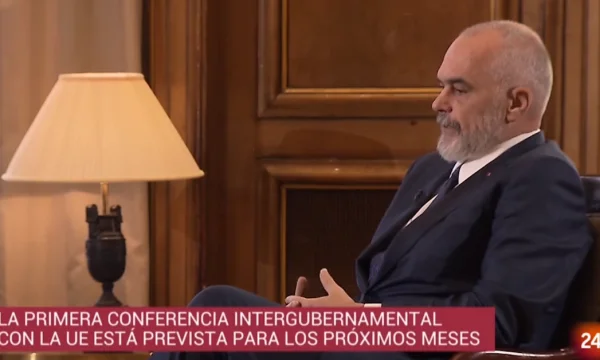
(5 years ago)Albania's Prime Minister Edi Rama, commenting on Kosovo's non-recognition of independence from Spain, has said that this state's position concerns its history and problems, but there is no kind of possible comparison between Spain's internal problems and the partition of Kosovo from Serbia. Rama in an interview [...]
Rama in an interview with Spain's Radio Television has also been asked about recent developments in northern Mitrovica, where she has said tensions are part of that process.
We cannot expect a peace process to progress peacefully and without tension. The good news here is that tensions arise and melt as both sides still communicate and try to find the necessary solutions for people. So it's not like it was in the past anymore. There is a big difference since we already have regional co-operation, with numerous meetings and meetings, round and round, summits of any kind. Of course, Kosovo is the last problem, still open and unresolved by the breakup of Yugoslavia and no doubt, recognising Kosovo as a sovereign and independent state from Serbia is the last chapter of the painful history of the breakup of Yugoslavia”, he has said.
Rama has also been asked about the possible influence of Russia and China in the Western Balkans.
The Western Balkans are surrounded by European borders, we are a body organ of Europe, and we are also isolated from the same body, something that makes no sense and is not the most appropriate thing for safety or the future of Europe that this part of the body is not fully integrated if it is a grey area, as it were, where other actors can play their game. We, Albania, at least, do not disturb these potential influences because for us Europe is our faith and the future in the European Union is our free choice”, Rama has said.
Total interview:
Presenter: If we talk about a country like Albania, we talk about Edi Rama, chairman of Albania's Socialist Party. He has been mayor of the capital, Tirana, in the period 2000-2011 and since 2013 is prime minister of the country's government, which means that for more than 20 years you have witnessed but also part of Albania's evolution. Hello, how are you?
Prime Minister Edi Rama: Well, thank you. And thank you for the invitation.
Presenter: You've just held a meeting with the chairman of the Spanish government and signed some agreements.
Prime Minister Edi Rama: Yes, it is the first official visit of this level, and I feel good because I believe it has great potential in our bilateral relations. I have great admiration over what Spain has achieved, as a model to follow, about how one could overcome such a dark past and become an excellent example for other countries. And, on the other hand, I would like to point out the fact that Prime Minister Sanchez, in the past, has closely recognized the terrible period of history of conflicts in our region and has the right sensitivity to support change. In fact, he wants Spain to be more present in our area, and that is very good news for us.
Presenter: As you just stressed, the government of Spain supports without any doubt the accession process of Albania's accession to the European Union, but we also have to say that European Commission President Mrs. Ursula von der Leyeen has said your country has fulfilled its duties. What steps is Albania taking to meet Brussels' requirements?
Prime Minister Edi Rama: I can say that they are not talking about what we should do anymore, but about how they have decided to work with us and in the region.
Presenter: Perhaps we should be stripped of some negative perceptions we have associated with that area of Europe.
Prime Minister Edi Rama: Of course, we are countries that will have to do much more to meet all the conditions for being members of the European Union. But we deserve to take further steps already and start formal negotiations. The perceptions relate to the past, with information that is not yet fluid, fluent. But I can tell you that everyone is already saying it, even a growing number of Spanish tourists coming to Albania, that there is a big difference between what is perceived from a distance to Albania and its reality. Of course, we have to make further progress with our reforms for modernisation, with the sustainable improvement of our economies and societies, with institutional empowerment and, after all, heading towards a better economic and social regional environment, but these are the challenges of countries that are on the road.
Presenter: If we look to the region already, we see tensions that have resumed between Kosovo and Serbia. I'd like to have your opinion, your analysis of this situation.
Prime Minister Edi Rama: Tensions are part of that process. We cannot expect a peace process to progress peacefully and without tension. The good news here is that tensions arise and melt as both sides still communicate and try to find the necessary solutions for people. So it's not like it was in the past anymore. There is a big difference since we already have regional co-operation, with numerous meetings and meetings, round and round, summits of any kind. Of course, Kosovo is the last problem, still open and unresolved by the breakup of Yugoslavia and no doubt, recognising Kosovo as a sovereign and independent state from Serbia is the last chapter of the painful history of the breakup of Yugoslavia.
Presenter: No doubt, Mr. Rama, one of the main issues is the recognition of Kosovo as a nation, still unknown to all 27 countries, between them and Spain.
Prime Minister Edi Rama: It is true, but we well know that Spain's position has nothing to do with any problems related to Albanians or to Kosovo itself, but it has to do with history and its internal problems. All right, but we have to be actually very clear here, as there is no kind of possible comparison between the internal problems of Spain, regarding independent or separatist movements and partitioning Kosovo from Serbia.
Presenter: In fact, one of the European Union's concerns regarding the Western Balkans is the influence of both Russia and China in this region.
Prime Minister Eddie Rams: Look, the Western Balkans are surrounded by European borders, we're a body organ of Europe, and at the same time we're isolated from the same body, something that doesn't make sense and it's not the most appropriate thing for the security or for the future of Europe that this part of the body is not fully integrated if it's a gray area, so to speak, where other actors can develop their game. We, Albania, at least, do not disturb these potential influences because for us Europe is our faith and the future in the European Union is our free choice.
Presenter: Mr. Rama, thank you so much for your participation on Spanish television.
Prime Minister Edi Rama: Thank you very much.
That's right. Albania, based on the country's size, is the European state that is expecting more Afghan refugees coming from the last crisis. The Albanian government, as Edi Rama said, is prepared to cut 4,000 Afghans naturally, as did Jews in World War II. In Brussels, the high-level Forum on Afghanistan has been held, in which it is clearly defined that the process of organised expectations of the endangered Afghan population should be continued.











