9 minutes ago
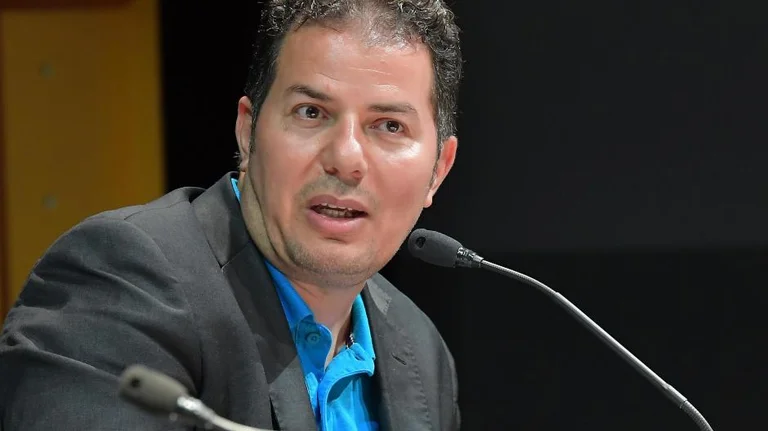
The mafia of religion more dangerous than Cosa Nostra, says expert Hamed Abdel- Samad
Periskopi(5 years ago)
(5 years ago)The best-known German expert of Islam has spoken openly about his life under police protection and his conversion from a devout Muslim to a humanist. QUESTIONS (interviewors Florian Chefai and Jonas Pöld): You were raised in a very religious family in Egypt. How religion has shaped childhood and youth [...]
QUESTIONS (interviewors Florian Chefai and Jonas Pöld): You were raised in a very religious family in Egypt. How much has religion shaped your childhood and youth?
ANSWERS (Hamed Abdel-Samad): Since I was raised in a religious family, I literally absorbed the Koran in my mother's milk. The study of the Koran has a long family tradition. My father, grandfather, and great - grandfather were all imma, and I was expected to follow the tradition. That's why I started memorizing Kuran's chapters (captives) at the age of three. I just parroted without understanding any of that. So my brain learned the formula and melody of the Koran without understanding its meaning.
The older I became, the more I cared about the meaning of the Koran. When I was eight, I finally started asking critical questions: Why Hell? Why did God create us when he knows that many of us will end up in hell? Even then, it sounds brutal and unfair. As a result, I became suspicious.
ASK: You later gave up your religious education and Islam. Was there a specific turning point in your life, or was it a long process that led to desigration?
ANSWERS: It was not easy to give up religion. My relationship with Islam was like a very intimate relationship compared to a marriage in which one finds security, understanding and orientation. But at some point you may begin to doubt your mate. The feeling slowly crawls into what's wrong. I faced a difficult decision: should I continue to ignore red lights, the many questions in my head in order to maintain the obvious peace, or to make sure that this relationship is actually as perfect as I have told myself for a long time? I had to ask whether my relationship with religion really was based on true love, or my fear, and my inability to think critically and to know the truth. At one point, I mustered up the courage to see these questions honestly. I realized that it was not true love that was based on reciprocity. It was a violent affair, a great illusion.
QUESTIONS: Have you had the pain of sharing religion, as is the case with divorce, to stay in the picture of marriage?
ANSWERS: Yes, I had withdrawal symptoms like a drug addict. It was a cycle for several years until I realized I could find inner peace without Islam. This step was not an easy one. Because religion had manipulated my body from birth, my relationship with myself, and with other people. As a child, you get your attention without asking and as a teenager you are not allowed to experiment with your sexuality. Religion enslaves the body in every area - how you carry the need in the toilet, how you shower, when you should pray, what you should eat, and not eat. You're not allowed to kill yourself, but you're allowed to blow up more explosives for Allah's sake. There's a god who gives you a body but you owe him an instrument for his needs. A totalitarian dictator who wants to control people could not have thought of something better.
The real silence developed only when I came to Germany. It happened when I did not have to firmly defend my faith and thinking. In Erfurt, I learned the early history of Islam at the university for four years at the Islamic Research Center. It was where I had to deal with the Koran from a completely different perspective - its history of origin and its historical resources. It was a time when I realized that the so - called holy scripture was not descended from heaven.
QUESTIONS: You may say that you have bought your freedom very dearly. Because of your books that are critical of religion, you are threatened by Islamists and have been under police protection for several years. How is freedom possible under such circumstances?
ANSWERS: Actually, the price I had to pay for my freedom was extremely high. Psychological, social, security-related consequences are huge. As a person, however, I have become much calmer even after I have received death threats. Because I knew that my inner peace depended on myself and that no one can kill me. I can change my beliefs again tomorrow without having psychological collapse. The fundamentalists, on the other hand, are enslaved by their religion.
Of course it's sad that I have to live under these circumstances but only my physical freedom suffers, not spiritual freedom. I'm much, much, cheaper in my being than those who are threatening me. The physical freedom I have lost, I am trying to compensate for mental and spiritual freedom by engaging in scriptures, by engaging in Iluistic truth, and by promoting contractive debates. From this point of view, it wasn't fanatics who won, it was me. At the end of the day, this is also a comfort to me.
QUESTIONS: At the moment there are two main themics where critics are in danger of their lives: Islam and the Mafia. Those who were once members themselves are particularly threatened...
ANSWERS: Yes, this is a very striking comparison that I refer to in my books. Above all, Islam and the Mafia are united by strong peer pressure. People who do not belong to the same family or religious communities will react with suspicion and hostility. The principle is: “Who isn't for us is against us” This is especially true of apostates („depressors“who have broken the group's honor code.
Therefore, it is no coincidence that critics of Islam or mafia are particularly threatened. But a mafia critic may at times find places to save and live safely. I'm nowhere sure of Islam be it Germany, Egypt or the US. Religious mafia is far more dangerous than Cosa Nostra.
QUESTIONS: How can people who are persecuted and isolated from their critical attitude toward religion be well supported? What can the State and the Society do to protect these people?
ANSWERS: The state guarantees to people like me police protection. That's good, but it's not enough. Because no one cares for many other people outside Germany who have left their religion and therefore are persecuted. They don't have lobes and they have only a few supporters. Fortunately, there is the Giorano Bruno Foundation and the Secular Relief for Refugees, who are doing important work in this area. But only that is not enough to reach and help all these people threatened.
I try to give voice to these people. Not everyone has access to the media, not everyone can express their criticism. That's why I criticised Islam on behalf of exiled Iranians, exiled jazids and exiled Christians who were oppressed in the Islamic world. I try to make them listen to women who suffer massive violence in patriarchal structures. Last but not least, I try every opportunity to draw attention to people like Raif Badawi, who has been sentenced to prison and torture simply for campaigning for basic human rights in Saudi Arabia.
QUESTIONS: You are a member of the Giorano Bruno (GBS) Foundation Adviser Board. As an inborn individualist, you're actually hard to institutionalize. How did you get in touch with GBS?
ANSWERS: In 2010, I was a guest on a panel of discussion attended by GBS board spokesman Michael Schmidt-Solomon. Michael was no doubt interested in my presentation, for he later invited me to give a lecture at the foundation headquarters. After my lecture, I was finally asked if I would like to become a member of the Foundation's advisory board. The founder, Herbert Stephen, was very honest with me in this regard. He said there were people who were originally members of the foundation, but then they withdrew because they had to experience hostility. For me, however, the issue was clear: if the foundation lies for humanity, free thought and individualism, then I will be there regardless of the cost. This is how I live my whole life. I'm not running from Egypt so I can always be careful which way I am. In retrospect, it was the right decision that I never regretted. I was basically introduced to very interesting people who are real humanists and individualists. Friendship with Michael and Herbert, for example, is a treasure to me.
QUESTIONS: Until recently you were also a member of the German Conference of Islam, but then you announced your resignation. According to you, what are the main deficits in the current Islamic debate?
ANSWERS: There is a problem for Islam in Germany. This is not only because of Islam, but also because of the unfinished century that has left a void in laws, education system and institutions. Privileges enjoyed by the churches can hardly be denied to Islamic associations. The state's desire for structure and communication personalities has caused Islam to be „, if that's what I can say. This allowed the worst Islamic groups to be imposed as audiences for “Muslims” because they are better organized, have more resources and receive financial and moral support from the outside. The state now entrusts them with important responsibilities, such as education on Islamic Islam or shepherding, even though they are not yet a corporation under public law.
The fundamental problem of the current Islamic debate lies in the group's priority over the individual. The German state treats Muslims, not as citizens, but as members of a religion. He no longer views them as individuals, but as a collective. This is fatal because tribalism is an enemy to open society.
QUESTIONS: In your new book “IDs: 20 thesis on racism and how we take power from him”, you have intensively addressed the problem of solid group affiliations. Why are collective identities so dangerous?
ANSWERS: Dangers are becoming evident today in many debates over identity policy. Again, whether you are white or black, immigrant or domestic, left or right. Instead of asking critically such a one-dimensional atriums, they cement extra. Antiracism should actually do exactly the opposite of that. He must build bridges, not walls. It must overcome ideological cracks and honor and empower people as individuals. But anti-racists often use the same tools as racists themselves, dividing people into groups and reducing them to their ethnic or religious affiliation. Unfortunately, it does legal service harm against racism.
For many people, identity policy has become a kind of substitute religion in which dogmas are counted more than freedom. On behalf of tolerance, bans of thought and free speech are imposed, unpleasant opinions are being marginalized. I see it as a counterrevolution against Enlightenment that endangers peaceful coexistence.
QUESTIONS: How is it possible to strengthen the cohesion and sense of community in a pluralistic society without falling back into an identifying camp?
The solution lies in individual freedom. That doesn't mean you have to give up your identity. We must understand, however, that all human beings are cultures of mixed race that combine multiple characteristics. The rigid concepts of identity do not give justice to this fact, but they make people unacceptable down to certain attributes. In any case, the world would be much more peaceful if we separated ourselves from tribal structures and sought higher identity. What can be a better identity for us humans than being human? We are all part of a human race, part of the same universe. It is related neither to fear nor to hierarchy but sharpens our sense of responsibility without limiting the individual's free development.
In a pluralistic society, mutual respect and protection against discrimination are naturally required. Ethnic and cultural diversity also requires diversity in expressing opinion. Unfortunately, this is no longer a natural matter. A writer today should be careful about what he says because he can strike out the feelings of species and groups. Unfortunately, this has made the area of legalization so much closer.
QUESTIONS: What measures do you think can improve the culture of debate again?
ANSWERS: By reserveing the right to offense, no matter how many wounded souls are shocked around you. The priority is freedom of speech, then feelings. I have the right to offend religions and ironize through satire. The religions are just a few thoughts that cannot be enjoyed by criticism. The law set limits. They're where people get killed and where it requires practice of violence. Besides, I decide for myself what I should say and what not.
We need to speak objectively about our rights and obligations instead of our unclear feelings. The arguments should be answered with arguments, not in anger. This would lead us far further socially than with ID-political discussions. Identification policy is satisfied with symbolic accusations and gestures, but it neglects problems that merit our attention much more.
QUESTIONS: How optimistic or pessimistic are you that secularism and individuality will prevail politically in the future?
ANSWERS: I am pessimistic when I think of the long way we should go in the future. But watching the road that mankind has already made makes me optimistic again. Because in science, philosophy, and art, we have made impressive progress. It is unlikely that some background legends can overturn all these advanced developments. Experience has shown that the historical times of the turning bring uncertainty with them and thus fosters nostalgic reevaluation of traditions and religions. However, this return to the past will not guarantee a future of worth living and will not build prosperity. This can be achieved only by a secular society, endowed with reason, science, and human rights.
Of course, we should not be under the illusion that fundamentalist forces are withdrawing and willingly giving up. The end of history, as predicted by political scientist Francis Fukuyama, is not in sight. In the long-term plan, however, fundamentalists will lose the battle because they cannot continue with social transformations.
QUESTIONS: At the end of our interview, a somewhat unusual question: Imagine you're dying. It turns out to your surprise that Islam was actually the right religion. What would you say to Allah when you meet him at the gate of heaven?
ANSWERS: I would say: “Maybe Islam was the right religion but not for me! How can you expect from me something that wasn't right for me? You've done an extraordinary job of hiding from me. You've done an extraordinary job so I can't even see you listening. How could I find you, mortal? You won because you wanted to win anyway, as God Almighty. If you are not only powerful but also righteous, you will not drive me to hell. ”
[Shouted from original to German: i.k. ]