 an hour ago
EU statement allows no one's proposals for steps back in the WB6 enlargement process
Periskopi(5 years ago)
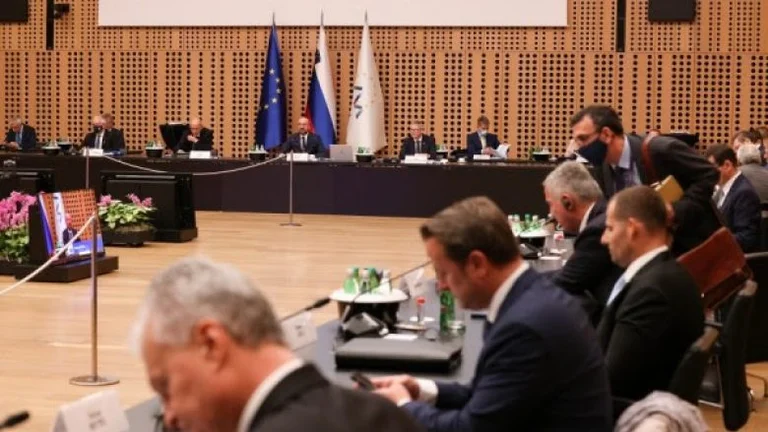
(5 years ago)The declaration signed at the Brdo Summit by European leaders on the EU's pledge to support the 6 Western Balkan countries (WB6) in their European perspective has been the most optimistic result that could be released at this time. So says Maya Boucar, professor at Ljubljana University and expert on politics and [...]
In an interview for Kosovo, Kosovo expert Buncar says that disputes between EU member states over the bloc's enlargement, the situation created by Brex, even from Poland and Hungary are some of the reasons the European Union during the Brdo summit did not give the Western Balkan countries a deadline for the possibility of membership.
The EU summit for the Western Balkans, held in your country in Brdo/Slovenia, ended with a statement by European leaders on the EU's commitment to supporting the European perspective of the Western Balkans. Leaders of Western Balkan countries seem to be a deja vu, something they have been hearing for years. As a good connoisseur of EU policies, do you think such repeated statements do not inspire Balkan countries?
Bučar: In view of the current situation in EU member states, I think such a declaration is the possible optimum result at this time. At least there is commitment, despite some members reluctant to discuss enlargement. Because of some internal unrest, starting with Brex, issues with Poland and Hungary, different opinions on certain crucial EU policies among member states, the approach of certain member states is that we first have to work in internal cohesion before adding new members to the bloc.
The statement signed at the European Union summit - the Western Balkans was confirmed that European integration is a “interest and common strategic choice”, while the EU stressed that “will further intensify engagement” so that the region experience the transformation of political, economic and social, but no specific date was mentioned when these countries can expect membership. Why wasn't a date mentioned, according to you?
Bučar: Setting a date was the ambition of the Slovenian presidency, however given all the arguments I specified above, was not possible to reach a consensus on that. In my opinion, this is unfortunate, since it allows constant postponement of enlargement and thus allows for delaying needed reforms in the Western Balkans.
Although the text of the declaration is a strong signal that enlargement is still ongoing and that it will occur. Given the reserves of several bloc member states for the enlargement process (particularly France, the Netherlands, and Bulgaria in the case of Northern Macedonia), how serious can this commitment be on the part of the European Union?
Bučar: The very fact that France will be the next country to assume the European Council presidency, the declaration is important -- at least no step back from enlargement can be proposed by them. I believe that at the moment the text is the optimistic statement that can be found in all member states. The conclusion is that there has been no clear opposition or very strong conditioning, in fact unofficially there have been some criticism of Bulgaria's position and even Croatia's for putting their issues, in fact, bilateral at the table.
Let's go back to the second question, about not giving a deadline until the six Western Balkan countries should complete their membership duties in Block. Do you think a part of the European Union cannot predict how fast the countries will progress on the road to the EU.
Bučar: It is not only how quickly reforms in the BP will progress but also how domestic issues evolve. The lessons of “Big Bang”- the previous round of enlargement are for older members, that it is not so easy to adapt to EU policies and regulations. In my opinion, the BP is as much a victim of relatively slow reforms in the country as the victim of some disagreements that are taking place among member states themselves. Issues like the Polish Constitutional Court's decision on the supremacy of the national constitution on EU law certainly do not help the enlargement process.
Slovenia's proposal as a host, for the membership of 6 Western Balkan countries to take place in 2030, has not received support for approval. I am interested in knowing from your point of view, is this linked to Kosovo's non-recognition by the five EU member states.
Bučar: Unrecognition is just one of the factors, but far from being alone. As it often happens in politics, one requires a reason not to engage in different areas/political, strategic interests, and this is the case with these five countries.
There seems to be a scepticism between the two sides, so on the one hand, the Block appears to be skeptical of deep reforms that Western Balkan states can achieve and on the other. WB6 is losing patience, and there are states that have signalled a greater bid with China and Russia. How can distrust be overcome between the two sides?
Bučar: Greater co-operation between EU member states and BP states is essential to reducing distrust. There are many open areas where co-operation can be further strengthened: economic relations, co-operation in science, in the field of environmental protection and climate change, cultural co-operation, etc. This could have a double effect: it improves knowledge of the Western Balkan states in the EU, as well as shows the benefits of following EU policies for the local population, which can therefore have a more positive view of EU-awaited reforms.
In a summit where his idea was the commitment of all parties to the European perspective of the Western Balkans, Serbia's president said, “even when he is on the European road, Serbia should take care of itself and its relations with Russia and China, and no one has the right to blame us for wanting to live and survive” do you think that the EU will one day seek Serbia for a clear definition, that is, end the balance game between East and West?
Bučar: Nobody, China, Russia and the EU come to the Western Balkan countries without the agenda. The European perspective is probably clearer, since EU values and policies are clearly expressed and BP countries should only look at recent enlargement and see what has happened to the newest member states in terms of their economic growth, benefits from structural policies, etc. The increased presence of China or Russia will not be without obligation, and that is something the Serbian president must also consider.











