3 hours ago
“Balkan opened”, Albania's Official Library releases memorandum for ease of trade
Periskopi(5 years ago)
(5 years ago)It has been published in Albania's Official Book of Understanding for Co-operation, Equipment of Imports, Exports, and the Movement of Goods in the Western Balkans, which was approved in the government's meeting Wednesday under the “Balkans initiative. This joint initiative among three countries: Albania, Northern Macedonia and Serbia aims at [...]
It has been published in Albania's Official Book of Understanding for Co-operation, Equipment of Imports, Exports, and the Movement of Goods in the Western Balkans, which was approved in the government's meeting Wednesday under the “Balkans initiative.
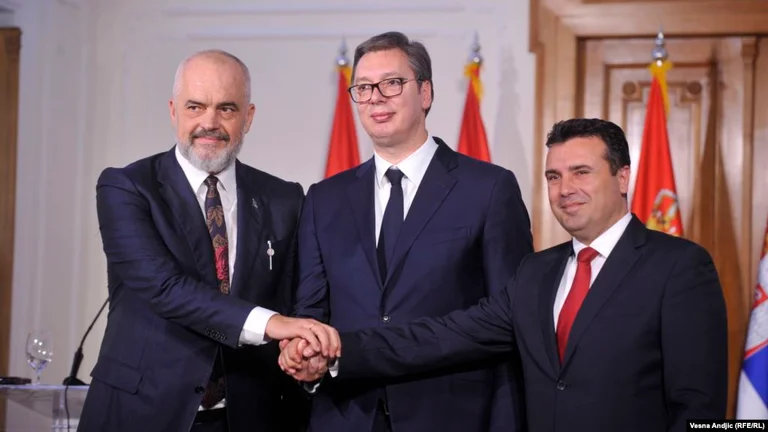
This joint initiative among three countries: Albania, Northern Macedonia and Serbia aims to spread this memorandum to all CEFTA countries.
Its point is to facilitate trade. While aiming for this memorandum to be followed by a plan of measures that will ensure free movement of goods, trade for all businessmen, OraNews broadcasts.
The memorandum will serve as support for subjects operating in Albania and subjects that trade with these two countries.
According to the reply accompanying this agreement, “Western Balkan participants referred collectively to such as “Piles” and individually as “Pala”, expressing willingness to strengthen bilateral relations and understanding, especially in the field of imports, exports and the movement of goods, with the aim of eliminating obstacles in bilateral trade, contributing to economic co-operation progress, and expanding the subject of mutual trade exchange; deciding to eliminate barriers in common trade and to strengthen progressive trade links.<>>
The agreement emphasises that the “pa are ready to invite other Western Balkan participants to join the Memorandum of Understanding under the spirit of inclusion, regional co-operation and to improve life within the entire region, and to contact each of them to encourage them and prepare for the implementation of the Memorandum of Understanding under the spirit of regional co-operation and to improve life within the entire region, and to contact the Albanian Parliament, and to take advantage of the CENTvans/Remotive Commissions/Remotive Commissions; given that improved bilateral co-operation between competent authorities, customs responsible for customs and other procedures, and other procedures, will contribute to the CfP of the CENTRS, financial Commission and the Humanisation of the RSPE to the Humanisation of the CENTRS, the CEEE, the FEEECEEEEEEEEE, and the CENTRS, the CENTRS, the CEEEEEEEEEEEEEECEEEEEEEEEEEEEEEEEEEEEEEEEEEARS, and the CEEEEEEE The Stabilisation and Association Agreement between the Republic of Albania and the European Economic Community” and the Stabilisation and Association Agreement between the European Communities and their Member States and the Republic of Macedonia; recalling the Agreement between the Council of Ministers of the Republic of Albania and the Government of Serbia for the Assistance of Inter-Reformation in Prevention, Investigation and Combating Customs and the Agreement between the Federal Government of Yugoslavia and the Government of Macedonia for the October Macedonian Republic of Macedonia, such as Prime Ministers and the Greek Republic of Macedonia's version of the Greek Republic; by introducing the translation of the Greek Republic of Agriculture and the Development Ministry of Agriculture, the Greek Ministry of Public and the North Bank's Landing Republic's Profector and the Greek Republic's Proprincipliance of Greece's Probliance of Greece; and Greece's Parliament's Defence and Greece's Parliament and Greece, Greece, Greece, Greece, Greece, Greece, Greece, Greece, Greece, Greece, Greece, Greece, Greece, Greece, Greece, Greece, Greece, Greece. Memorandum” .
The objectives of this memorandum are: a) the growth and strengthening of economic co-operation between the Pauls; b) simplifying procedures regarding imports, exports and movement of goods to the broadest extent possible; c) the exchange of data between customs authorities and other competent authorities to the extent that each Paul's legislation allows; d) promotion, through enhanced bilateral trade, harmonised development of economic relations between Pals; and gradually eliminating barriers in the trade of goods.
Simplification of formalities related to export import and goods movement
The sides must implement trade and procedures regarding import, export and movement of goods that are simple, reasonable and impartial. The sides will ensure the renewal of bilateral agreements on international road transport in order to facilitate the transport permit regime for bilateral countries, transit and third countries, thus facilitating transport and trade in the Western Balkans. The sides reduce, to the possible extent, the controls, formalities, and the number of documents required to ensure compliance, with the aim of minimizing the incision and complexity of import, export and movement and documentation requirements, each side guarantees that these formalities and documentation requirements: a) have been implemented, with the purposes of the release and distribution of fast goods; b) have been implemented in a way that aims to reduce time and cost of incompatibility; and c) are in the lowest amount of trade limit.
Transsit
The Pali customs authorities co-operate in order to provide the conditions to simplify the transit procedure between them to the extent possible.
Confidenciacy and Protection of Information
All information received under this memorandum is considered confidential and is treated at least with the same level of protection and privacy, just as information provided on the basis of Palla's information legislation.
The co-operation of customs authorities and other competent authorities each of them must guarantee its competent authorities, responsible for customs and controls and other procedures related to import, export and transit of goods, co-operate with each other and co-ordinate their activities to facilitate trade. The checks conducted by authorities mentioned in the paragraph of this article are based mainly on risk analysis, using electronic data processing techniques, with the aim of identifying and evaluating risks and implementing necessary measures, on the basis of criteria developed at the Paul level and, when possible, at the international level.
Food Security, Veterinary and Victorizer Issues
The sides must make concerted efforts to facilitate the movement of animals, products and foods of animal origin and at the same time prevent the introduction of infectious diseases and products and foods of harmful animal origin to health, to develop cooperation in the field of veterinary and food safety, to facilitate plant movement and plant origin, to food and food for plant and plant origin, to prevent the entry of harmful plants into quarantine, and to work on simplifying procedures in the field of food safety to protect against the introduction of harmful organisms and harmful products, and to facilitate bilateral trade and plant products and other plant products, and other products that are in the processable, and other items that are in the process of co-operation.
The competent Paul authorities inform each other of the veterinary and phyto-sanitary demands for the import and transit of goods. Import, export and transit of plants, plant-born products and other objects subject to phytosanitary control (resistently referred to as “dragesa”) can be accomplished only if phytosanitary requirements are met, in line with importative and transit health regulations.
The sides take all necessary phytosanitary measures to prevent the entry of plant pests into quarantine from remitting plants and plant-born products that are exported, in line with specific phytosanitary requirements of importative and transit.
The import of food and food for animals of plant and mixed origin can only be carried out if the conditions described are met, in line with food safety regulations in effect on the importative Palla. Reports of the officially authorized labs for testing food and food for animals of plant and mixed origin and laboratorys formally authorised for testing food and food for plant-born animals will be mutually recognised by the competent Paul authorities. During the import, food and food shipments for animals of plant and mixed origin must be accompanied by results of unannounced laboratory analysis of 4 (four) months, carried out with accredited methods and released by officially authorized laboratorys.
Each Paul holds the right to control and examine food and food deliveries for animals of plant and mixed origin during import. The sides will appoint official labs to conduct laboratory tests and diagnosis of the sample taken during phytosanitary control. The sides agree to mutually recognise lab analysis rezonants from labs officially authorised for samples received from shipments that are subject to import. When it is determined during import that food delivery does not meet the provisional provisions of the Palla importation meal, the competent importatory authority will immediately inform the competent authority of the exporter, in this regard, and will take measures in line with its domestic rules.
The competent Paul authorities report each other's measures that restrict or prohibit the import of food and food for animals of plant and mixed origin. The competent Paul authorities exchange the forms of veterinary and phytosanitary health certificates that accompany remittances to the Pauls and inform each other of their changes. The competent Paul authorities appoint competent persons for co-operation and co-ordination of activities in the field of animal health, phytosanitary and food safety issues.
Moving Food Products
The parties should make concerted efforts to facilitate the movement of food products, namely. New food, food for specific population groups (food for small babies and children, food for special medical purposes, substitute for a daily diet for people with dietary weight loss, dietary supplements, dietary supplements, food for different nutrients (food for intlerants to gluten, substitutes for salt for human consumption, foods reinforced with vitamins, minerals, and other food - related nutrients and food - producings, food and food - management fields, food flavoring, food and food supplements, food and food supplements, food and drinking tools, and drinking facilities (first, marined) and other food - and food - based water - and food - based water - and other water - and food - and food - saving foods - efficient foods - as wells.
Products, according to the paragraph of this article, can be specified in a special appendix. The competent Paul authorities inform each other of the conditions for importing product deliveries.
Non-food industrial product movement
The sides must make concerted efforts to boost bilateral trade, to eliminate technical barriers in the trade of non-food industrial products, enabling free movement of non-food industrial products in a way that does not limit international trade while ensuring the required level of product safety and the protection of human life and health, animals and the environment.
Based on the ISO/IEC 6850 Agreements for recognition and acceptance of the results of the reform assessment and recalling the importance of the status of their acronym organs as ELA signatories with European Co-operation of Discension (EA), the parties must make concerted efforts, in order to simplify the certificate procedure of transparency, and also, mutual acceptance of evidence reports from the accredited labs, in relation to non-food industrial products, as long as the organs of the signing parties have the status of the agreement allowing for recognition of the mutual transparency of the laboratory system of labs that includes tests. The sides can expand the scope of co-operation, in terms of the object of accreditation and achievement of the objective and object of this memorandum will come into force on the day of the latest notification, through which the Pauls inform each other, that their internal procedures, for entry into force of the memorandum, have been completed.
This memorandum could be changed with mutual consent of all sides. The memorandum remains in force indefinitely, unless one of the sides announces its intention to withdraw from the Memorandum.
In this case, the memorandum will be completed 30 days after the date of the written announcement.
Any disagreement, which may arise in the application of this memorandum, is resolved by mutual consent through competent Paules authorities.