3 minutes ago
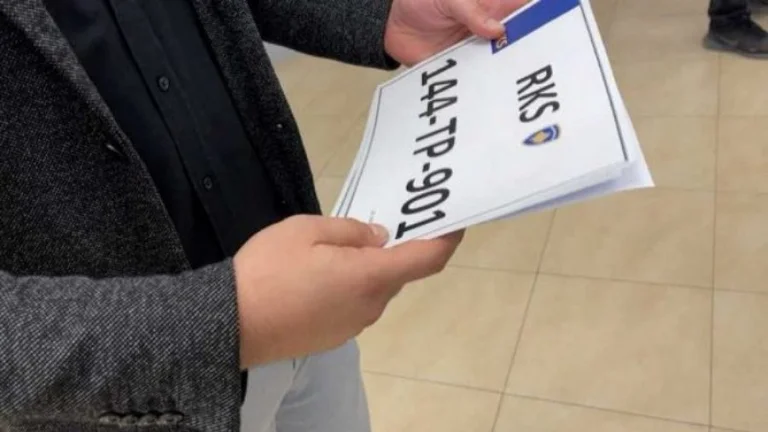
Agreement for Targa: The stickers were removed from the Svechla Ministry warehouse, printed four years ago.
Periskopi(5 years ago)
(5 years ago)For the suspension of the situation created in the north, Kosovo and Serbia have discussed in Brussels. After two days of discussion, the two states have reached agreement that eases the tense situation. Kosovo and Serbia have agreed to three points. One of them has to do with October 4th, will start applying the regimes temporarily to the labels/afish in [...]
Kosovo and Serbia have agreed to three points. One of them has to do with October 4th, it will begin to temporarily implement the regime's/afishing labels in cars, instead of removing vehicle license plates registered in Kosovo and Serbia, until a permanent solution is found.
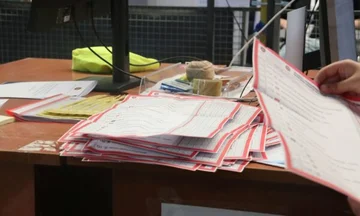
The posters, known as “stiera”, were produced four years ago and are being held at the interior affairs ministry's warehouses.
“The number of stick cards produced in 2017 is 300,000 pieces of”, the MPB news office announced.
After two days of discussions in Brussels, Kosovo and Serbia reach agreement on extending the situation to northern Kosovo. The news revealed the European Union's own charge for dialogue between Kosovo and Serbia, Miroslav Lajcak.
On his Twitter account, Lajcak published the letter of the agreement, where it is seen that the parties have agreed on three main points.
The special police units located at the joint border crossings in Jarinje and Brnjak will leave along with the barricades, starting from October 2nd, 0800 p.m., until 4: 00 p.m. that day. Mission NATO in Kosovo, KFOR will be engaged at these two points in Jarinje and Brnjak, before the launch of the withdrawal of police officials and barricades and will remain there for two weeks to ensure security.
From October 4th, it will begin to implement the clinging card regime temporarily, instead of removing vehicle plates registered in Kosovo and Serbia, until a permanent solution is found.
On 21 October, a team consisting of European Union, Pristina and Belgrade officials will begin working to find a permanent solution. Within six months, from the start of the first meeting, the so-called Work Group, will present the findings for a permanent solution to the high-level dialogue format.
There have been numerous reactions to this agreement, even against it.
Kosovo's former chief negotiator in dialogue with Serbia, Edita Tahiri, has said that Kosovo's state sovereignty has not been protected yesterday in Brussels, following the signing of the agreement on license plates.
She has stressed that instead of reaching a mutual recognition for the recognition of the license plates of both states, yesterday's license agreement on plates has turned the dialogue process into something that had happened five years ago.
Kosovo's state sovereignty was not protected in Brussels. The government, Kurti, with the license agreement, allowed Serbia to decide when it goes or doesn't go the Kosovo Special Unit north of our state. As that government has in words promised to protect the state and the Constitution in Brussels' dialogue, it violated Kosovo's Constitution and sovereignty. Also, instead of reaching mutual recognition of the license plates, as the road leading to mutual recognition between the two states, it turned the process back into something that had happened 5 years ago, as a reciprocity that had meaning at the time, but not now when talks in Brussels have entered the phase of mutual recognition”, Tahiri has said.
Even so, immediately after the deal, the immediate reaction of Kosovo Prime Minister Albin Kurti was, who said that “with the agreement reached with Serbia in Brussels on Thursday, “Serbia will start to learn with reciprocity”. He said that once the barricades are removed, there will no longer be a need for Kosovo Police Special Units to stand at two Jarinje and Brnjak border points.
Of course, our next border police will implement the license reciprocity. KFOR will stay there, about two weeks, so that everything will be safe”, Kurti wrote on Facebook.
The international factor, the European Union and the US, welcomed the achievement of the license agreement and the extension of the situation in northern Kosovo. European diplomacy chief Josep Borrell wrote that “after this agreement, Kosovo and Serbia must resume dialogue for normalisation of the reports”.
Kosovo and Serbia must now be involved constructively in the dialogue to make rapid progress in normalising relations”, Josep Borrell said.
Serbia's victory, reaching the deal, is seeing it -- President Aleksandar Vuciq, who praised that the agreement reached in Brussels for vehicle plates between Kosovo and Serbia -- was the best “obsolute that could be reached” and that it was a good result for Serbia, media broadcast in Serbia. Those comments, according to the media in Serbia, took them to the media conference held in the town of Nis, telling Serbia had reacted responsibly and wisely in this case, always showing caution to Kosovo Serb citizens.
Speaking of the shortcomings of the deal, Vuciqi said one of them is that a perhaps more difficult solution would still have to be reached in the next period, as well as the fact that, in practice, the plates issued by Serbian authorities can only be used in northern Kosovo. He has also said that meetings in Brussels are expected to continue, underlining that the next topic there will be the establishment of the Serb Major Community Association in Kosovo. The next “Theme in the dialogue will be the Association of Serbian Communists”, Vuciqi said.
Kosovo had warned and established the reciprocity measure for the plates during the latest round of dialogue with Serbia, mediated by the European Union. Deputy Prime Minister Besnik Bislim, who heads the Kosovo delegation in Brussels, had said the agreement for the plates expires on September 15th and that Kosovo would not respect that unilateral one. The issue of car plates was regulated by the Brussels Free Movement Agreement, reached in July 2011, within dialogue between Kosovo and Serbia.