 an hour ago
13 days blockade. All that happened in the north.
Periskopi(5 years ago)
(5 years ago)Now 13 days, northern Kosovo is blocked. In Jarinje and Brnjak, barricades from Serbian citizens have been placed, in sign of dissatisfaction with the Targa decision. But what happened there during these days, and how was the agreement reached to remove barricades and special police? The morning of Monday, September 20th, the police [...]
Now 13 days, northern Kosovo is blocked. In Jarinje and Brnjak, barricades from Serbian citizens have been placed, in sign of dissatisfaction with the Targa decision. But what happened there during these days, and how was the agreement reached to remove barricades and special police?
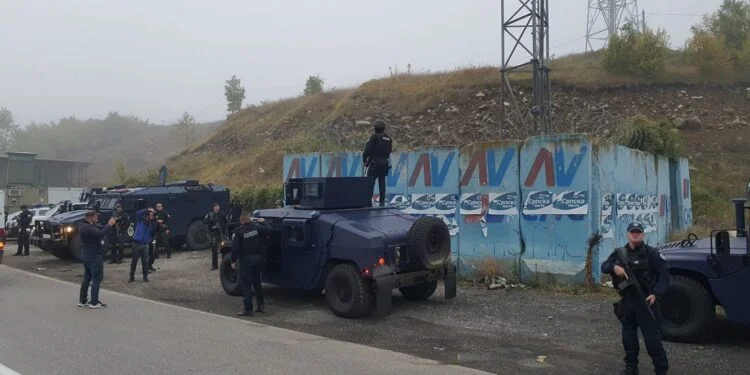
Monday morning on September 20th, Kosovo Special Unit officers stormed the north.
The Kosovo Police's autoblonda tens were positioned at the site where it was previously the border checkpoint at Jarinje.
This had been warned that on that day, the deployment of the “pro-vulnerative rebels” for cars entering from Serbia to Kosovo would begin.
In recognition of this decision, Serbian citizens blocked the roads leading to the Jarinje and Brnjak border points. They set up blockades there, unable to make the switch.
Since that day, they have protested and spent the night in tents.
From time to time, there has been tension. Even images of the Serbian Army were published in Rudnica, a country close to the Kosovo border.
But, as of Thursday, Serbian television reporter N1 reported that the Serbian Army located near Jarinje in Rudnica has been pulled out and deployed in Raska.
Meetings in Brussels were also organized to find solutions to the situation.
After two - day meetings, the agreement was reached.
The European Union's Emisari for the Kosovo-Serbia dialogue, Miroslav Lajcak, announced that the two sides have reached an agreement regarding the crisis recently caused at the kuftier crossings in Jarinje and Brnjak.
We have a deal! After two days of intensive negotiations, a de-pass agreement and the road ahead has just been reached. I thank Besnik Bissim and Petar Petkov for their willingness to negotiate and to reconcile for the benefit of the people”, Lajcak wrote.
The agreement contains three points, including unlocking roads to Jarinje and Brnjak, along with members of the Kosovo Special Police Unit starting today.
Their departure is expected to begin at 8: 00 p.m. and end no further than 1600.
Under the deal, from Monday Kosovo and Serbia will use posters for cars that come from one another. This will serve as a temporary measure.
Likewise, a working group consisting of representatives of Kosovo and Serbia and led by the EU will be set up to find a permanent solution to the license issue. The working Group's first meeting is to be held on 21 October in Brussels.
Within six months of the first meeting, the Labour Group will present its findings on a permanent solution.
US Deputy Assistant Secretary of State for Europe and Eurasia Gabriel Escobar said it was important that Kosovo and Serbia reached agreements on lowering tensions in northern Kosovo.
He also said Kosovo has had the right to impose reciprocity, but Washington was surprised by the implementation of this decision.
The EU-led “Dialogue is the right place to find a solution and thank the EU's Special Envoy ( Miroslav) Lajcak and his team for the hard work they have done”, Escobar said during a news conference in Brussels on September 30th.
“The lesson is that in partnership with the EU we can make some progress in helping the Balkans integrate more with the EU after a difficult period in which the region has passed”, he added.
As for dialogue between Kosovo and Serbia, Escobar, who is at the same time sent by the US State Department for the Western Balkans, said there is still much work to be done and that depends on the political will of the parties.
When asked whether they were informed by the Kosovo side that they would place the reciprocity measure for plates with Serbia, the US official said that “Kosovo has had the right to do so”, but that they were surprised at the way they implemented this decision.
Kosovo has a right to reciprocity and that has been known. But we were very surprised by the way we applied. But we expected that to happen at some point. We are happy that we secured the drop in tensions”, he said, adding that long-term solutions to the license issue should be found.
Meanwhile, NATO said it welcomes the agreement between Kosovo and Serbia for the extension of the situation in northern Kosovo.
In a statement to the media, spokeswoman Oana Lungescu said the peacekeeping mission NATO in Kosovo, KFOR, “will play a fundamental role to ensure effective implementation” of the agreement











