3 hours ago
Why are very few convicted of war crimes in Kosovo?
Periskopi(5 years ago)
(5 years ago)From the series of DWs a look at war crimes and penalties: U n The NMIC, EULEX and Kosovo institutions have filed dozens of war crimes cases, but the sentences have had very little. Why? He who experiences a war changes his life forever. More than 21 years have passed since the Kosovo war, but the consequences [...]
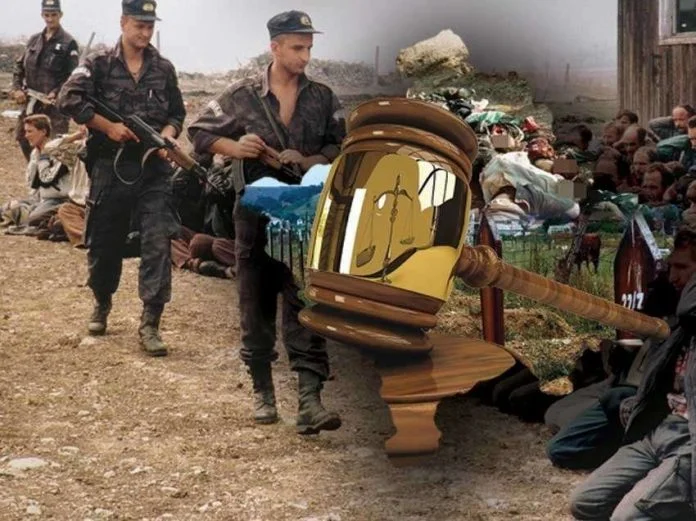
From the series of DWs a look at war crimes and penalties: U n The NMIC, EULEX and Kosovo institutions have filed dozens of war crimes cases, but the sentences have had very little. Why?
He who experiences a war changes his life forever. More than 21 years have passed since the Kosovo war, but the consequences are still present. In people's lives, the pain she left for her family but also the widespread destruction. There are still many open questions about wartime in Kosovo. A Deutsche Welle series is devoted to just these open questions to finding an answer by experts and studies on war crimes, the current sentences, sexual violations, mass graveyards and property destruction. Bekim Shehu continues with a summary of Kosovo war crimes sentences.
Kosovo's “War Crimes Unit” is entitled a research in which details are revealed about Kosovo's war crimes processes and judgments. The research released by the Kosovo Institute for Justice (IKD) includes three periods, the post-war one when Kosovo was administered overall by the UN mission (UNMIK) by 2008, the period of the EU mission (EULEX), when competencies in justice had this mission entirely, as well as the period following the acquisition of competencies by Kosovo institutions.
October 1999 until June 2020, “has been sentenced by UNMIK judges, EULEX and locals, with a formal act of 40 persons. Of them 35 are Albanians and four Serbs”, the research says. Executive Director of Institute I KD, Ehat Miftaraj, explains about Deutsche Welle running these processes.
The 2000 “by 2008, U n The NIMK has been the authority to address war crimes cases. This mission has filed charges against 3 Serbs, 19 Albanians and a Montenegrin”. But for all these occasions the mission UNMIK has sentenced only one person for war crimes, an Albanian accused. After the UNMIK mission was completed, responsibilities in this area have been transferred to the European Union mission (EULEX), which has operated from 2009 to 2018. But this mission had executive competence until 2014.
EULEX during this period has filed war crimes charges against 11 Serbs, 39 Albanians, a Montenegrin and a community person RAE. While after passing competencies to Kosovo authorities in 2014, Kosovo's Special Prosecutor has filed a war crimes indictment against 39 people by June 2020. But no person has been sentenced to firm decision until today. If we look at these statistics, it turns out that 70% of persons indicted and tried for war crimes are Kosovo Albanians, 20% are Serbs and 10% of other ethnic groups”, Ehat Miftaraj explains.
The Amnesty of Criminals
In research “War Crimes Unit in Kosovo”, it is found that both international missions have not exercised their responsibilities enough in prosecuting persons suspected of war crimes. Ehat Miftaraj says, these missions seem to have wanted to preserve the status quo “, which has damaged justice.
“These two missions have apparently had the idea of preserving the status quo, even through non-action or non-investigation of war crimes in Kosovo, in a way, to achieve a reconciliation between the Serbian and Albanian sides. Adding to this is the fact that in the last war we have had at least 13 thousand Albanian and others, war crimes that have been linked to ethnic cleansing and other criminal acts, and ultimately it turns out we have only one person convicted of war crimes, then we can freely say that these two missions have offered full amnesty to those who committed war crimes”, Miftaraj says.
The same logic is said to have followed Kosovo's institutions after assuming responsibilities from international missions. No government and no institutions have had in place the treatment of war crimes”, Miftaraj claims.
Experiences of Other States
The other former Yugoslav states have faced the same problems: Serbia, Croatia and Bosnia and Herzegovina. But they have drafted and adopted strategies at the level of governments or states and shared financial means to investigate, prosecute and try war crimes indictees in their territories. On the other hand, Kosovo has neglected this issue entirely”, Ehat Miftaraj says. He takes for example Croatia, which, after the war within three years, has investigated, prosecuted and sentenced approximately 1,000 people who have committed war crimes.
A similar research “following Kosovo's War Crimes Trial in the 1999-2018x2>, from monitoring almost all war crimes trials in Kosovo, has also made the Humanistic Law Fund (FDH). Project co-ordinator Anka Kurteshi Hajdari says the main problem for such a small number of engagements is witnesses who either forgot what happened or did not want to testify. But the big problem is also the lack of co-operation between Kosovo and Serbia, as well as the lack of prosecutors dealing with these” subjects.
Lacks of the Justice System
Even now we have a situation when only one or two prosecutors deal with war crimes, which is not enough. The reason is because witnesses are being reduced. People are dying while investigations are getting harder over the course of”, Hajdari says. Kosovo still has no legal rules for judgments in the absence of war crimes. This presents an additional challenge in prosecuting war crimes suspects who are located outside Kosovo. Long ago, mission chief E ULEX, Lars-Gunnar Wigemark, has said that “a change of this law would be welcome”.
“Project Code of Criminal Procedure”, under which the issue of trial in absentia is still under consideration at the Justice Ministry Legal Department. It is said to be in the final phase of the review, but has not yet been approved in the Parliament. A provision regulating judgment in absentia has been added to the Criminal Procedure Code in May of last year, but it has not been implemented so far.
UNMIK Centre
The special prosecutor of the Republic of Kosovo states that the reason is, “is needed to meet the conditions, which in practice can hardly be realised as defined, in cases where the person required is found in Serbia”. In June 2020, the Venice Commission has issued an opinion regarding Kosovo's law of indiscriminate judgment, which states that “according to standards and international law on humanitarian law, judgment in absentia in itself is not considered incompatible with the right to a fair trial”. But as mission chief E explained ULEX, Lars-Gunnar Wigemark, “this kind of judgment is allowed only under separate circumstances, and provided effective procedure protection measures are provided for defendants”.
Witness Defense
Another problematic issue, related to war crimes in Kosovo, is witness protection. The witness's uncertainty is said to be the reason for the establishment of special court headquarters in The Hague. IKD Executive Director Ehat Miftaraj criticises international missions and local institutions for this. Kosovo today has the programme for witness protection and witness protection. But this commission has not had any protected witnesses in treatment so far, proving that Kosovo has systematic problems and lack of courage to investigate the high profile of crime suspects. The failure of witness protection has existed even at the time of UNMIK and EULEX, and has continued as it appears with the Special Court, against its headquarters being placed at The Hague”, Miftaraj says.
Special Court Work Begins
Specialised rooms have already begun court processes against former Kosovo President Hashim Thaci and other former KLA leaders. They are accused of war crimes and crimes against humanity. In Kosovo an internal debate is under way whether the Special Court, headquartered in The Hague, is <x0-entity”, because it will address only the Council of Europe Report claims compiled by Senator Dick Marty. In this report, he mentions only former KLA members.
With this debate “if the Special Court is an ethnic”, the director of the Humanitarian Law Fund in Kosovo, Bekim Blakaj, does not agree. He told DW: “I don't believe that justice should be treated that way, so that it can be said that the crimes committed by Serbs must first be tried, and then Albanians. The important thing is for justice to do its job and be tried by all who committed crimes. The Special Court does not prevent Kosovo and Serbian courts from continuing with judgments on their competencies. I think that the political class and civil society have had to spend this energy on this debate, direct it towards co-operation between the Kosovo prosecutors and Serbia, and prosecute those who committed war crimes, whether by the Serb side, who certainly committed more crimes or by the Albanian side, if there are cases of persons who committed crimes. All those who committed crimes, where there is evidence”, Blakaj says.
So does Ehat Miftaraj. “Special Court, can be one-ethnic and can only judge war crimes allegedly committed by KLA members. But the Republic of Kosovo has a mandate, has competencies, has responsibilities and obligation to investigate all war crimes in Kosovo. Opinion, politicians and those who are in The Hague today must understand that Kosovo must have the will to investigate, prosecute and judge those who committed crimes in Kosovo, regardless of which ethnic group belongs to”, Miftaraj says.
At the end of his mission, the International Tribunal for War Crimes in the former Yugoslavia has recommended that the countries of the former Yugoslavia, including Kosovo, investigate and deal with the crimes committed on the territory of these countries. / DW