 5 hours ago
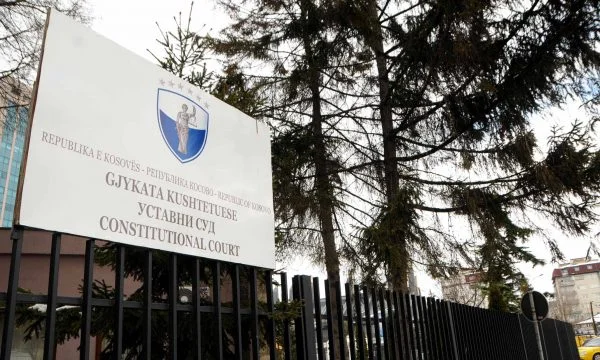
Constitutional Releases Full Court of Government Dejection Hoti
Periskopi(5 years ago)
(5 years ago)The Constitutional Court has published the full conviction about MP Etem Arifi's case. The Constitution has found that the person convicted of criminal offence with a firm form judicial decision in the past three years can neither be a candidate for MP nor win a valid mandate in the Assembly. And [...]
The Constitution has found that the person convicted of criminal offence with a firm form judicial decision in the past three years can neither be a candidate for MP nor win a valid mandate in the Assembly.
It has also been found that the selection of the Hoti Government on June 3rd is in accordance with the Constitution of Kosovo and demanding that the president announce elections, which should be held no later than 40 days from the day of their proclamation.
The bias has a backward effect.
Hoti government remains in office.
Insulting, Libun Aliu and 16 other deputies of the Republic of Kosovo Parliament, assess the constitutionality of the Republic of Kosovo's decision no. 07/V-014, June 3, 2020, for the Kosovo Republic Government Election
KO95/20, Act passed on December 21, 2020, published on January 6, 2021
Key words: institutional requirement, loss of mandate, criminal acts, majority of all MPs, acceptable request
The request was based on Article 5 - 113 [Juridication and Authorised Palaces], of the Constitution, articles 42 [Supporting Request] and 43 [Aphats], of the Law for Constitutional Court of the Republic of Kosovo, No. 03 L-121, as well as rule 74 [Asking in agreement with Article 113. 5 of the Constitution and Article 42 and 43 of the Law, of the Constitutional Court of the Republic of Kosovo's work. The subject of the issue of application was the assessment of the constitutionality of the Republic of Kosovo's decision no. 07/V-014, of June 3, 2020, for the Government of the Republic of Kosovo's Election, with which pre-advisors claimed that it is not in compliance with Article 95's paragraph 3, [the Government's election], with regard to subparography 6 of Article 3 Article 70, of the Constitution.
In the title "FUNDAY of this Act, the Court summarized the case's essence and pointed out the following:
With March 28th and August 20th 2019, Etem Arifi was sentenced to the court's fair form of Appeals Act, to one year and three months in prison. On October 6, 2019, early elections were held for the Republic of Kosovo Assembly. Etem Arifi ran and was elected deputy of the Republic of Kosovo Assembly. On November 27, 2019, The CEC certified the election outcome and on the list of certified deputies was Eemem Arifi. On December 26, 2o19, the Convention Constituent Meeting was held where Etem Arifi's mandate was confirmed. Ever since, Etem Arifi continued to exercise the MP's office, even though he was facing a court sentence of formal form for a criminal offence, one year and three months in prison.
In this constitutional requirement, 17 deputies of the Republic of Kosovo Assembly rejected the constitutionality of the Republic of Kosovo's decision no. 07/V-014, for electing the government, released on 3 June 2020. Predators claim that the verdict in question is contrary to the Constitution, respectively, with Article 95 [the Government's election] paragraph 6 of Article 70 [Democrat's mandate] Article 70. That is because, according to the forgers, in the procedure of voting the controversial verdict, Etem Arifi, whose vote was invalid due to his sentence of one year and three months in prison, had court rulings of formal form.
The court estimates that the fundamental issue involving this requirement is whether Etem Arifi had a valid mandate at the time of bringing the verdict against the government's election (in whose vote he attended).
In this regard, the Court took into account: the answers delivered by the member states of the Venice Commission Forum, the Venice Commission's positions; and the previous practice of the Republic of Kosovo Assembly for similar situations.
As for the constitutional and legal provisions in the Republic of Kosovo, which give answers to cases raised by this request, the Court found that:
Article 71.1 of the Constitution, in connection with Article 29.1] of the Law on the General Elections, stipulates that no person can be a candidate for the Parliamentary Elections if he has been convicted of criminal action with a firm form ruling in the last three years;
Article3 (6) of the Constitution stipulates that the MP's mandate ends or becomes invalid if he/she is sentenced to court decision of formal form, one or more years in prison. This constitutional definition is also reinforced with Article 8,1.6 of the MP's Law for Rights and Responsibilities, Article 112.1.A. of the General Election Law, as well as Article 25.1.d of the Assembly Rule;
The court considers that, in terms of the right to run parliamentary elections, articles 45, 55 and 71.1 of the Constitution must be read interlockably. Thus, Article 45 of the Constitution generally speaks of electoral rights, generally determining that they can be limited to judicial decisions, while Article 55 determines the quantum conditions under which human rights guaranteed by the Constitution can be limited. While Article 71 of the Constitution, which speaks exclusively of “qualifications” to run for Parliamentary MP ʹ stipulates that each citizen of the Republic of Kosovo, who is eighteen years old or older, and meets the legal criteria, could be a candidate for MP. These “legal criteria”, referred to as Article 71 of the Constitution, define the Law for General Elections, which in Article 29.1 (q) clearly and explicitly emphasises that no person can be a candidate for parliamentary elections if convicted of criminal action with judicial decision of form cut in the last three years. This constitutional and legal definition is in line with the practice followed by many democratic countries, as noted by the Venice Commission's relevant documents as well as the responses of the Venice Commission Forum member states.
The court stresses that the above constitutional and legal norms, which concern inadequacy (inadequacy) to run for MP in general elections, as well as the end or inadequacy of the MP's mandate, as a result of the prison sentence for committing criminal acts, should not be viewed as purpose in itself. In essence, these standards are not primarily aimed at punishing certain individuals by trying them to exercise the MP's office, but they are fundamentally aimed at protecting constitutional integrity and civic credibility in the legal body as the pillar of parliamentary democracy.
The court considers that civic credibility in the Assembly of the Republic of Kosovo is violated whether, despite the stops that Article 71 of the Constitution puts in touch with Article 29.1 (q) of the Law on General Elections ) is allowed for the MP's mandate to win and exercise a person who has been convicted of criminal work, with judicial decision of the valid form in the Republic of Kosovo.
In this regard, the Court brings attention to the Venice Commission's report, which stresses that “legality is an element of the rule of Law and implies that the law should be respected by individuals and authorities. The exercise of political office by those who have seriously violated the law puts at risk the implementation of this principle [the rule of law], which is one of the preconditions of democracy, and therefore jeopardises the democratic nature of the state”. (See the Venice Commission's Report on Disfellowshipping Chiefs of Illegal Acts by Parliament, CDL-ADO2015)036, November 23, 2018, paragraph 168.
In that spirit, the Court estimates that it is the clear constitutional requirement embedded in Article 71.1 in connection with Article 70.3 (6) of the Constitution, that it is incompatible with the Constitution for a person to gain and retain the MP's mandate if he is convicted of criminal acts, with judicial decision of formal form, as defined by these provisions. This requirement is reinforced with articles 29 and 112 of the Law for General Elections, as well as Article 8.1.6 of the Law on Rights and MP responsible.
Furthermore, the Court points out that Article 70.3 (6) of the Constitution, Article 8.1.6 of the MP's Law for Rights and Responsibilities and Article 112.1 (a) of the General Election Law refers to the sentence of MP (for sentence after it has won the mandate), is a reflection of the promise that Article 29.1q) of the Law on the General Elections, which relies on Article 71.1 of the Constitution, does not allow a person sentenced to prison during the last three years before the elections to run for the deputy's term and won the mandate.
Consequently, based on the clear language of Article 71.1 of the Constitution in interconnection to Article 29.1 (q) of the General Election Law, as well as the subparagraph 6 of paragraph 3 of Article 70 of the Constitution, the Court considers that no person can win and hold the MP's valid mandate if he is condemned for criminal acts like these provisions, with judicial decision of cut form, if there is a condemnation that is in power in the Republic of Kosovo.
The court notes the CEC's clarification that according to the AA Act. -Uzh.nr.16/2017, of September 19, 2017 of the Supreme Court, <x0 Groups cannot be denied the right to race in the elections, if such a right was not taken by judicial ruling, which means, that the candidate should, by decision of form, be convicted, and the court, have pronounced the complete “rule of law to be elected”.
However, the Court considers that the Law for General Elections does not require that persons convicted of criminal acts be pronounced necessarily as a supplementary punishment “lifting the right to elect” so they are not allowed to run in parliamentary elections. This is because, according to Article 29.1 of the Law on General Elections, among other things, comes forward these two grounds: (i) lifting the right to be a candidate in the election with the decision of PZAP and the court; and (ii) the inability to be a candidate because of a criminal offence with a final court ruling in the last three years. These are different/separated bases that cause inadequacy/inadequacy to be candidate. The court feels that this interpretation is compatible with the related reading of nines 45, 55 and 71 of the Constitution.
The court considers it important to note that the run-up to parliamentary elections of Etem Arifi, his election as MP and the exercise of the MP's mandate all these after he was sentenced to one year and three months in prison, with the judicial decision of the strict form ʹ disfigure the uncertainty of norms and serious shortcomings in the institutional mechanisms of the Republic of Kosovo, which are competent to ensure the legitimacy and constitutional integrity of the election processes and parliamentary activities. This uncertainty is also evident in the answers given by the respective Assembly troops and the CEC.
In this regard, the Court points to the need for the Assembly of the Republic of Kosovo to co-operate with its responsible institutions, including the CEC and the CEC, to clarify and consolidate inter-institute co-operation and norms related to running in parliamentary elections and exercising the MP's mandate, on the part of persons convicted of criminal acts.
This is necessary to avoid paradoxical situations, from a constitutional point of view, where a person, after being sentenced to judicial decision of form cut as envisioned with relevant provisions of the Constitution and laws, is allowed to run in parliamentary elections, elect MP, verify the mandate, and continue to exercise the MP's post in the Parliament of the Republic of Kosovo, even during the suffering of prison sentences. While the Constitution and relevant laws place clear norms of not allowing persons sentenced to prison for committing criminal acts to elect MPs and exercise the MP's mandate.
As for the government's election, the Court stresses that in order for the Government to be elected, confirming paragraph 3 of Article 95 of the Constitution, “for” Government should vote at least sixty-one (61) deputies of the Parliament. In the concrete case, according to official document from the Parliament, the Court notes that on June 3, 2020, sixty-one (61) MPs had voted “for” Government, responsible for the controversial decision. In favor of the controversial decision, Etem Arifi had also voted. After the court found that Etem Arifi's term had been invalid before the contested verdict vote, that decision had received only sixty (60) valid votes. As a result, the procedure to elect Government has not been developed in line with Article 95 [The Government's election] of the Constitution, because the government has not received the majority of votes of all MPs in the Republic of Kosovo Assembly.
The court points out that Article 95 of the Constitution, as interpreted through its judicial practice, envisions two attempts to elect Government from the Parliament. In both cases, the Government to be considered elected should hold the majority of votes of all Parliament deputies, respectively, sixty-one (61) votes. If not after the second attempt the government is not elected, Article 95.4 The Constitution envisions the election declaration on the part of the president of the Republic of Kosovo.
The court recalls that the government voted through ruling No. 07/V-014 of the Parliament, June 3, 2020, is based on President No. 24/20, dated April 30, 2020, released based on Article 95 of the Constitution, in the second attempt at electing the Government, respectively. In this regard, the Court recalls the interpretation given at the Ko72/20 Act, where it stressed that <x0-elections would be inevitable in the event of the government's failure to elect even in the second attempt, [...] with cerrast, based on paragraph 4 of Article 95 of the Constitution, the president declares the elections, which should be held no later than 40 days from the day of their proclamation<x1.
In light of this, the Court stresses that in concrete cases, paragraph 4 of Article 95 of the Constitution is put in motion, under which the president of the Republic of Kosovo declares elections, which should be held no later than 40 (40) days from the day of their proclamation.
The court considers it important to stress that it is aware that Etem Arifi has participated in other voting procedures in the Assembly, even as he did not have a valid mandate. However, based on the principle not ultra Pettita (“beyond demand”, the Court is limited to assessing the constitutionality of the act disputed with the request filed before it, or decision No. 07/V-014 of the Republic of Kosovo's Parliament, in terms of the Government of the Republic of Kosovo election.
The court finds it necessary also to clarify that, given the principle of judicial security, as well as the fact that this Act cannot have a backbreaking effect, the decisions of the current government remain in force, and the Government remains in office until the election of the new government











