5 hours ago
Weiman's History and Wealth
Periskopi(6 years ago)
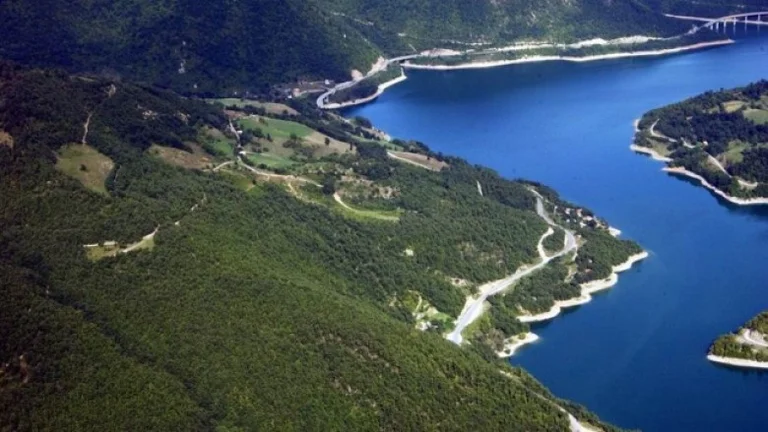
(6 years ago)With an estimated 400 million cubic metres of water, Weiman is the largest artificial lake in Kosovo, flowing from the Iber River, whose source is in Montenegro. The lake lies in the northern part of the country, most precisely in Zubin Potok, and is also on the border line with Serbia. As a project of [...]
With an estimated 400 million cubic metres of water, Weiman is the largest artificial lake in Kosovo, flowing from the Iber River, whose source is in Montenegro.
The lake lies in the northern part of the country, most precisely in Zubin Potok, and is also on the border line with Serbia.
The World Bank's project started its construction in the 70th year under the Autonomous District of Kosovo.
The manager of this project at the time, Avdi Gjonbalaj, tells of TIME that Wyman was built for the needs of Kosovo citizens.
According to Gjonbalaj, a special law for this natural resource was issued at the time, based on the laws of the former Yugoslavia.
This is confirmed by a World Bank audit report in May 1986.
Subtitles: - The YU, signed on June 30th 1971, is the first effort in Yugoslavia to ensure a comprehensive development of water resources for a whole region. The region in question, the province of Kosovo, is Yugoslavia's least developed region with average per capita income only one-third of the national average... However, expansion of industry and agriculture was limited by water shortages; and a master plan was prepared to use the two major rivers in Kosovo, Ibrin and Lepencin, to provide water for industry, municipalities, irrigation and generation of hydro plants”, it said, in part.
The report away explains the whole plan for Weiman and its composition.
It says that the main purpose of this water plant is to provide industrial use water in Kosovo's Autonomous Wing by 1995, as well as to water over 21,000 hectares of agricultural land.
The additional benefits of the project include providing an adequate drinking water source for several communities, improving public health in the region, protecting from floods in the Ibër Valley on the lower course of the Gazivod Dam and producing energy. The project's main physical components include two dams, a 34-megawatt hydropower plant, 135km of main water pipelines, two pump stations, a irrigation scheme and the 21,000-h courses and the corresponding supply routes”, the report said.
The integration of this million project has made the hydroeconomic company “Iber Lepenci” that even now manages with Wyman.
Abazi Deme, who is technical director at the company, shows that Weiman is a source of water for a considerable part of the country's territory.
For a long time, it is also being discussed about ownership of this lake, as Serbia claims Weiman belongs to it, since it does not even recognise Kosovo citizenship.
According to Abbas, however, there is documentation that proves otherwise.
On 4 September in Washington, Kosovo Prime Minister Avdullah Hoti and Serbian President Aleksandar Vuciq, with US mediators, signed agreements concerning even Wyman, in which a feasibility study is said to be conducted with the aim of joint use of the lake.
This study will be conducted by the US Department of State for Energy in collaboration with other US government entities.
This initiative is being welcomed by the Institute for Development Policy, as according to them, this research can tell about Wyman's real potential.
However, Dardan Abazi from INDEP adds that no other natural resources in Kosovo can be provided in the exploitation.
Meanwhile, any interference by Serbia in the flow of the Iber River, which is the source of Wyman, is seen as violating international water laws.
Fitim Humolli, who is legalising economic geography, says Wejman is Kosovo's only resource.
Weiman also makes up 33% of the source for renewable energy production.