 7 hours ago
Serbia expands co-operation with Huawei despite Washington agreement
Periskopi(6 years ago)
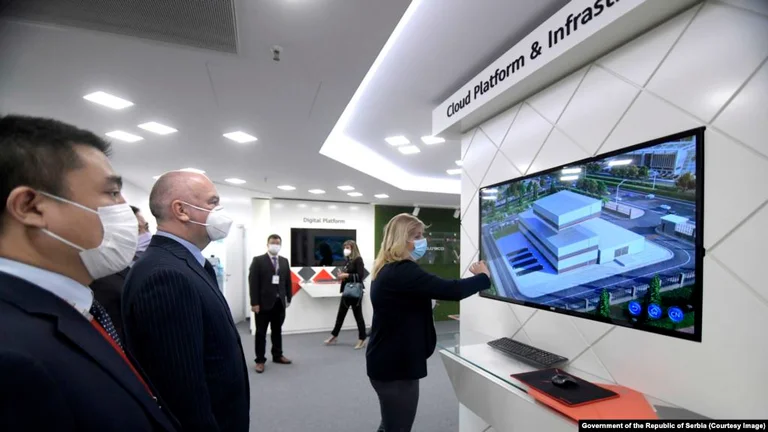
(6 years ago)Serbia has intensified co-operation with Chinese technology company Huawei through the opening of the Centre for Development and Inovation in Belgrade on September 14th. Its opening took place ten days after the signing of the agreement in Washington, on the part of Serbia's president, Aleksandar Vuciq, under which the use of the 5G network is prohibited, of [...]
Its opening took place ten days after the signing of the agreement in Washington, on the part of Serbia's president, Aleksandar Vuciq, under which the use of the 5G network, provided by unreliable vendors, is prohibited.
Although Huawei is not mentioned in the agreement, it is this very Chinese company that is located under United States observation. Washington is urging its allies to avoid this company, as American officials believe the Chinese government can use its technology to spy on Western countries.
“The Agreement has not discouraged Serbia much from continuing co-operation with Huawein”, an associate in the Belgrade Fund for Political Excellence (BFPI)'s programme told Radio Free Europe. He is one of the authors of a publication on China's co-operation with Central and Eastern European countries.
“Formulation flexible” of the agreement
Serbia's Prime Minister Anna Brnabyq attended the opening of Huawei's Belgrade Centre. She said she has talked with Chinese partners about the agreement signed on September 4th at the White House, on the part of President Vuciq and Kosovo Prime Minister Avdullah Hoti, in the presence of US President Donald Trump.
Under the deal, Kosovo and Serbia “will ban the use of the 5G network within their infrastructure, from unreliable clients”. The agreement also says both sides, take over, remove such equipment at the right time and take other necessary steps where they are already present.
“Hawei and we, have fully understood this point of agreement, which means that Serbia should have an open and transparent tender for partners when the time comes for the deployment of the 5G” network, Brnabiq said, answering journalists' questions.
Brnabic added that he has set it as the government's priority to run, the country's digital transformation, saying the Centre for Development and Innovation in Belgrade will have an important role in this regard.
The regional director of the Huawei company, Li Menngqun, at the centre's opening ceremony, said he hopes the Government of Serbia will have equal treatment for business partners.
On the other hand, Vladsavyev told Radio Free Europe that the agreement itself signed in Washington “is very flexiblely formulated” and that it remains to be seen how implementation of the agreement will continue and how it will affect further co-operation between Huawei and Serbia.
The signing of the deal, President Vuciq, in a statement to Radio Television of Serbia on September 10th, said Serbia will respect Washington's agreement and that it “does not say Serbia cannot use Chinese equipment for the 5G network, but cannot use unsafe network equipment 5G “.
We're off the 5G grid, but there's no mention of China”, Vuciq said.
Network 5G and Huawei in Serbia
In Serbia, 5G technology is not yet available for smart phone users, nor are the procedures for issuing licenses for using necessary radio frequencies.
Serbia's Telecommunications Ministry has long told Radio Free Europe that internet construction could begin next year.
The three existing operators in Serbia -- Serbia's state-owned Telekom and private companies Telenor and VIP -- will compete for radio-freeness.
But, even other operators can take part in auctions, Free Europe, Serbian Deputy Minister of Telecommunications Irini Relljin, told Radio earlier.
Just the co-operation of state-owned company Telekom will be interesting, in the context of how and how Serbia will implement Washington's agreement and the part about the 5G network, the expert says, Vladosavev.
“Hawei has no co-operation only with Serbia's Telekom. There are specific co-operations in some respects as well as Telenor. However, the most interesting thing will be monitoring the further way of co-operation between Telekom of Serbia and Huaweit, because Telekom is state property and through Telekom, Serbia's foreign policy” will best be reflected, Vladsavev says.
He stresses that the agreement has no legal power until it is ratified and included in national legislation.
“Beyond some informal statements by Serbian officials in 2019, Chinese companies -- primarily Huawei -- were cited as key collaborators, as key suppliers interested in participating in the construction of the 5G telecommunication network in Serbia”, Vladsavev claims.
Is there transparency in this business?
During the opening of Huawei's centre, Prime Minister Ana Brnabiq said that when it comes to the 5G network, Serbia will respect international standards during the purchase of necessary equipment.
This procurement must be open, transparent and should not be discriminated against any partner. This is not contrary to the agreement signed in Washington”, Brnabiq said.
However, nontransparency is one of the features of doing business on the part of this Chinese company in Serbia, what the foundation “has written about. Share”, a nongovernmental organization for protection of digital rights and freedoms.
Huawei is present in Serbia for more than ten years. This company is familiar with the project “Safed City”, which it is developing in co-operation with Serbia's Ministry of Internal Affairs and including installing 1,000 surveillance cameras equipped with technology for facial recognition at 800 locations.
All data on this project, Serbia's Ministry of Internal Affairs has marked as “Secret”.
“Foundation scholar Share”, Bojan Perkov told Free Europe Radio that the whole story with Huawei cameras is “quite controversial”.
When it comes to a multi-interventional technology, such as facial recognition technology and mass surveillance, and there is no major debate in society if it's really necessary, whether it's the only way to prevent anything or to build security, you get into a serious situation, first because you have no transparency, second because there are some concerns in citizens if someone's spying on us and what will happen with those data<1>, says Perkov, and adds that companies operating in Serbia are forced, without exception, to obey that country's laws.
Authorities Do Not Talk About Revising Co-operation
Serbia's Ministry of Trade, Tourism and Telecommunications told Radio Free Europe that it sees no reason to review co-operation with Chinese company Huawei after the United States imposed sanctions on this company in 2019.
Huawei is one of the greatest producers of smart phones in the world.
State Secretary in the Ministry of Trade, Tourism and Telecommunication Tatjana Matic has said that “Hawei is expanding business in Serbia and the state's stance on this co-operation has not changed”.
“Any company that wants to do business in our country, process and collect data from the citizens of Serbia, preserve it and similar it is obliged to respect the laws of the Republic of Serbia, especially in terms of information safety standards and personal data protection”, says Bojan Perkov of the “Foundation. Share”
This field is regulated through the Law on Information Safety and the Law for Personal Data Protection, which, according to Perkov, is harmonised with European law, and as such, entered into force in August 2019.
“Citizens have a number of other rights that the law allows them for example the right to possess their data mirror, to erase data and similar. Now the question is when you have such an untransparent relationship, what happens with these rights”, Perkov points out.
All Huawei's activities in Serbia
The international organisation Freedom House, which in a report classified Serbia as “hybrid regime”, says placing Huawei's cameras is the most concrete example of China's technological impact in Serbia.
Huawei has a contract with the state phone operator to build an Internet expansion infrastructure.
Serbia also co-operated with Huawei for the opening of the Data Centre in the town of Kraguyevci, which began work in March 2020. At this centre are data from city administrations, public enterprises and institutions, which will be preserved and linked to national databases. As it was announced at the time, China donated $2m to building “data centre”.
Huawei is also a strategic partner of the Government of Serbia within the various municipal services within the “Wise City” project.
In May 2019, US President Donald Trump placed the Chinese company Huawei, in “the blacklist, preventing American companies from using the equipment of this Chinese technological giant, to argue that this endangers national security.
In October of the same year, the US State Department ranked 28 Chinese government security agencies and technology companies specialised in surveillance equipment, accusing them of participating in a campaign of human rights oppression and violations, mainly against the Muslim ouguric minority in China.











