 7 hours ago
The Mystery of 8 Families Who Rule the World
Periskopi(6 years ago)
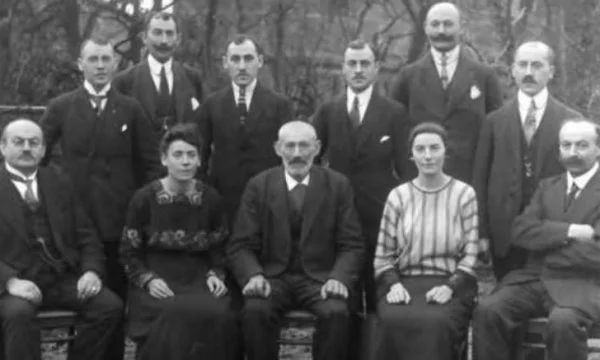
(6 years ago)The Rothschild family (exactly called simply Rothschilds) is an international dynasty in Germany's Jewish - born banking and finance sector, which began operations throughout Europe and received a noble title from Austrian and British governments. The rise of family fame on the international stage began with Mayer Amschel Rothschild (1744-1812), the strategy of [...]
The Rothschild family (exactly called simply Rothschilds) is an international dynasty in Germany's Jewish - born banking and finance sector, which began operations throughout Europe and received a noble title from Austrian and British governments.
The rise of family fame on the international stage began with Mayer Amschel Rothschild (1744-1812), whose strategy for future success was to maintain control of their businesses in the hands of the family, which allowed them to preserve the most secret about their wealth and future achievements in the business field. Mayer Rothschild successfully preserved his wealth within the family through carefully thought - out marriages within members and close family relatives.
Nathan Mayer Rothschild started his London business, “N. M. Rothschild and Sons” in 1811 in New Court, London, which continues to exist in the same land to this day. In 1818 he lent 5 billion pounds to the Prussian government and made bonds for loans Government became the main pillar of his business in the banking field. He achieved such a strong position in the city of London that by 1825-1826, he was already able to offer enough coins to enable him to avoid a liquidity crisis.
Plantagens
In the unclear conclusion between the Plantagenes and the Tudagres, the Plantagens won because most of the development of English culture as well as the political system (remained to this day) started at the very time of their rule. At the time of the Tudors, the Church of England was established, and some say that in their time there has been a golden age, but the importance of the Plantagenet line is much greater (and, among other things, should not be forgotten that Henry too V III was a direct descendant of the mother of the Planagennet family. The House of Plantagens was a Royal House founded by Henry II of England, son of Geoffrey V of Anjou. A prominent English culture and art arose and developed during the era of the Plantagenes, encouraged by some of the monarchs who were the great supporters of “baba of English poetry”, Geoffrey Chaucer. The style of Gothic arcite was very popular during that time, with buildings such as Westminster Abebey and York Minster remodating exactly that style. There were also long - term developments in the social sector, such as the signing of Magna Cartas by John I of England. Political institutions, such as the English Parliament and the Model Parliament, date back to the time of the Plantagens, as do many educational institutions, including Cambridge and Oxford Universities.
The Nehru-Gandhi family
The Nehru-Feroz Gandhi family is an Indian political family that has dominated the National Congress of India during most of India's early independence period. Three members of this family have been prime ministers of India, two of whom (Indira and Rajiv Gandhi have been killed). A fourth family member, Sonia Gandhi is currently president of Congress, while she and Raji's son Rahul Gandhi are the youngest members of the family entering active politics when he competed and later won a seat in India's lower parliament in 2004. The Nehru-Feroz Gandhi family has nothing to do with India's independent leader Mohandas Gandhi.
Khan Family
Ghengis Khan was the founder, Khan (ruler) and Khagan (Perranth) of the Mongolian Empire, the greatest and most solid empire in human history. He came to power by uniting many of Asia's northeastern nomad tribes. After founding the Mongolian empire and being declared “Gengis Khan”, he began Mongol conquests as well as attacks on the areas of Kara-Khiitan Khanate, Caucasus, the Khvarezmid Empire, Western Xia and Jin dynasty. During his lifetime, the Mongol Empire conquered much of Central Asia. Before Gengis Khan died, he appointed Ogedei Khan as his successor and divided his empire into Khanates between sons and grandchildren. Genghis Khan died in 1227 after defeating the Tangus. Khan was buried in an unsigned tomb somewhere in Mongolia in an unknown country. His descendants continued their efforts to extend the Mongol Empire to most of Eurasia by occupying or forming vasal states in areas of modern - day China, Korea, caucasia, Central Asian countries, and much of what is now Eastern Europe and the Middle East.
Claudius and Julius Families
These two families have joined one because they have been the most important families of ancient Rome and they joined together to create the Julius-Claudian dynasty from which most of Rome's most famous emperors have emerged: Caligula, Augustus, Claudius, Tiberius, and Nero. These five emperors ruled the Roman Empire from 27 BC to 68 C.E., when the last of this line, Nero committed suicide. These five rulers were bound through marriage and adoption. Each expanded the territory of the Roman Empire and initiated massive construction projects. They were generally needed by ordinary people, but they opposed the hostility of the senators' class a feeling reflected by ancient historians. Ancient historians describe the Julian-Claudian dynasty as self-extensive, foolish, perverted and tyrannical.
Habsburgs
The House of Habsburg was a very important royal home in Europe, and it is best known as the supplier of the Holy Roman emperors chosen formally between 1452 and 1740, as well as rulers of Spain and the Austrian Empire. Born from Switzerland, the dynasty first reigned in Austria, which it ruled for over six centuries but a series of dynasty marriages brought Burgund, Spain, Bohemia, Hungary, and other territories to its heritage. Dynasty is named after the country of origin, Habsburg Castle, located in the Swiss Canton of Arigau. The motto of the dynasty is: “Let others fight, but you, happy Austria, will marry”, which is also an indication of Habsburg's talent to connect its members to other royal homes in Europe with the purpose of making alliances and inheriting territories. Empress Maria Teresa is known above all in this regard and is sometimes called “The mother of Europe”.
The Ptolemyic Family
The Ptolemic dynasty was a royal family from the Macedonian area of Greece that ruled the Ptolemyic Empire in Egypt for nearly 300 years, from 305 BC to 30 BC. Ptolemy, one of seven bodyguards who served as Macedonian generals and deputy Alexander the Great, was appointed satraps of Egypt after Alexander's death in 323 BC. In 305 BC, he committed himself to King Ptolemy I, later known as “Today” Soon the Egyptians accepted the Ptolemyic family as descendants of the independent Pharaohs of Egypt. Ptolemic fame ruled Egypt until the Roman conquest took place in 30 BC. The most famous part of this line was the last queen, Cleopatra VII, best known for her role during Roman political battle between Julius Caesar and Pompeii, and later between Oktavian and Mark Anton. Its suicide after the Roma occupation also marked the end of the ptolemic rule in Egypt.
The Medici Family
The Medici family was a powerful and influential family in Florence in the period from 13th to the 17th century. Three popes ( Leo X, Clement VII and Leo XI), many rulers of Florence (most prominent was the Great Lawrence, one of the supporters and sponsors of some of the most famous works of Renaissance art), as well as later members of many of the English and French royal families. Like many other gentlemen's families, they dominated their city. They were able to place Florence in the power of their family, creating an environment in which art and humanity flourished. They became leaders of the road to the Renaissance of Italy along with many other large gentlemen in Italy, such as the Visconti and Sporza families in Milan, the Este family in Ferrara, and the Gonzaga family in Mantua. Bank Medici was one of the most successful and respected financial institutions in Europe. According to some estimates, the Medici family has been Europe's richest family for a time. Starting on this basis, they gained political power first in Florence and later more widely in Italy and Europe.











