 5 hours ago
The Kosovo agreement Albania or mini Schengen?
Periskopi(6 years ago)
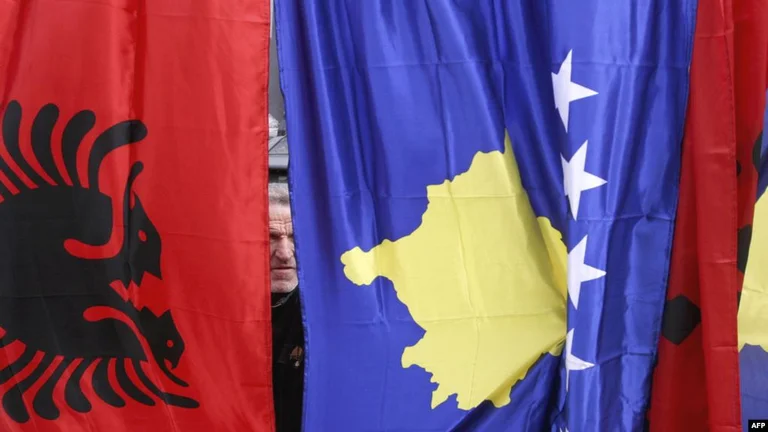
(6 years ago)Kosovo and Albania no longer need to sign co-operation agreements, now when in Washington, Kosovo has agreed to be part of mini-Sengen, says Emir Abrashi, public policy researcher from Democracy Plus. Meanwhile, Astrit Panja from the Kosovo Producer Club says there is no need for new but [...] agreements.
Kosovo and Albania no longer need to sign co-operation agreements, now when in Washington, Kosovo has agreed to be part of mini-Sengen, says Emir Abrashi, public policy researcher from Democracy Plus.
Meanwhile, the Panja Astrit from the Kosovo Producer Club says there is no need for new agreements, but to implement what has been signed so far.
Mini-Shengen, according to them, will have a new form of bilatheral co-operation, regionally.
The Kosovo government and Albania have held joint meetings since 2014, which are consistently promised for bilateral co-operation and signed agreements in various areas.
So far, five joint meetings have been held and over 70 agreements have been signed, ranging from the economy to education. These agreements have aimed at a joint strategic government, in particular eliminating trade barriers between the two states.
Such a meeting of the Government of Kosovo and Albania is expected to be held on 2 October, as Kosovo Prime Minister Avdullah Hoti has announced.
Each year, agreements that were not implemented overall
However, the meeting warned between the two governments is being deemed unnecessary if, as they did at each preliminary meeting, agreements are signed between the two states.
Emir Abrashi, public policy researcher from Democracy Plus, in a proposal for Radio Free Europe says there is no longer a need for a Kosovo agreement, which, he says, had no effect, as they were not implemented.
The Kosovo accords -- Albania -- have become so many tables and meetings of governments, but the results are not being observed. This means that these agreements have also been lost. We have put barriers together, even though there are agreements that all barriers and red tape will be removed, there are failures on both sides to attract foreign direct investment, and it is also evident that there is a lack of law enforcement and law”, Abrashi says.
Serbia and Kosovo, with the agreement on economic normalisation signed on September 4th at the White House in Washington, have agreed to join the mini-Shengen area, declared by Serbia, Albania and Northern Macedonia in October 2019.
Abrashi says the mini-Shengen as such means that barriers should be removed not only between Kosovo and Albania, but with all states that are members of this market.
Many of the agreements signed between Kosovo and Albania have been intended to eliminate barriers between the two states. But in practice, representatives of production businesses say these agreements are not implemented and businesses are the ones who have consistently complained about bureaucratic procedures.
Astrit Panja, executive director at the Kosovo Producers Club, in a conversation for Radio Free Europe, says the two governments should focus on implementing signed agreements and not on new agreements.
We believe regular meetings are important between the two governments, but how productive these governments have been... for years many agreements have been signed, but not implemented in practice. I don't believe that new agreements should be discussed, but accountability should be requested where we are in terms of implementing existing agreements”, Panja says.
He adds they are sceptical whether mini-Shengen will be realised due to problems between Kosovo and Serbia, but in the case of a mini-Shengeni, then agreements will have to be the most of all countries that are part of this initiative.
Panja says all countries that have pledged to implement mini-Shengen must sit down and negotiate the mode and form this process will take.
Kosovo, Albania to empower businesses
Meanwhile, Emir Abrashi from Democracy Plus says that at the upcoming meetings expected to be held between Kosovo and Albania, the two states must support their businesses in order to boost competition under the mini-sengen market, as he says, there is a disproportion between Serbia's economy with that of Kosovo and Albania.
I think it should become a nationwide business-building strategy between the two countries. We have a huge disrepute between the level of imports of Kosovo and Albania. You can imagine what discretion can be created in an open market that includes Serbia, Northern Macedonia, Montenegro and Bosnia and Herzegovina. In this open market, our products can have nonexistence on the market if something doesn't change”, Abrashi says.
The so-called mini-Shengen project, has been praised by field experts that it will enable the mobility of businesses and professionals and help eliminate trade barriers within Western Balkan states. This initiative is aimed at improving regional co-operation.
Trade exchanges between Kosovo and Albania are not at a satisfactory level.
Official data from the Kosovo Statistics Agency for 2019 shows that the value of products imported from Albania to Kosovo totals over 200m euros annually, while the value of Kosovo products exported to Albania is about 70m euros.











