 7 hours ago
Happy Germany that no dirty “agreement was made in Washington
Periskopi(6 years ago)
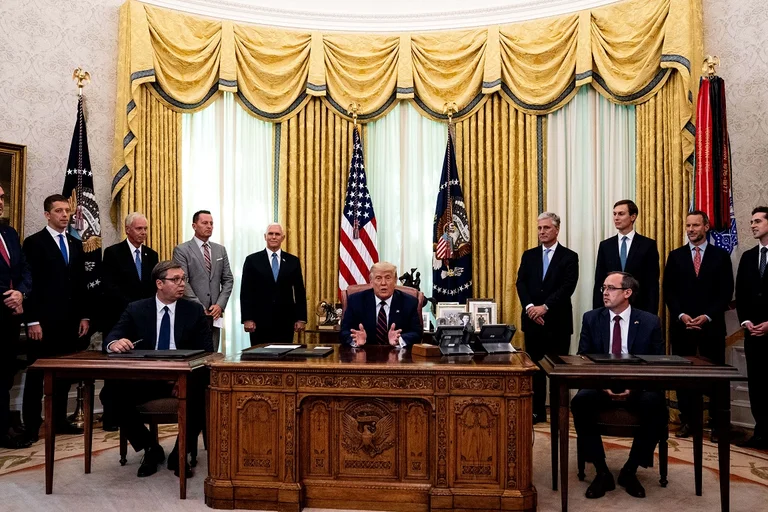
(6 years ago)The lack of German euphoria has to do with the fact, that the deal in the first place was not agreement, said diplomatic circles. The official statement from Berlin on Monday, 07.09.20, in response to a question of Deutsche Welle, at the government's regular conference, could be summed up this way: “
The lack of German euphoria has to do with the fact, that the deal in the first place was not agreement, said diplomatic circles.
The official statement from Berlin on Monday, 07.09.20, in response to a question of Deutsche Welle, at the government's regular conference, could be summed up this way: “we formally welcome all efforts made to improve relations between Serbia and Kosovo, but we especially support mediating efforts of the EU charge, Lajcak.” So, therefore, German Ministry of Foreign Affairs spokesman Christopher Burger, adding: “Agree both the establishment of diplomatic relations between Israel and Kosovo”.
Why the achievement -- that the US president, Trump, followed by leaders in the Balkan region -- calls “historic agreement“ -- was not met with euphoria from Germany -- has little to do with the numerous differences that exist today between the German government and President Trump's administration. Rather, Germany would even rejoice if the United States truly reached some agreement, says a German diplomat in Berlin in a conversation with DW.
Deal or wishful speech?
Germany's joy after the deal was mainly about the fact, that no dirty “agreement was made to the detriment of war victims, with no punishment or amnesty for war criminals still at large. But the chances of this happening, after the act of impeachment to President Thaci, were small.
The lack of German euphoria has to do with the fact, that the deal in the first place was not agreement, said diplomatic circles. This, not only because of the form, as he would claim, Ambassador Wolfgang Ischinger, in a message on Twitter.
The good thing that the United States cares for Kosovo and Serbia, but it is important to note that no agreement has been signed between the parties in Washington, DC, because there is still no mutual recognition. Much work remains for the EU, Miroslav Lajcak and the EU Commission”, writes Security Conference organiser in Munich.
It was also the content, which is seen by field experts in amazement. <x) Because we're dealing with a variety of declarations of purpose. ”
Topical Potpur
Martens is referring here especially to documents signed exclusively by Vucic's Hoti who had nothing to do with the region: the „is not just the point of Israel in the American-Serbian-Kosovo three-point pact that raises the question about the substance of a” agreement, writes Martens. He recalls that Grenelli had earlier stated that his aim in charge of the Serbia-Kosovo dialogue had been the economic approach and improvement of the living of ordinary people, but Martens thinks that <x2) diplomatic relations with Israel almost have no impact on these” them.
Even less are expected to influence for the better the points involving Hisbo God, the shift or deployment of embassies in Jerusalem, the derimitation of homosexuality, the failure to co-operate with China for networks 5 G, etc. Rather, only curbing the economy can be expected from the latter, the author suggests. According to Martens, not even the points on economic co-operation are new, except for access to American instruments of regional economy financing. The rest, they were told before. Martens, in his analysis, concludes that no solution was reached in the Kosovo-Serbia conflict from last week's meeting in Washington.
EU warns
Diplomatic circles from Berlin argue similarly. In addition, what is said in Berlin in an undertone was expressed Monday by EU Commission spokesman for foreign and security issues Peter Stano. There is no EU member state with an embassy in Jerusalem,” saidvStano. “Any diplomatic step that could question the EU's joint position on Jerusalem is a serious concern. ”
But even in the Serbia-Kosovo negotiating plan, observers in Berlin, not only do they not see any progress, but rather, they are disappointed with the point that forces Kosovo to give up for a year from applying to international organisations. This is a setback to the process of recognising Kosovo”, says of the DW, a high-ranking diplomat in Berlin. Germany was the main lobbyist in 2018 to membership Kosovo in Interpol.
Disgruntled are circles from Berlin, even because of Kosovo's introduction to Mini-Schengen. Because it has been the Regional Co-operation Council, the first structure designed specifically for this purpose under the Berlin Process. And there were all Western Balkan countries.
EU Pressure
The large Swiss daily Neue Zürcher Zeitung, in an article by Istanbul correspondent Volker Pabst, also voiced doubts about the effect of this achievement. However, she at least recognises an award to Yerenelli: Which is pressuring the European Union to engage more in this area. The result of this extreme pressure is also the appointment of special employee Lajcak. The agreement signed on Friday is a small step on the long track to resolve major issues, especially that of recognising Kosovo by Serbia”, Pabst finds.
For Germany it is clear that after this meeting, the ball will continue to remain in Brussels. There Hoti, Vucic, Borrell and Lajcak gathered again on Monday and discussed concrete issues such as missing persons, the association of Serb majority municipalities, financial and property issues. None of these topics were touched in Washington documents.
But diplomatic circles from Berlin are also aware that compromises and advances are needed and concessions are needed in enlargement policies. But this is hard to achieve, given that the EU is unable to give Kosovo citizens such an initial right: free movement, and at this point Green and Ischinger agree: “instead of complaining, why don't you give Kosovo's citizens visa liberalisation which you have promised for many years”, applies Green to Ischinger's Twitter criticism. “I strongly agree, visa liberalisation for Kosovo should be given over time. I have been saying” for years, the German diplomat, former negotiators for previous talks between Serbia and Kosovo, is justified.
Ischinger, he's not the only one with that thought. But one of the countries that curb the visa liberalisation process is Germany itself. When this problem is solved, no one can say that.











