 4 hours ago
What is known and what is not about the dialogue in Brussels
Periskopi(6 years ago)
(6 years ago)The practice of nontransparity regarding negotiations between Kosovo and Serbia, within the dialogue in Brussels, is continuing even in the current phase, when the parties have already stressed that on some topics they have harmonised positions, assessed connoisseurs of political developments, Life Krasniqi and Blerim Vela. Dialogue between the sides in Brussels is renewed on 16 [...]
The practice of nontransparity regarding negotiations between Kosovo and Serbia, within the dialogue in Brussels, is continuing even in the current phase, when the parties have already stressed that on some topics they have harmonised positions, assessed connoisseurs of political developments, Life Krasniqi and Blerim Vela.
Dialogue between the parties in Brussels has been renewed on 16 July and is being mediated by the European Union.
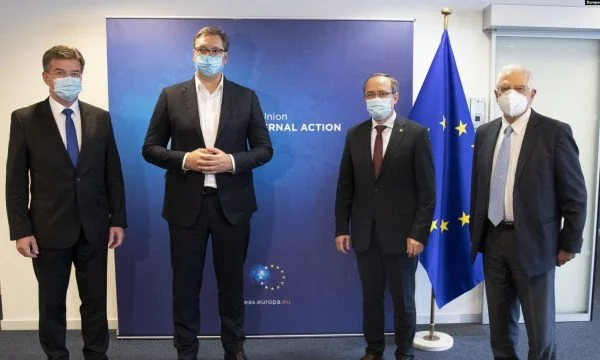
Kosovo Prime Minister Avdullah Hoti and Serbia's president, Aleksandar Vuciq, have met for the second time on 7 September.
In this case, according to statements on both sides, topics have been opened for the Association of Serb majority municipalities, for joint financial and property claims, already harmonised positions concerning the issue of the missing, displaced persons, and economic co-operation.
Kosovo Prime Minister Avdullah Hoti had then stressed that the parties had progressed towards drafting the final agreement between the two countries, with the goal of fully normalising bilateral recognition relations.
Similarly, on 5 September and 6 September, Kosovo and Serbian expert teams, led by Kosovo state co-ordinator for dialogue with Serbia Skender Hyseni and the director of the Government of Serbia's Office for Kosovo, Marko Djuric. It was the fourth consecutive meeting of two delegations at the expert level, where the parties had to approach positions for issues that were opened at the high political level.
Krasniqi: Transparency missing for Brussels negotiations process
Analyst Life Krasniqi from the Kosovo Democratic Institute tells Radio Free Europe that there is always balance between privacy and transparency in the process of negotiations.
According to her, this is also evident in the dialogue taking place in Brussels. But, as she says, in this process, it is not seen what his mediator, Miroslav Lajcak, has spoken about, who has asked both sides to prepare their societies about the agreement.
This is for the reason, according to her, to have citizen information and to build a support for the process.
This citizen support for the process is difficult to achieve when we do not have information about the process in general. Now we're getting information, which is few and we get it when they're not continuous and they're not in a wider frame. Lack of transparency, lack of more regular and conservative information on citizens. This should be changed, since it should not be endangered to reach out to an agreement reached and then it will be difficult to move into the assembly, but it will be difficult to build even broad civic support for its”, Krasniqi said.
Political affairs analyst Blerim Vela, speaking of Radio Free Europe, says the process of dialogue between Kosovo and Serbia in Brussels, since 2015, has been forwarded with nontransparentity.
This practice of total nontransparentity, but also of non-involvement of the assembly in the circles of dialogue, except in the final phase, according to him, is still continuing from the current Kosovo government.
But, as Vela says, the European Union has learned a lesson from such past in Kosovo, when there has been a lot of difficulty in ratifying the demarcation agreement with Montenegro. This means that the assembly and public opinion should be informed early in negotiations so that no major conflicts can be produced within the political scene.
“Now it remains to be seen whether there is only one information that was first made about the structure of the process or that there has been a contextary discussion. However, it is the government's obligation to announce the assembly and public opinion with what is happening in Brussels or Washington. This is distressing, because if it is required to ratify a final agreement in the assembly, the likelihood is that this government does not have the majority enough to do so. Then, there will be consequences for Kosovo, whether as it happened in 2015, a small isolation that happened to Kosovo or even to have repeat scenes that took place in 2015 within the Kosovo Assembly”, Vela stressed.
Bajram Qerkeyni, head of the Association “Parents' office”, the centre of the family of the missing persons in Kosovo, tells Radio Free Europe that despite the interest of the family that represents them, to understand the details that the parties in Brussels have agreed to, especially regarding the subject of the undiscovered, has not received any information from the Government of Kosovo.
Not at all. We don't know anything. Except what we heard in the media. We don't even know anything or say it was someone or anyone who tried to come. We asked questions and wanted to have meetings. We've been told there's no meeting and no word, no one's informed us about what Hoti and Vuchy did. We don't know anything”, Qerkey stressed.
The parties don't offer details
So far, in addition to warning of topics discussed, the opinion in Kosovo is not reported on the details of talks in Brussels.
Kosovo's state co-ordinator for dialogue with Serbia, Skender Hyseni, has told Radio Free Europe that it's a “resolution in the dialogue under way”.
In a question of exactly what the subject “claims common financial and property”, which has been warned, Hyseni has said briefly: “We still haven't started (talking) on this topic”.
On this issue, European Union spokesman Peter Stano, in a written response to Radio Free Europe, has stressed: “We don't provide details for the content of the discussions, while the process is going on --x1>.
It cautions that we refer to the recent statement by EU special representative for dialogue Miroslav Lajcak, in which both sides reportedly have achieved progress in question, but without providing concrete details.
In today's meetings we've talked about economic co-operation, the unconscious and displaced persons these topics that have opened at the last high level (political) meeting. I'm glad that I can declare that we have fully advanced in discussions”, Lajcak said.
He has added that for the first time, as part of negotiations on legally binding comprehensive agreements, the topic has been opened for non-multiful communities and for resolving common financial and property claims.
Our next “meeting will be dedicated to these two” topics, Lajcak ordered.
Vela: Kosovo risks facing act committed
Analyst Krasniqi says the Kosovo dialogue process has not yet reached the point of reaching the final agreement. Therefore, according to her, taking into account past experience when agreements reached with the nontransparament process have faced a problem for ratification in the assembly, as well as for them to gain broad public support, then the government of Kosovo must change its approach.
This process should be built in another format because it's a process that we've seen in the past can't go to the formats where all discussions are made within a narrow circle and are built only by a close circle of people. There should be more involvement, so that (the agreements) are long-term and in order to be applicable. For us, the deal is not important, but that through the agreement we achieve our goals”, Krasniqi stressed.
Analyst Vela, expresses the opinion that the Government of Kosovo, based on the practice to date, is trying to keep all the details of the negotiations in Brussels quietly in the face of opinion, to the achievement of the final agreement, whether the political spectrum and public opinion agree with it or not.
I think that the Government of Kosovo, with this approach, risks establishing itself, but Kosovo, before the act is committed. For themselves, the fact that there is no broad political support on the one hand to push forward the negotiator process effectively, simply, their position in power depends on the negotiating process itself. So, being part of the negotiator process, they continue to be reliefists on stage and remain in power”, Vela said.
Although, initially, in 2011, it was warned that Kosovo and Serbia will have technical dialogue, which will lead the two countries' working groups in late 2012, has launched political dialogue on normalising relations between Kosovo and Serbia.
So far, within this dialogue, 23 agreements have been reached at the technical and political level.
The first agreement, reached in 2011, was for my mother's books and then was signed the freedom of movement agreement.
Other agreements, customs stamps, diplomas acceptance, integrated management of borders, representation and regional co-operation, telecommunications and official visits, energy, judiciary and so forth. But these agreements have not all been implemented on the ground.











