 7 hours ago
Costett: I don't know if Kosovo will establish Association
Periskopi(6 years ago)
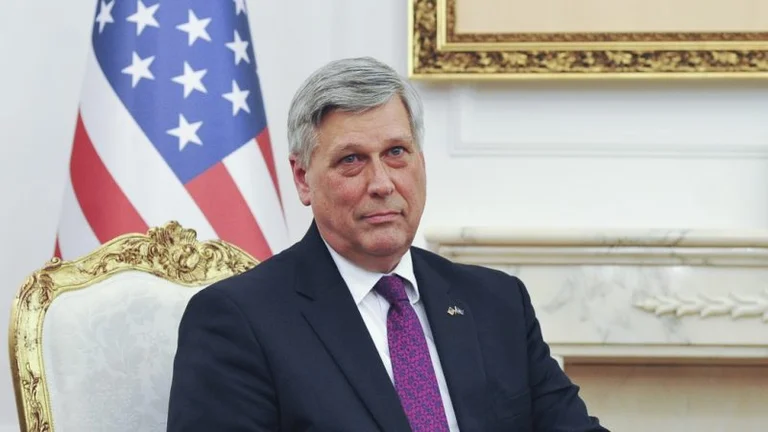
(6 years ago)US Ambassador to Kosovo Philip Costet in an interview for Radio Free Europe said that in order for Kosovo and Serbia to move forward, all should have new access to issues and “to take bold steps to bring about changes”. Not wanting to go into the details of the political process [...]
US Ambassador to Kosovo Philip Costet in an interview for Radio Free Europe said that in order for Kosovo and Serbia to move forward, all should have new access to issues and “to take bold steps to bring about changes”.
Not wanting to enter into the details of the political process in Brussels between Kosovo and Serbia, Kostett said it is impossible to reach an comprehensive agreement without compromises made on all sides.
The United States, according to him, is trying to focus on reachable things instead of processes, regulations and protocols. Kostett said Washington's goal is to encourage a process that will end with full normalisation of relations between the two countries. According to him, efforts to solve political problems have dragged on for years without major progress. So, he said, the US decided to focus on economic issues between the two countries.
Speaking of the agreement reached at the White House on September 4th, Ambassador Costnett said it is the responsibility of the Government of Kosovo and Serbia to adhere to pledges granted in Washington.
Radio Free Europe: Ambassador, Kosovo and Serbia have pledged to the White House for economic normalisation, signing two different documents. But the main issue is mutual recognition. When do you think this is gonna happen?
Philip Costnett: I think it's hard to determine a deadline or a deadline. The aim of the United States is to encourage the process, which will end in full normalisation of relations between the two countries. What US President Donald) Trump wants to do is focus first on economics. Efforts to solve all political problems have lasted for years, without significant progress. So the president said why don't we put this aside and focus first on economic issues that are very important to ordinary citizens of the two countries? ) We think that this is already producing its own outcome, and what we do in economic terms aims to meet and encourage steps that will be taken in a political way. However, I cannot say how long it will actually take up to full political normalisation between Kosovo and Serbia.
“Kosovo and Serbia to fulfil pledges made in Washington”
Radio Free Europe: There is already an agreement on economic normalisation. Who will oversee the implementation of the agreement?
Philip Costnett: It is essential that the Government of Kosovo and Serbia fulfil the promises Washington has made. Of course, the United States is conducting this closely and much of the progress will depend on the role of American businesses and the role of US Government agencies. As you know, a team from the U.S. Government will arrive this evening in Kosovo, led by Ambassador (Richard) Greenell and chief executive from the Financial Development Corporation, along with other US Agency officials. The purpose of this journey will be to move from promises to Washington, turn them into reality and find ways for the American government and American businesses to support Kosovo until Kosovo moves forward. All we can do is support, as is the fight with COVID-19 or the battle for corruption in Kosovo. So it's a big part that Kosovo's friends can make it support. But, in the end, it is up to people and Kosovo leaders to make it (the agreement) work.
“Let's not focus on rules and protocols, but on reachable questions”
Radio Free Europe: Do you see the European Union engaged in implementing this agreement?
Philip Costnett: We think the work done in Washington completes the work that has been done in Brussels by the European Union. There's a disagreement as to what's placed in the agenda, that's for sure. When we talk about the economic development of Kosovo and Serbia, when we talk about strengthening economic co-operation in the region, of course the EU has a role in this and it's something we talk about with them. But what we want to do is not just focus on the process, rules and protocols. But focus on reachable issues.
Radio Free Europe: What if one party does not respect the vow, is there a condemnation or sanction?
.
Philip Costnett: That's a hypothetical question. We will seek responsibility from Kosovo and Serbia for the pledges they have given. We think they're accessible. Attention should not be to talk about sanctions or penalties. I used to focus on the possibilities Washington's deal will bring. We are talking about the possibility of big American investments in Kosovo and Serbia. The commitments Kosovo and Serbian leaders have taken to Washington, combined with efforts to fight corruption and improve the investment climate throughout the region, also aim to attract money from private investors. I think that the more we focus on opportunities in job creation, investment, giving private sector energy in Kosovo and in neighbouring countries, then we'll see more actions than talking about sanctions and penalties. This is not the right way to see these issues.
Radio Free Europe: Given the agreement reached, the two sides will stop using 5G technology equipment by businessmen who are not trusted by the US. Is Huawai a salesperson who doesn't believe in the United States? The issue is very controversial in Serbia, taking into account the ties and co-operation Serbia has with Chinese companies.
Philip Costnett: I am not the US ambassador to Serbia. Therefore, I will not talk about what Serbia's plans are. I know that the Government of Kosovo has made it very clear in the past that it understands American concerns concerning Huawei and will stay outside Huaway or buy any technology related to this company in Kosovo Telecom and that we are satisfied with this decision.
Financing Washington's Projects
Radio Free Europe: Ambassador who will finance projects that the parties agreed on in Washington?
Philip Costnett: I don't think there's a clear answer to that yet. As we have discussed the Financial Development Corporation is seeing (the opportunities) to have a great presence in the region, including Kosovo. Our EXIM bank, Export-Import Bank, will be involved. We also hope there will be investments in the private sector. And of course, European investments, as mentioned earlier, will have a European role in strengthening regional trade and regional infrastructure development between Kosovo and Serbia, as well as among all states of the Western Balkan countries. I think this will be an issue for intensive negotiations in the coming months, but nothing has been decided yet.
Radio Free Europe: Are we talking about loans or donations, financial assistance, when talking about these projects?
Philip Costnett: I think we're talking about all forms of funding; loans, loan guarantees, private sector investments. It will all be clearer in the coming weeks and months.
Radio Free Europe: How much is Kosovo willing to host American investors?
Philip Costnett: I think if you talk to American investors, and I do this all the time, including the Kosovo diaspora in the US, but other companies, are aware of the possibilities in Kosovo and the priorities in Kosovo. For example, Kosovo has a very new and very skilled working population. I originally lived in Kosovo in 2003, and when I returned two years ago, I was surprised by the people I met here. They are very young, very educated, who speak several languages, trained for many things. People who can make this country another Israel, another Singapore, an oasis of technology developed in the region. So good opportunities that American companies see.
We believe that improving relations between Kosovo and its neighbours, in particular with Serbia, as well as overcoming deeply entrenched culture of corruption and nepotism in Kosovo, are important to improve the atmosphere for foreign investment. And to be honest, when I talk to foreign investors, the first question they have is we can trust the justice system? Are Courts Honest? If we have a dispute with a local partner, for example, would we have a fair trial? ) And I can't give them an enthusiastic answer as I wish. This is one of the reasons the United States through the Department of Justice, the Agency for International Development in the State Department, has been working for years to strengthen the justice system in Kosovo.
“Fissibility in Weyman, sʹe questions sovereignty”
Radio Free Europe: Ambassador, let's go back to the arrangements reached at the White House. One of the points that has sparked discontent in Kosovo, mainly among opposition parties, concerns the study of feasibility and the shared use of Weyman Lake. Do you believe Serbia has its share?
Philip Costnett: We believe it's very easy to tell them things, and it's much harder to say yes or maybe, let's take a look at them. We've been trying to explain that our aim is to have a power department team to conduct feasibility research about using the lake for sustainable energy and water supply. Stable energy and water supplies are major problems for Kosovo as well as neighbouring countries. I'm aware of history and I'm aware of why some people have said that this is the first step that questions sovereignty and control. Again, it's very easy to say, "No, we won't make the brave decision." Our attitude is to make better use of the lake through feasibility, which does not question sovereignty, that does not move any government to take specific steps.
This is a great effort to create economic relations in the region, which Kosovo residents and their neighbours need in order to move forward. Let me make this clear. In the past 20 years, a culture has developed in Kosovo, where many people, political field or related to the political spectrum, even many ordinary citizens, have come up with the idea that the United States, the European Union or others will continue to offer great economic assistance to Kosovo.
I have to say that our economic assistance is designed to be temporary, to be transitional. For example, in the agriculture sector, we don't just share cash available to farmers, but the U.S. Agency for International Development (USAID) has spent millions trying to modernise the agriculture sector here, help farmers increase the profit chain and make it easier for products.
We have invested in the education sector. We want to believe that our assistance in the education sector during the pandemic has had a significant role and enabled children to learn online. I can continue for many things like this, but the job is that all our efforts here and our European friends' efforts should be over a period. Therefore inevitable, Kosovo will have to take more responsibility for its economic development, and the way to get there is through taking bold steps to create regional economies, empowering the justice system and the private sector, and all of this will then affect attracting foreign investments.
“Should we allow the future to be a hostage to the past”
Once again, all these are related to efforts to improve political and economic ties with Kosovo's neighbours. This has nothing to do with Serbia alone, example, another element of Washington's agreement is the so-called initiative of the Schengen-Shengen. When émini-Sengenni) became a matter, I have heard many friends of mine in Kosovo saying there must be something wrong in it, because Serbia likes this idea, and if Serbia likes it, then it must be harmful to us, or, that this thing recreates the old Yugoslavia. Okay, I understand these concerns. I know a little about the history of this country and I'm not making fun of people who are concerned. I think we should look beyond these concerns and understand how we can build a regional economy, which is good for Kosovo.
See the map, Kosovo's neighbours need Kosovo, as much as Kosovo needs to be part of the regional economy. For example, if we look at the energy infrastructure, the power grid, the construction of pipelines through which sustainable and cheap natural gas would be enabled that could become an important part of the region's energy in the future you cannot achieve if Kosovo is only a black dot in the middle. What I've often told my friends here is that if you don't like the original concept of '%mini-Shengen, the answer shouldn't be ignored, the answer is that you have to go to meetings, offer arguments about your attitude and try to shape the future. This does not mean forgetting the past. It is important for the people of Kosovo to remember the past, it is important for Kosovo and its neighbours to face the bads of the past directly. I never told anybody, forget the past, don't worry about it, but we can't let the future be a hostage to the past.
Costett: With EU partnership, not rivalry
Radio Free Europe: As we talk about political processes between Kosovo and Serbia, is there any joint effort between the United States and the European Union when Brussels' dialogue is at stake? On what level?
Philip Costnett: We are in close contact with our European Union colleagues, here in Belgrade, Brussels, Washington. Ambassador Green speaks to Europeans, Matthews Palmer, who is a special envoy of the U.S. State Department for the Western Balkans, is his job of working with Europeans and others to try to move this thing forward. Palmer was recently in Brussels and met with Mr. Lajcak. Definitely no rivalry, it's partnership.
Establish association ) “
Radio Free Europe: During last week's negotiations in Brussels, at the level of experts, the Serbian side has conditioned the continuation of negotiations with the establishment of the Serb majority municipalities. The Kosovo government, on the other hand, has said that Kosovo will create this association, but after recognition. How did you comment?
Philip Costnett: My comment is that, I believe you should do interviews with the European Union representative here, I think you should talk to the Government of Kosovo and the EU about the details of the discussion in Brussels.
Radio Free Europe: Do you expect Kosovo to create association soon?
Philip Costnett: I can't say anything about this today. I don't know.
Radio Free Europe: Ambassadors, Kosovo leaders have said several times that this country has made enough compromises for the Serb community through the Ahtisaari plan and that it will not do more. But Serbia, on the other hand, seems not to sign the final agreement without getting something in return. How do you see this?
Philip Costnett: Without entering into the details of Ahtisaari's plan or political processes in Brussels, I think it is impossible to reach that a comprehensive agreement, without making compromises on all sides. During my experience as a diplomat, successful agreements do not fully satisfy all sides, everyone believes that he has given up something, or that he has given up a lot. But that is how you reach a successful agreement. Serbs have access to Ahtisaari's plan and what has happened in the past. I think that to get ahead, everyone has to look at things one more time. That doesn't mean that past agreements should be put aside, but it does mean people have to figure out how to get to the point rather than say "no." And that includes Serbia, as this is an area where everyone has to take bold steps to create change.
“The Trump administration is working to bring change to the Balkans”
Radio Free Europe: Back to Washington's agreement, will there be other meetings in Washington, other agreements like that for economic normalisation?
Philip Costnett: I have nothing I can declare now, but I think that Kosovo, Serbia and colleagues in Washington and me are focused on encouraging the implementation of the agreement that was reached in Washington. There's a lot of work to do. It has been very important that Kosovo and Serbia pledge these commitments, but making these commitments from paper to field work, on highways, requires a lot of work and will take time and we won't waste any time on this, so we're working. There are people who thought Washington just wanted to bring some people to Washington for a joint picture, so a beautiful picture of everyone at the White House, which would be like an illusion of progress. That doesn't stand at all.
I think that the fact that we have a delegation arriving in Kosovo today is indifference that we don't just want symbolic, we want actions, we want these pledges to turn into reality and the US will be part of this process.
Radio Free Europe: Is anyone trying to be symbolic?
Philip Costnett: I think it's easy to get into the process. We have consistently said that we want results, as this is our diplomatic approach to the Balkans. It is a fact that the Trump administration has shown more interest in bringing economic development to the Balkans than many other American administrations in many years, whether republic or Democrats. Clearly this segment is the priority of the Trump administration. One thing I can say with full confidence that support for Kosovo and support for close reports between the US and Kosovo is the goal of both parties. Republicans and Democrats care about Kosovo, it's a very close, special report, but the current administration is really working hard to bring about change.
Costett: There are people in Kosovo who don't care about Specialised Chambers
Radio Free Europe: Ambassador, Quinti states have called on the government and opposition to oppose any attempts to discredit the Specialised Chambers and Prosecutor's Office and ensure that the mission of these chambers is in accordance with the Constitution. Is there such movements about the court's position and who do you think is behind it?
Philip Costnett: I think it's clear and it's no secret that there are people in Kosovo who don't care about Special Chambers. They think it is inappropriate to have a court that is focused on crimes that may have been committed, charges of crimes in Kosovo and that there is no broader mandate, including other crimes in the region, crimes for an earlier period during the 1990s. I know that. My government's position is that the Balkans need more justice, not less justice. And the answer is to make sure that the entire national judicial system actively deals with crime, no matter which community the victim belongs to or where the perpetrators come from.
I will say it more directly: there are people who say why there is a court that is focused solely on Albanians, when many Serbs have not faced justice. Again, our view is in the answer that there should be no less justice but more justice. Now, in terms of specific cases that are under way, in Kosovo, as well as in the US, there is the rule of presumption of innocence. We assume that everyone is innocent and deserves to be treated as such, until convicted by the court. So the fact that diskush is ignorant or whether he has an offer of accusation does not mean that they are guilty of nothing. We want the Court to be able to function, and in this direction, we think it's important that each of us give the Court an opportunity to do its job.











