6 hours ago
16 Killed in Fighting Between Armenia and Azerbaijan
Periskopi(6 years ago)
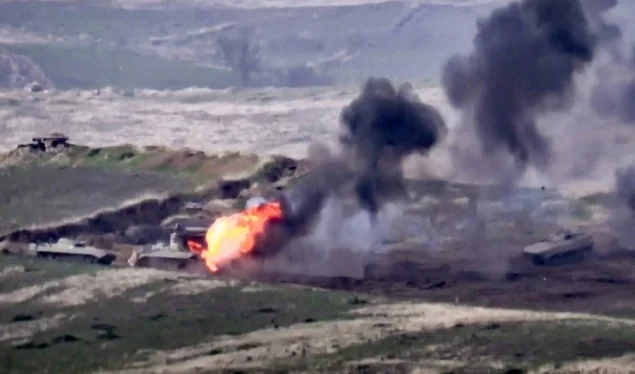
(6 years ago)Wars between Armenia and Azerbaijan have erupted over the separatist Nagorno-Karabakh region, and Armenia's Defence Ministry says two Azerbaijani helicopters have collapsed. Ministry spokesman Shushan Stepanyan also said Armenian forces hit three Azerbaijanian tanks. Armenia also claims that two Azerbaijani helicopters fell and three Azerbaijanian tanks were hit [...]
Ministry spokesman Shushan Stepanyan also said Armenian forces hit three Azerbaijanian tanks.
Armenia also claims that two Azerbaijani helicopters fell and three Azerbaijani tanks were hit by artillery, but the Azerbaijann Defence Ministry rejected that claim.
Heavy combat broke out in the region within Azerbaijan this morning, but has been under the control of Armenian-backed ethnic Armenian forces since 1994, at the end of a separatist war. It was not immediately clear what caused the fighting, the worst since the July clashes killed 16 people on both sides and dozens injured.
Nago-Karabakh authorities reported that the grants hit the capital of Stepanaker's region and the towns of Martakert and Martu. Armenian Defence Ministry spokesman Artsrun Hovanisian also said Azerbaijan's grants hit inside Armenian territory near the city of Vardenis.
Azerbaijani President Ilham Aliyev ordered the establishment of military law in several regions of the country and called for a curfew in major cities.
In a televised address to the nation, Aliyev said that “has losses between the Azerbaijann forces and the civilian population as a result of Armenian shelling”, but did not provide further details. He also claimed that “many enemy military equipment units have been destroyed”.
Albanian Prime Minister Edi Rama, chairman of the Organisation for Security and Co-operation in Europe, called on the parties to stop fighting. Highly unsuccessful territorial status resolution negotiations have been conducted under the auspices of the OSCE.
Armenian Prime Minister Nicholl Pashinian said today the country could reconsider whether it would recognise Nago-Karabakh as independent. Such an action will likely impede further negotiations. The news was sharply received in Turkey, a close ally of Azerbaijan.
Turkey's ruling party spokesman Omer Celik wrote on Twitter: “We strongly condemn Armenia's attack on Azerbaijan. Armenia has once again provoked the law. ”
He promised that Turkey would stay near Azerbaijan and that Armenia is playing with fire and is jeopardising regional peace.
At the Vatican, Pope Francis said today that he was praying for peace between the two countries, urging them to perform concrete actions of goodwill and brotherhood” to achieve a peaceful solution through dialogue.
Nagorno-Karabakh a region about 4,400 square miles [4,400 sq km], roughly the size of the American state of Delaware stretches 50 kilometers from the Armenian border.
The conflict between Armenia and Azerbaijan began in February 1988, when the autonomous region of Nagorno-Karabakh declared the expulsion from Azerbaijan.
During the 1992-1994 conflict, Azerbaijan lost control of Nagorno-Karabakh and seven neighbouring regions. Negotiations on a peaceful solution to the conflict have been under way since 1992 within the OSCE Minsk Group, led by Russia, the United States and France.