a minute ago
“Territorial Exchange is definitely not on the table”
Periskopi(6 years ago)
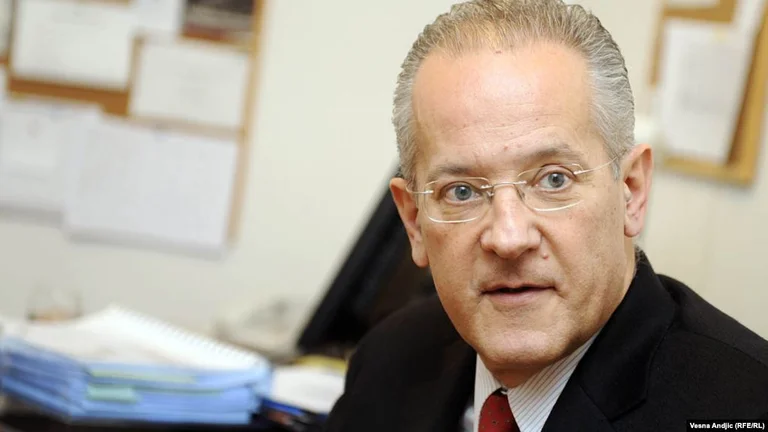
(6 years ago)The possibility of exchange of territories between Belgrade and Pristina is not on the table. It is no longer part of discussions, although it may have been earlier, Ivan Vejvoda, a scientific adviser at the Human Sciences Institute (IWM) in Vienna, said in an interview for Radio Free Europe. Vejvoda, also vice president of [...]
The possibility of exchange of territories between Belgrade and Pristina is not on the table. It is no longer part of discussions, although it may have been earlier, Ivan Vejvoda, a scientific adviser at the Human Sciences Institute (IWM) in Vienna, said in an interview for Radio Free Europe.
Vejvoda, who has also been vice president of US Marshall Fund programmes, says he does not believe the Serbian government and Serbia's president, Aleksandar Vuciq, are ready sign an agreement At this moment, which will include recognising Kosovo's independence.
Radio Free Europe: You have long been in touch with political processes in the Balkans. How do you currently assess the situation in the Balkan countries? I mean, the internal governance of these countries and the reports with the neighbors?
Ivan Vejvoda: The Western Balkan countries have gone into dramatic processes since the collapse of Yugoslavia, which began in the early 1990s. That situation and violence have been defining the political environment for a decade, until the collapse of the regime of (former Yugoslav president Slobodan) Milosevic.
European integration processes began since that period and the situation stabilised and a lasting peace was established. About 30 years after the fall of the Berlin Wall, 20 years after the collapse of the Milosevic regime and 25 years after the Dayton Agreement, the current situation shows that countries of the region are in different stages of European integration, all of which have strategic orientation membership in the European Union, some of which have even become NATO members, such as the case of Albania, Croatia and North Macedonia.
Of course, the situation is also determined by the dramatic financial crisis in 2008, after Bank default “Lehman Brothers” and other dramatic developments with the European-euro currency.
Unfortunately, these developments have made the economic growth situation difficult. Instead of having economic growth of 6 to 7 percent, as we had until 2008-09, the figures marked decline and then governments were unable to fill the pockets of citizens, resulting in economic and social tensions. And last, but not least for the region, is an unresolved issue between Kosovo and Serbia. There have been good periods of reconciliation over the years and certainly there have been bad moments when tensions have increased.
Despite predictions that there could be war again in the Balkans, many of us have said war would never happen again, as it occurred in the 1990s.
Radio Free Europe: In the last period, it appears that only Northern Macedonia has noted progress, both in the internal and external aspect.
On the other hand, we have tense Kosovo-Serbia reports, the difficult functioning of Bosnia as a political entity and tensions between Montenegro and Serbia on the issue of church property. Is there a danger of new conflicts in the Balkans, not war as in the 1990s, but conflicts of lower level?
Ivan Vejvoda: I don't think we're gonna have minor conflicts, but it's not good if there's high-level tension. This would not help economic growth, stability and foreign investment. None of the countries in the region have a capable economy for domestic investment, so we are highly dependent on foreign direct investments that mainly come from Europe and the United States.
Investors are looking for countries in the world where stability and lasting peace exist. The fact that we have, as you said, unresolved issues that could lead to conflicts that I believe will not happen, this situation does not help the overall progress of the region and countries apart.
Radio Free Europe: I want to focus on dialogue between Kosovo and Serbia. How do you evaluate the performance of this dialogue? We had a long break of it, while now it has resumed with the European Union's mediation.
Ivan Vejvoda: As we all know, dialogue began in March 2011. There has been a decline and a rise during this period. The main success, of course, was the April 2013 agreement. And, as we know, NATO gave its support.
The European Union, under which this dialogue is conducted, which is the right way to develop it, because we are on the European continent, and our history and culture are related to Europe, is now, I would say, in the driver's country, with, of course, a very important role played by the United States. The EU and the US have always said they would work together to resolve this crisis. The European Union has clearly said it will not accept new members who have unresolved territorial issues.
They have linked this to Cyprus, saying they will never accept in the bloc a new “Cipro”. I think this has been an overall framework of the geopolitical strategy that has been presented especially to Serbia, which must resolve this issue during its journey towards EU membership.
On the other hand, there has been political instability in Kosovo due to the change of governments, and now we have the return of sides to dialogue. In my opinion, they have realized that it is important to move forward as quickly as possible. Let me say that if we look at the global level, in cases like this of Kosovo and Serbia, of course each has its own specifications, but yet they have some common features.
Both sides now must choose whether they want to become like India and Pakistan, which have an unresolved situation for 70 years. We know how many people have suffered. Or Cyprus, where they have been unable to solve problems for 45 years. It has now been 20 years since the end of the 1999 bombing (by NATO in the former Yugoslavia v.j), and that means that we have already spent enough time with an unresolved situation, which if we return to the social and economic aspect, implies that many investors are not looking at this region because they see an unresolved situation.
I think that if there is a rational approach, the leaders of Pristina and Belgrade would do everything to find a solution and put the point on it so that the region can eventually achieve stability and full peace.
Radio Free Europe: Meanwhile in September, a meeting at the White House is scheduled between the leaders of Kosovo and Serbia. Do you think there might be an important arrangement in this meeting?
Ivan Vejvoda: I think it'll be a step in the right direction. Since the summit's warning, many analysts have said it should not be expected much, as talks will focus economic issues. We should not downplay the importance of negotiations on economic issues, as we all know that the average salary rate in our countries is very low and in the fundamental interest of people is to see their standard increase.
If there are packages that are being prepared as part of the agreement that would lead to stability, which I believe would include the International Monetary Fund, the World Bank, possibly the European Bank for Development and Reconstruction, then this is a positive sign.
I think it's possible that this meeting can offer us such a package, that is, different investment programmes and projects, but, again, let's not hold our breath, we need to see what happens first. Of course, we should also remember that this is a meeting that was supposed to take place earlier, but it was postponed due to the situation that happened with the president, Hashim Thaci.
But I have to repeat that nothing will happen without the Union's united efforts, which is in the leading role and the United States which will be present in reaching a possible agreement.
Radio Free Europe: In Kosovo, they say the final agreement will contain mutual recognition. Do you think Serbia's president, Aleksandar Vuciq, will be willing to sign something like that, and at what cost?
Ivan Vejvoda: I don't think the Serbian government or President Vuciq are willing to sign mutual recognition at this time, yet no one knows what might happen in the future. All he and the Serbian government have said is that they want agreements, but that does not envision recognition of Kosovo.
What I see are steps that lead to greater stability. That's why in the last 15 or 20 years, much has been said about the so-called two German scenarios. To remember the situation with the two Germanys, it has been so that West Germany has agreed that East Germany will become a full member of the United Nations but not knowing its independence.
As for the Serbian side, the key issue may be the guarantee for the security of the Serb community, the Association of Serb Communists and of course the status of the Serbian Orthodox churches in Kosovo. There have been many similar cases in the world, but each has specific elements.
In Europe, we could mention the case of Southern Tirol between Austria and Italy or the previous case of Schleseg-Holstein between Denmark and Germany. Solutions have been found on these territorial issues in the world, but in the case of Kosovo and Serbia, I think the matter of leadership and courage, such as in the case of Northern Macedonia and Greece, we all know how much opposition there has been in these two countries for the kind of agreement that has been reached.
I think that on both sides, Kosovo and Serbia will have objections in particular from nationalist extremists, right radicals, for an agreement that could be proposed. But, the silent majority on both sides, so those people who realize we've reached a point in history when a solution has to be found, in the end, will prevail and most will accept a rational agreement that will come out of negotiations.
Radio Free Europe: A long time has been talked about exchanging territories as part of a solution between the two countries. Then it was said that this issue no longer exists as an option. In your opinion, is this idea still on the table of discussion?
Ivan Vejvoda: I don't think it's on the table of discussion. For the past months, this option no longer exists even if it has been before. Of course, many scenarios have been developed over the past 20 years. This is actually what governments do, from Washington to Berlin, they look at options and see what is possible to implement. So, in my opinion, this idea is definitely off the table, because it's looking at a European solution, where both sides like any compromise would be happy, or partly satisfied. So we're looking at a solution that would actually be acceptable that it would not involve any territorial issue.
This in particular has been a powerful stance that has come from Berlin, and we know that Germany is the key partner of the region in terms of security, economic, political, etc.
The fact that we have France and Germany, German Chancellor Angela Merkel and President Emmanuel Macron, who are personally and seriously committed, respectively, makes me realize that Europe wants to see this element of instability on its territory, which is the situation between Kosovo and Serbia, Finally resolved.
On Serbia's side, we have President Vuciq, who has a clean mandate now and a majority in the country to change the Constitution and go to the referendum.
I think this is an important political element. On the Kosovo side, and you know better, we will see whether the Avdullah Hoti government will be long-lived or there will be new elections. Anyway, I think these 20 years have shown us that if we're so European and we want to live to share values, then now it's time to move forward and come to terms. /Radio EuropeLire/