5 hours ago
Oxford: Kosovo tops European countries' list of measures against COVID-19

Periskopi(6 years ago)
(6 years ago)A research team from Oxford University has studied policies adopted by governments of over 180 countries to address the pandemic caused by the Devov-19 infection, developing an index of response to Ovid-19, based on 17 indicators. Kosovo (the result of 69.44 out of 100) tops the list of European measures, while Belarus [...]
A research team from Oxford University has studied policies adopted by governments of over 180 countries to address the pandemic caused by the Devov-19 infection, developing an index of response to Ovid-19, based on 17 indicators.
Kosovo (the 69.44 out of 100) tops the list of European measures, while Belarus and Georgia are the two countries with the worst score, 8.33 out of 100.
Albania, with a score of 53.7 out of 100 maximum points, ranks ahead of Italy, France, Switzerland, the Netherlands, Austria, Czechia, Poland, Serbia, Croatia, Hungary and Bulgaria and is overcome by Spain, Germany, Great Britain, Ukraine, Belgium, Bosnia and Herzegovina, Greece and Moldova.
Of the European Union countries, Portugal leads with a total score of 66.2 /100, while Estonia and Lithuania are in the last place (19,44 / 100).
Sort based on
Government response
The economic support offered to the population
) public health control and measures
Austerity of Measures
The last parameter specifically shows the severity of government-made measures and aims to promote discussion about the most appropriate measures against the epidemic.
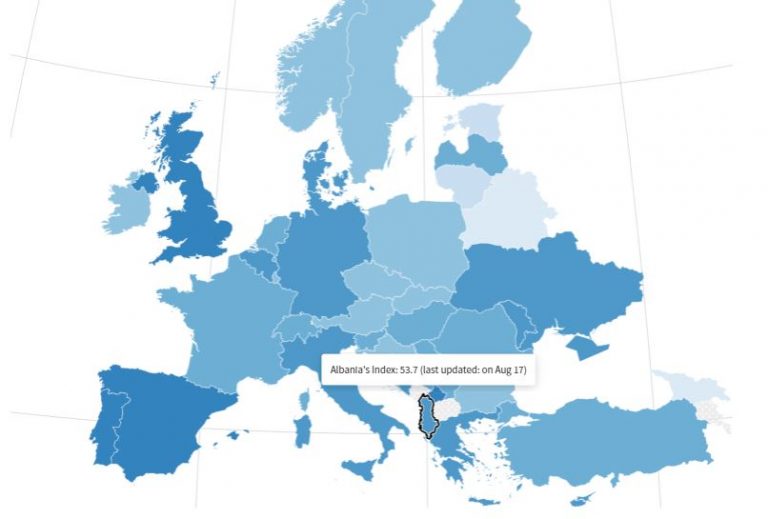
How do you calculate the index?
Dr Anna Petherick, co-author of the study, said that “to measure the severity of the measures were taken into consideration 9 voices such as closing schools and jobs, restrictions and measures on public transport, information campaigns or travel restrictions”, and that “c.c. 290 associates have updated information from governments or media and have converted them into coded parameters that devour the” index.
The purpose of the research, say the authors, is not to measure the effectiveness of the control policies as situations may vary greatly from country to country, and the number of cases recorded depends on the amount of tests conducted ) but “to make a contribution to the pandemic”.
The stricter the measures, the better
Oxford researchers, reportedly in connection with the research that combination of measures continues to be necessary because only in this way will we have the highest health benefits. According to them, data show that the low number of deaths associated with Ovidius is related to the severity of government measures and the speed of their implementation.