17 minutes ago
What was Enver and Nedmije Hoxha's salary, and what could you buy with those salaries?
Periskopi(6 years ago)
(6 years ago)In capitalism, inequality and differences are great, mainly this inequality is achieved through free enterprise and initiative. What concerns Albanians today 30 years after the fall of communism are not the differences in wages and privileges politicians have, with ordinary citizens. It is corruption, enriching a handful of people unjustly, lacking even [...]
In capitalism, inequality and differences are great, mainly this inequality is achieved through free enterprise and initiative. What concerns Albanians today 30 years after the fall of communism are not the differences in wages and privileges politicians have, with ordinary citizens.
It is corruption, enriching a handful of people unjustly, even in the absence of a justice system, that would hinder them.
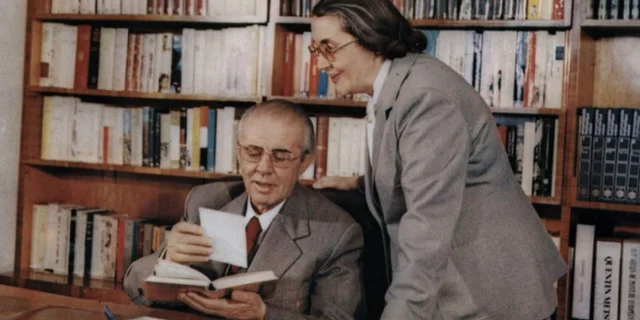
Rare documents discovered by an article in Nevila Dervisi about Abc News speak of the wages of Enver Hoxha and his wife during the most golden period of the communist era.
But there is no document to prove that Enver Hoxha backed state corruption, and did not punish him, when we were with his own isolated will, as it is, ironically today the EU's main requirement for starting negotiations and Albania's membership.
Hagi Kroi, the dictator Enver Hoxha's eternal secretary, has left behind a volume journal where almost all the most peak or important events of the time were recorded.
Known as “al ego” second to Enver Hoxha, the journal of Haxhi Croi does not bring any particular value, as it is cured to hide all disasters, that the communist system in general and Enver Hoxha in particular brought to Albanians and Albania.
However, the journal contains interesting information of the time.
So for example, in the saved note of January 17th 1972, Hagi Croy wrote that “has sent his friend Nexmije's first two-week salary of January. For Comrade Enver $1150, and for him for 750 dollars, a total of $1900,818x1.
The interesting note serves to understand how much the number one in the hierarchy of the Communist State was paid at this time.
According to a simple account, he was paid $1150,21 [$2,250,000] a month, while his wife, Najmija, $1,500 a month.
At that time, wages for the common people ranged between 300 and 450 dollars a month for a simple worker, between 100 and 400 dollars a month for a cooperative (dependent on the daily rate and the agricultural area, since in the north of the country there were co-operatives for a day's work, or less than the price of a bread cost of $4, 500 to 800 dollars per month for an educator, 800 to 1,000 for a qualified engineer, etc.
What could you buy with Enver Hoxha's monthly salary?
With two months of Enver Hoxha's salary, you could buy a TV, which was one of the most expensive homewives 44,000-5700 dollars.
With Enver Hoxha's annual salary, you could also buy a modest home (house prices ranging from 20,000 to 60,000).
Two stores opened in recent years of the regime in Gjirokastra and Tirana, where you could buy quality foreign production goods, but only on dollars.
The first color TVs cost $100 per piece. At this time the State Bank collected the dollar with 7.5 dollars from ordinary citizens.
Persecutors of the Communist regime, who dared not approach the bank, exchanged their dollars in the black market for $1 for $5.