 5 hours ago
Costett: In an Attempt to Honor KLA, do not undermine its heritage of freedom
Periskopi(6 years ago)
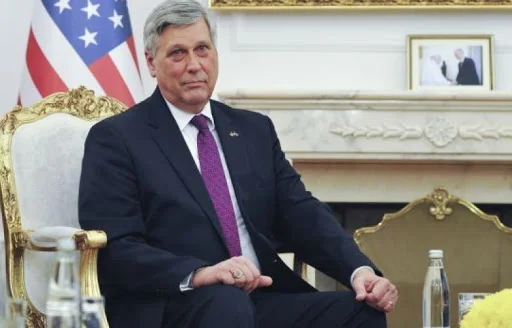
(6 years ago)American Ambassador to our country Philip Costnett, in his authorial writing published on the US Embassy's page has expressed his views on the KLA War Values Protection Law, saying that “efforts to honour KLA, don't undermine its legacy of freedom”. [...]
American Ambassador to our country Philip Costnett, in his authorial writing published on the US Embassy's page has expressed his views on the KLA War Values Protection Law, saying that “efforts to honour KLA, don't undermine its legacy of freedom”.
Cosnet writes that the United States is not against The KLA, on the contrary, -- he -- we understand today that Kosovo would not be an independent state without the efforts of the KLA and other resistance organisations”, and then it shows where the problem lies with the Law on KLA Values.
The fundamental issue at stake is that it undermines freedom of expression. Although it would be the Constitutional Court of Kosovo that defined whether this law conflicts with the Constitution of Kosovo, I believe it at least conflicts with the spirit of that document. If criticism of certain classes of people, organizations, and interpretations of history becomes a criminal act, as stated by law, this would produce a thrilling effect on freedom of expression. It would scare citizens of any ethnicity who want to offer views or interpretations beyond the ordinary, cause shadows of fear and uncertainty about political speeches, and open the door for a technological or selective rise of charges”, Kosnett writes.
His complete scripture:
Today, the Kosovo Assembly ranks the review of the proposed Law for the Protection of the KLA War Values. I believe that this law, regardless of its intentions, is not in line with the pledge of fundamental freedoms that are essentially the Constitution of Kosovo. The adoption of the law, in its present form, would weaken Kosovo's democracy.
From the moment our embassy started expressing these concerns in private discussions with political leaders and with representatives of KLA veterans, recently through public statements some have been surprised at the US position. Are Americans against KLA? What's wrong with honoring veterans' efforts and sacrifice?
Let me explain our attitude and offer suggestions on how to move forward.
First, the United States of America is not “against KLA” Instead, we understand that today Kosovo would not be an independent state without the efforts of the KLA and other resistance organisations. As far as I am concerned, I lived in Kosovo only four years after the end of the conflict, when signs of war were still seen everywhere and when the country was just beginning to take its feet. I've met with war veterans, members of families of homeless people, survivors of sexual violence during the war. It is impossible to live among the people of Kosovo without understanding the reality of war and not respecting those who freed this country, including the warriors and civilians who have suffered alongside them. We support, in principle, initiatives to provide financial assistance, employment and health care for veterans and survivors of sexual violence, even though these goals should take into account the budgetary reality that Kosovo faces, including the need to give priority to immediate requests for response to the COVID-19.
So what's the problem with the Law on KLA Values? The fundamental issue with it is that it undermines freedom of expression. Although it would be the Constitutional Court of Kosovo that defined whether this law conflicts with the Constitution of Kosovo, I believe it at least conflicts with the spirit of that document. If criticism of certain classes of people, organizations, and interpretations of history becomes a criminal act, as stated by law, this would produce a thrilling effect on freedom of expression. It would frighten citizens of any ethnicity who want to offer views or interpretations beyond the ordinary, cause shadows of fear and uncertainty about political speeches, and will open the door for a technological or selective rise of charges.
In private, many Kosovo citizens -- politicians, journalists, academics -- have told the embassy that they already do not feel comfortable speaking publicly about this law due to the emotionally charged atmosphere that conveys public discussion about KLA and war years. Imagine how much more suppressed citizens will feel if the law is passed.
In addition, the law would pave the way for legislation that would penalise other forms of freedom of expression, setting a dangerous precedent. Penalising criticism against any group or individual is a dangerous step, even if it is not for that purpose, towards authoritarianism. There are places I mean. They penalise criticism of a incumbent president or other political leaders, which is part of the daily record in Kosovo, the United States of America and other democracies.
The proposed law could also undermine efforts to ensure justice. The Witnesses, regardless of their background, would ask if they could be punished for testifying about the alleged crimes of individuals associated with the KLA, even if those individuals were accused of acting alone and not on behalf of the group.
Moreover, Kosovo already has laws against slander and insults. These existing laws should be applied if people make false, authentic statements against KLA veterans. Rather, the proposed new law would impose an unnecessary burden on the law - enforcement and justice system. It would be impossible to apply. It would offer easy opportunity for rivals to press charges on each other, expecting that the investigation and prosecution would immediately follow. This would pave the way for future political manipulations.
For 20 years, the United States of America has supported Kosovo on its journey to become a state completely independent, recognised and fully integrated into European, Western and international structures, as long as it is economically connected to all neighbouring states. To fulfill that goal, the Government of Kosovo must demonstrate that it is committed to protecting the rights of all its citizens and to respect the rule of law.
So, what's the alternative?
There are aspects in the initiative for new legislation that could play a constructive role in honoring the KLA and in healing the country's still intact wounds. Once again, legislation that would provide adequate educational, employment and health care opportunities for those who have tried and suffered during the war -- including KLA veterans -- deserves to be considered.
I have discussed with political leaders and veterans for the benefit of Kosovo investing in a museum for Kosovo's war towards independence. In my country and other countries, contemporary war museums honor warriors of the past, but also serve as the basis for research, internal reflections and investigations. Such a museum in Kosovo could contribute not only to education but also to help citizens accept and understand better what, without a doubt, is a difficult and painful story. If done properly, it could be an instrument that unites citizens by building the future by confronting the past with sincerity.
KLA fighters have fought to extend freedoms to the people of Kosovo, not to limit them. In an effort to show respect for KLA, Kosovo's Assembly should not unwittingly undermine its heritage











