2 minutes ago
Will Albanians be part of Serbian government
Periskopi(6 years ago)
(6 years ago)Following the June 21st elections in Serbia, President Aleksandar Vuciq and the Albanian political representatives from southern Serbia, appeared to have found a common language for co-operation. However, an obstacle in this direction was presented following the formation of the local government in Bujanoc, a town of 12,000 people in southern Serbia. Four [...]
Following the June 21st elections in Serbia, President Aleksandar Vuciq and the Albanian political representatives from southern Serbia, appeared to have found a common language for co-operation.
However, an obstacle in this direction was presented following the formation of the local government in Bujanoc, a town of 12,000 people in southern Serbia.
Four Albanian parties agreed to rule in Bujanoc, without the participation of Serbian parties, so the Serbian Progressive Party coalition (SNS), which won 10 seats and the Socialist Party of Serbia (SPS) with three advisers, remained in opposition.
This problem, which was presented at the local level, also moved to the central level, leading to a cold of reports.
Serbia's president, Aleksandar Vuciq, has sharply criticised this act of Albanian political forces, even declaring that Serbia's room for maneuvering in talks with Kosovo will be cut, among other things, due to the “creation of a single Albanian government against Serbs in Bujanoc”.
State Must Solve Problems
Party for Democratic Action leader at the Serbian Parliament, Shaip Kamberi, told Radio Free Europe that the state in order to avoid tensions should not intervene in party coalitions in multinational environments, but must engage in resolving their problems.
In Bujanoc, a town in southern Serbia, 300km from Belgrade, since 2002 local power has always been formed jointly by Albanian and Serbian parties.
In this country, according to the latest data, the Albanian community makes up 65 percent of the population.
The agreement on forming the ruling majority, following elections held on 21 June, was reached by Albanian parties: Democratic Party (PD), Party for Democratic Action (PDD), Movement for Democratic Progress (PDP) and Alternative for Change (AZP).
Currently, Bujanovac is among the rare municipalities where the Serbian Progressive Party is not in power. This party will form Serbia's next government.
At the constitutional session held on July 23rd, with 25 votes for Nagip Arifi, the leader of the DP, was elected mayor of the Bujanoc municipality.
Disgusted with the formation of the single-ethnic local government, Serbian party advisers left the session.
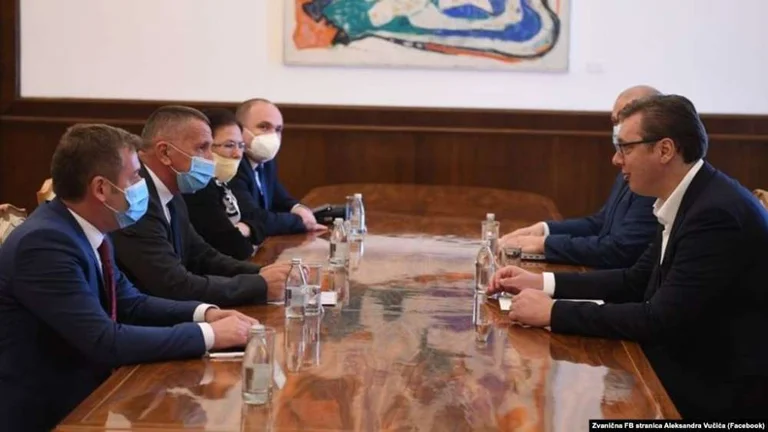
It happened just days after the meeting for the formation of the new government between the delegation of Albanian parties with Serbia's president, Aleksandar Vuciq, in Belgrade.
At that meeting, Albanians expressed their readiness to participate in the government and demanded these positions -- Minister of Local Self-Government, Assistant Economy Minister, State Secretary at the Ministry of Education and the position of president of the Co-ordination Body.
However, following the formation of local government in Bujanoc, reactions from Belgrade have been stormy, clouding opportunities for this co-operation.
Negative Attitude Toward Albanians
Shaip Kamberi says that Serbia's southern Albanians, since 2001, when the armed conflict ended, are found in “a kind of political process once dead, sometimes alive”, unable to solve life problems.
This means that the state consistently avoided the treatment of Albanians as equal partners, having a negative attitude towards us. Here, even now, it is trying to present the formation of government in Bujanoc as an evil prepared by Albanians, in order to justify some future steps that may lead to our refusal as part of the government and the failure to start a dialogue on the seven-point plan that we have requested by President Vuciq”, Kamberi stressed.
For Vucinqi, Bujanoc is blackmail
Serbia's President Aleksandar Vuciq, in one of his reactions, has signaled that developments in Bujanoc could jeopardise the Albanians' possible admission to Serbia's Government.
Speaking on Radio Television of Serbia, Vuciq, on July 23rd, said his party's absence to local government in Bujanoc had become “with the influence of Tirana so that they could blackmail Serbia”.
The Albanian representatives came to me and said: Vucciq, integrate us into state bodies, integrate us into the system. I was happy and I said: No problem, I'll think about it. And then the next day they go to Albania and there they are told to form a government with no 42 percent of Serbs --”, Vuciq said.
Mitrovich: Albanian side has changed thought
Nenad Mitrovich, chairman of the Serbian Progressive Party branch in Bujanoc, told Radio Free Europe that, after the elections, they agreed with the DP on the joint formation of the government, but later, the Albanian side changed its mind.
“As two parties with more mandates, we agreed to form a government together with the DP. However, they were called for urgent consultation in Tirana, and after returning from Albania, (Nagip) Arifi informed us that he was giving up the coalition with the SNS, due to a political statement forcing them to form a government exclusively with Albanian parties”, Mitrovic stressed.
Desire to Expand the Elexorate
However, Shaip Kamberi, during the conversation for Radio Free Europe, stressed that forming local one-ethnic government in Bujanoc was based on a desire to expand the Albanian electorate, and not because of guidelines from Tirana. He said the decision has no connection to any goal of blackmail.
“We have not hidden that we will have a common position even after the elections, for which we received support from Tirana, but this is not directed against Serbia. Our wish is to expand our own electorate rather than blackmail”, Kamberi said.
According to him, Albanian parties cannot blackmail the state “because it is stronger than those”.
Few chance for Albanians to win a ministry
Idro Seferi, a journalist and publicist, told Free Europe Radio that he has doubts whether Albanians will receive a ministry, although in his opinion, it would be a very positive act for Serbia, as he would thus respond to the emotional accusations that it neglects Albanians.
“I think the government in Serbia should give them an opportunity because with themselves the fact that they have ended the boycott and participated in parliamentary elections, Albanians from the south of Serbia have indicated they want to integrate into system institutions”, Seferi says.
He argues that Tirana provided support to Albanians from southern Serbia to participate in parliamentary elections in Serbia, and that, according to him, it could be interpreted as an impact on making their political decisions, but that “of course that effect is not directed against Serbia”.
Official “Belgrade will have to respect the arguments of citizens from southern Serbia and influence the improvement of the economic and social position”, Sefer said.
He also praised that authorities in Serbia should not see the solution to the problem in that region through prism of the general solution to Kosovo's problem, because local Albanians feel like “a kind of hostage in negotiations between Belgrade and Pristina for Kosovo”.
Minorities Part of Serbia's Future Government
After the 21 June elections, President Vucic has held consultations with other parties that won seats in the new Serbian Parliament's composition.
At his party's meeting on July 31st, Vuciq said the election of Serbia's new government would happen in late August.
Vuciq has said he has even talked with the party leadership of potential coalition partners, claiming there are four possibilities in this direction.
As he explained, in all these possibilities, minority parties will be part of the government of Serbia.
However, Vucic has not specified which minorities are referred to in his statement. / REL