8 hours ago
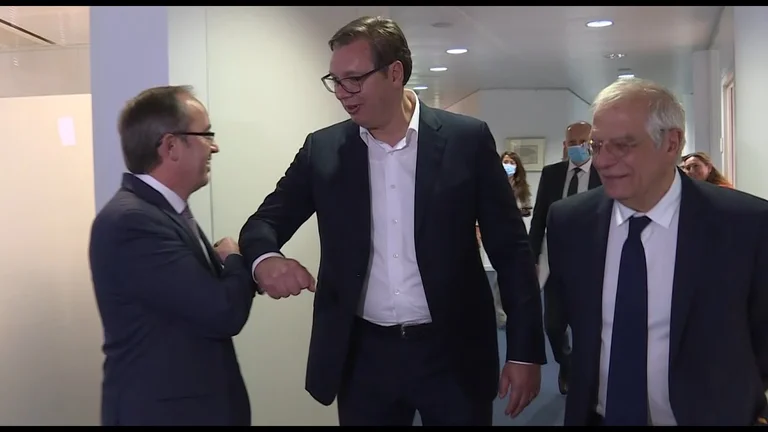
Vuciq: Hoti and I have to try, but I'm optimistic we're gonna find a solution.
Periskopi(6 years ago)
(6 years ago)In a video conference organised by the Washington-based Atlantic Council, leaders of six Western Balkan countries have been hired for bold and practical action to help the region emerge stronger from the impact of COVID-19 with greater economic growth opportunities. In a joint document [...]
In a joint document they said they have agreed that” will accelerate the free movement of goods, services, capital and people in the region, eliminating problems that have hampered economic growth; pursue a plan to attract new foreign direct investment in the region and accelerate the distribution of pledged recovery funds from COVID-19, with a focus on infrastructure and energy.
Damon Wilson of the Atlantic Council said leaders have pledged to improve political co-operation and neighbourly relations, as well as to try to resolve bilateral problems in the region”, while high-profile the fact that today's meeting witnessed transatlantic commitment about the Western Balkans region.
US Special Envoy for region Matthew Palmer, backed the reconciliation achieved among leaders of the six Western Balkan countries as he reiterated support for their integration processes, including the process of Kosovo talks mediated by the European Union.
“We have the same view of the future and the Western Balkan countries we see as EU members, as countries that have made necessary reforms and the United States and the European Union work in partnership”, he said, emphasising Albania and North Macedonia's efforts to convince the European Council to open membership negotiations.
The June 5th agreement in Albania on electoral reform reflects the close co-operation and partnership between the United States of America”, said Mr. Palmer, already underlining the role of the European Union and special European envoy Miroslav Lajcak for the resumption of Kosovo talks on normalising relations between them.
The United States strongly, publicly supports this process and Mr. Lajcak's role, as well as urging both sides to make a papare of”, he said, adding that there is a strong content of transatlantic approach to the Balkans.
Serbia's president, Aleksandar Vucic, already said there are political nature disputes in the region, emphasising relations with Kosovo.
“It's not the fault of Avdullah Hoti or mine... we should, at least, try to do our best to solve this issue, even though I'm not entirely optimistic about this”, he said.
According to him, there are a host of obstacles that could be removed, including the numerous customs procedures that exist among the countries of the region, while underlining that 17 per cent of Serbia's entire export goes to countries in the region.
“Even if we join the European Union before some countries, we will remain in the region and co-operation between us will remain the priority of Serbia”, the Serbian president said.
Kosovo Prime Minister Avdullah Hoti also said there are still many obstacles to economic co-operation.
“We have worked hard to integrate the region, but we must admit that the region is still fragmented to a high degree, as far as economic integration is concerned. Why? Because there are still many barriers to bureaucracy. The legislation might... We still do not have full infrastructure connections between our states”, Prime Minister Hoti said.
Albania's prime minister, Edi Rama, said that the economies of the countries of the region have been hit hard by the COVID-19 pandemic and should be compensated for the life of regional co-operation.
He cited the initiative for “The Western Balkans Schengen” that would influence boosting regional economic co-operation, while calling for such ideas not to be politicised because they do not represent replacement for the region's integration processes.