 8 hours ago
Unfinded Talks, Without Transparency
Periskopi(6 years ago)
(6 years ago)Since the launch of the dialogue process between Kosovo and Serbia in 2011, Kosovo authorities, involved in the dialogue, have not been transparent over time regarding developments within this process, and this nontransparency is continuing even after the resumption of dialogue, on 16 July of this year, assess connoisseurs of political developments [...]
On 16 July, Kosovo Prime Minister Avdullah Hoti and Serbia's president, Aleksandar Vuciq, have met in Brussels, under the dialogue facilitated by the European Union.
Prime Minister Hoti has stressed that only two topics -- for the unemployed and the economy -- have been discussed at the July 16th meeting.
On Thursday, 23 July, Kosovo and Serbian delegations have been met in Brussels, as said, on an expert level.
Kosovo's state co-ordinator for dialogue, Skender Hyseni, after meeting with the Serbian side in Brussels, gave no details about concrete topics from Thursday's meeting, but stressed that there are <x0-> reconciliation about the specific elements and that the conversation has been constructive”.
There is no agreement for specific chapters until there is no comprehensive agreement”, Hyseni said.
According to Prime Minister Hoti, at that meeting the drafting of the final agreement has started with just these two topics.
Analyst Life Krasniqi from the Kosovo Democratic Institute tells Radio Free Europe that transparency concerning the dialogue process that has resumed in Brussels, as well as its clarification is missing.
According to her, Prime Minister Hoti has not made clear what the fact that he will not go with special agreements means, but that all of these will be within a general agreement.
She suggests that the strategy which the parties are using at this stage of dialogue is to start with opening up a series of topics on which there is reconciliation, and if reconciliation is achieved on all these topics, then there will be agreement or otherwise not.
But, as she says, opinion still does not know what all those topics are about which reconciliation of the parties exists to discuss them.
This should be clarified in the sense that even the families of the missing people do not freeze their expectations that this issue will be resolved immediately. This may take time, and we need to know what it means. It is positive that in the context of dialogue the question of the found, as dialogue since 2011 has not had part of the subject.
But you need to understand exactly what this means, just as it should at the same time be clear about what is intended to achieve. We understand it's a negotiation process and there are elements of privacy. But there must be clarification on the bases and thick lines of this process, so that we can understand what the Kosovo Government is doing in these talks”, Krasniqi said.
But, Bekim Blakaj from the Fund for Humanitarian Law in Kosovo, speaking of Radio Free Europe, stresses that opinion has never known what is being discussed in the process of dialogue, and that nontransparence is continuing even after the resumption of dialogue on July 16th, especially on the subject of the undiscovered, which is already being discussed.
He says his organisation, along with those of the families of the missing persons, has stressed the need for involvement of this topic within the Kosovo-Serbia dialogue.
Too late, maybe two weeks ago, I realized it was actually about the subject of missing persons. However, the process has been so untransparent that we have no idea that the issue of missing persons has been mentioned. So even in the past, transparency never existed. So we've been in an informative darkness as to the subjects that are discussed in the dialogue, whether in the technical and then in the political one, but even now, it seems that this approach of our side has not changed. Unfortunately, transparency is almost zero.”, Blakaj said.
He added that in addition to the fact that it is being talked about missing persons, there is no more detailed information about what has been discussed, have any result in dialogue on this topic and how co-operation is provided in the process.
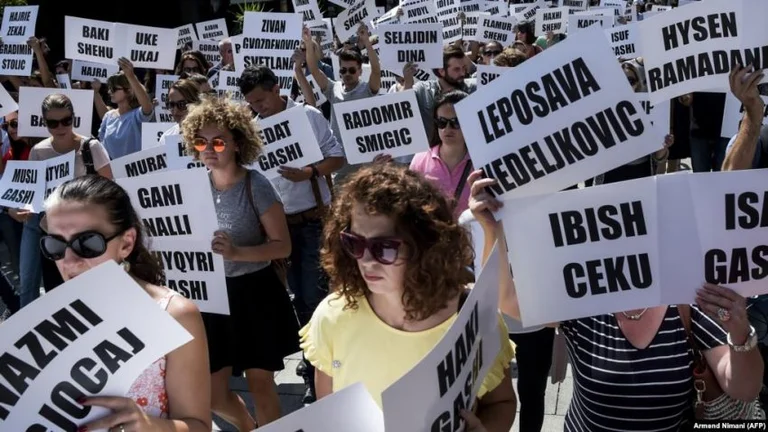
Organisations of family members of missing persons in Kosovo have welcomed the fact that the undiscovered issue is a topic of discussion within the Kosovo-Serbia dialogue.
Ahmet Gajchev, chairman of the Co-ordination Council of the Associations of Familys of Undiscovered Persons, tells Radio Free Europe, which is still uncertain about what the outcome of the talks on the missing within dialogue in Brussels will be. But, he hopes the Kosovo side will have respective field specialists within it, in order to produce a desired result.
These (government officials) have not talked to family members. I was in a consultation with the Prime Minister. We consulted and told the prime minister that we are ready in every way to assist the delegation in the process of negotiations on missing persons. Now, I am hoping that on the way or during this process, there will be a team of specialists who have been dealing with this matter for 20 years”, Grejchev stressed.
Hoti: Chapter for the Undiscovered
However, in addressing Kosovo Assembly deputies, Prime Minister Avdullah Hoti has said on Friday, July 24th that the issue of the unknown has been addressed with clear demands and principles. He has mentioned three principal principles.
The first principle, as he has said, is that “is in full compliance with the international humanitarian Law, resolve the issue of missing persons, including revealing information and providing all necessary human and technical resources for resolving this issue.
Meanwhile, the second principle, according to him, is “bringing justice to the country”, as well as the third principle “is the request for the care needed for the victims' families, according to international standards”.
The “Mby over these reconciled principles on July 16th, on Thursday in Brussels, has been drafted the chapter of the final agreement on the missing. This is the truth”, Hoti said.
He has added that in terms of this topic, “Kosovo requires the unfolding of full information for victims' families, according to international standards, from the archives of the former Yugoslavia, from the Ministry of Internal Affairs, from then-then territorial protection structures, from paramilitary and voluntary troops who have acted in Kosovo, as well as the Equipment of full information about the distribution of troops in smelters and in Kosovo furnaces and Serbia<1>.
The Agreement on Un finders, A pledge of Political Will
Bekim Blakaj, estimates that the principles mentioned by the head of Hoti's head are stable and, he says, “in an ideal world, the parties would have to agree on all these principles”.
But he has expressed fear that these principles will not be experienced. However, as he says, if the agreement is reached final and within its context one of the points is the commitment to whitewashing the fate of missing persons, then monitoring mechanisms would have to be created to monitor implementation of the agreement. READ THIS: Political temptation is determining the fate of the found
If the agreement is legally binding, they must apply it anyway. Then I am confident that there will at least be some progress, because once again there will be a return to the attention of institutions in whitewashing the fate of missing persons. No one can know from this moment whether we will have great or small progress remains to be seen. But it's important that this question is in agreement, because that then gives us room in civil society to put constant pressure on institutions”, Blakaj said.
Analyst Life Krasniqi, says the issue of the dead can be resolved in the context of dialogue with Serbia, if there is political will for such a thing, which has so far been absent.
According to her, when it comes to resolving the issue of found persons, it does not just mean knowing where they are and letting their families be informed or able to eventually receive their mortar remains.
More than that, she says, the issue of the dead is linked directly to war crimes and crimes against humanity, which could constitute acts of genocide.
For them one should assume responsibility and that is why it relates to political will. If there is a willingness to take responsibility, to bring to justice those who committed these crimes, to actually build peace and reconciliation reports, then it can be done as a matter. But it's a very sensitive issue and it needs to be very careful how it is handled, because we should not add a greater burden to the families of the missing and add to their pain, rather than ease it and respond to their demands”, Krasniqi stressed.
Prime Minister Hoti has been criticised by opposition parties in the Kosovo Assembly that at the 16 July meeting in Brussels went “platform, without a team and without a new agenda”, as well as the key “, the deadline, the” extension of the process.
Warnings that the meeting of experts on both sides, which was held on 23 July in Brussels, implies the resumption of the technical dialogue that began in 2011 and was subsequently followed by dialogue at the political level HINA has not been welcomed in Pristina.
Against the resumption of technical dialogue, the country's presidency has indicated, but also the two ruling coalition parties -- the Alliance for the Future of Kosovo and the Social Democrat Initiative.
But, Hoti has ruled out the possibility of dialogue being technical, stressing that dialogue will be completely political.











