 8 hours ago
Russia's new constitution to further silence thought differently
Periskopi(6 years ago)
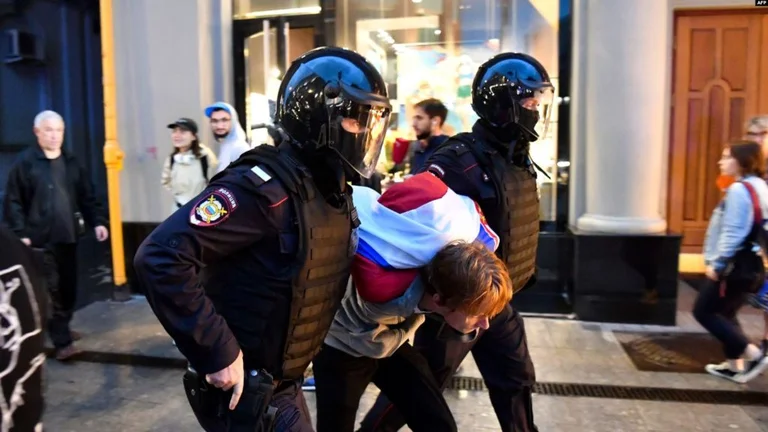
(6 years ago)Outside the headquarters in Moscow of the Federal Security Service last week, some of Russia's most prominent journalists protested the arrest of Ivan Safronov, a former journalist accused of treason. Some were detained for a while. If this were to happen in the United States or in any other democracy [...]
Outside the headquarters in Moscow of the Federal Security Service last week, some of Russia's most prominent journalists protested the arrest of Ivan Safronov, a former journalist accused of treason. Some were detained for a while.
If this were to happen in the United States or in any other Western democracy, anger would be extraordinary, but in Russia, the media rights struggle has become routine.
This battle is expected to become more difficult, as Russia on July 1st decided to adopt changes to its Constitution that would allow President Vladimir Putin's government to increase pressure on freedom of speech.
The same vote that allowed Putin to resume his presidential mandates and the possibility of staying in power until 2036 also created a series of legal gaps for constitutional prevention of censorship through the protection of “historical truth”, and set the ban on giving Russian territory foreign powers, and defined marriage as a legal act between only one man and one woman.
Russian MPs said they would now change about 100 laws and adopt several new laws so the legislation can be harmonised with constitutional changes.
Experts and media critics say the changes could be used to further silence criticism or debate on issues such as the annexing of the Crime from Russia, or to encourage authorities to react more sharply to instability.
Fears that the vote would cause a new decline in press freedom appear to have already materialised.
Since the end of the vote on July 1st, Mr. Safronov has been arrested and convicted Svetlana Prokopieva, a journalist contributing to Radio Free Europe / Radio Freedom, for “the abuse of terrorism” on a comment published last year concerning terrorist attacks in Russia. International human rights organisations called the charge “false” and described the case against it as an attempt to intimidate journalists.
Charges of State Secrets
Authorities accused Mr. Safronov, an adviser to Russia's space agency, who previously worked for newspapers “Commerant” and “Vedomist”, of providing military secrets to the Czech Republic, a charge he denies. Lawyer and his supporters say the charges have been fabricated.
The “regime began to act harshly and will continue to act even more harshly. Media pressure can intensify. Likely, funding opportunities for many independent Russian media and bloggers will be interrupted”, Alexander Morozov, an expert from the “Boris Nemtsov” Centre for Russia's Study at Charles University in Prague, told Voice of America.
The Russian Constitution officially prohibits censorship, but it has not prevented authorities from persecuting critical and independent journalists.
“Changes reflect a tendency that exists in practice, in Russian politics and legislation for nearly 20 years”, said Andrei Richter, who is a professor of media research in Slovakia and is former director of the Institute for Media and Legislative Policy in Moscow.
“As in the times of the Soviet Union, the government confirms its monopoly on truth”, he said. “Monopolis in this case implies the truth known to the government and nothing but truth. What's important to the government here is if you cross the line it has set for you on freedom issues of the word”.
Territorial Disputes Discussion
By banning “the alienation of Russian territory” a change that prevents the Russian leader from giving territory to a foreign country that phrase could serve to discuss territorial disputes.
The State Department, Russia's lower house of parliament, is proposing a law that would make a criminal violation of the international dispute. If approved, journalists may risk prosecution if they report anything they object to or question Russia's version of Crime.
Russia annexed Crime in 2014, a move the international community condemned and unknown. Russia has also supported separatist fighters east of Ukraine, Moldova and Georgia.
The same is true of media reporting on same - sex marriages, which is regarded as unconstitutional under new changes.
Tanja Loxina, associate director of the European and Central Asia Division in the Human Rights Watch human rights organisation, said the amendment “inherits the conservative” views.
This is a symbolic gesture that logically stems from efforts to discriminate against the homosexual community”, she said. The beginning of this pre-government change was the adoption, at the federal level, of the gay propaganda bill in 2013. According to this law, the press can take responsibility”.
Since the 2013 law's entry into force, several websites offering information and advice on homosexual issues have been closed.
The amendments on “historical truth” and the non-reducing of the heroic “of the Russian people in defense of Homeland” also reflect a broader tendency.
Russian History of Wartime
State media have reiterated Mr. Putin's comments about Europe's role in World War II, including his comments that the clash between Europe and Adolf Hitler led to war.
Russia's actions and strategy during the war has earlier angered listeners and viewers <x0patriots” and led to official investigations.
In 2014, for example, St. Petersburg's prosecutor's office investigated Dozhez TV for possible violations, after the channel held a study on the 900-day siege from Hitler of Leningrad City that claimed the lives of 800,500 civilians before the Russian army freed the city. Anything that can be perceived as critical is seen as dishonoring the memory of those who died.
Several transmission networks cut the channel into question, but prosecutors found no evidence of a criminal offence.
Under the new changes, the channel could face charges of “sizing heroic works”.
In general, Russia's media community does not expect anything good to come from constitutional changes or proposed laws.
“Gasers already carry a very heavy burden, and Svetlana Prokopiyevas's case is an example of this,” said Mrs. Lockshine. “The government gives the message to Russian journalists that any discussion about terror or questioning whether the authorities are entitled to be regarded as citing terrorism under the penal code and will thus be able to completely destroy a person's life”.
Miss Prokopieva's situation
This is the situation in which Prokopieva finds herself, Tanja Loxina said. Until its criminal history is cleared, it will remain on a list of terrorists and extremists, will lock up its bank account and be placed on the list of persons banned from travel.
This could happen to anyone who allows himself to speak unfavourablely of the government”, said Mrs. Loxina.
Some activists and human rights experts view the cases of Mrs. Prokopieva and Mr. Safronov as a signal to the press for quick and harsh consequences in the event of disobedience.
Others, including Mr. Morozov of Prague University, said the method Putin used for him was “taken hostage” The constitution can be seen by law enforcement agencies, and anyone who wants to suppress opposers as a permit to act harshly.
Before the amendments, many subjects were working on restrictions in Russia. A considerable group of parliamentarians have made it their profession to impose preventative measures, including for journalists”, Morozov said. “The way constitutional reform took place resolves the hands of these subjects: If they were limited somewhat before the adoption of these changes, they now have full permission”.
The fact that Putin simply decided to start his previous “mandates rather than find a more complex way to stay in office could signal that authorities will now be prone to simple and tough tactics, says political science researcher.
The “to implement all the clearly ideological norms that have now been set forth in the Constitution, they will adopt new laws where punishment will be introduced or intensified for those who do not comply with these” standards, Mr. Morozov said. “and each media will ask themselves if it has over-indicted by publishing something controversial”.
The harshest stance by authorities has already been seen in response to criticism for the arrests of Mr. Safronov and Mrs. Prokopieva.
When Rebecca Ross, spokeswoman for the US Embassy in Moscow, called on Twitter that the arrests appeared “a co-ordinated campaign against press freedom (#MediaFreedom)”, Russia's Foreign Affairs Ministry responded: “Mind your own business. ”(VOA)











