9 hours ago
Is there hope in 20 years? Undiscovered, Dialogue Subject in Brussels
Periskopi(6 years ago)
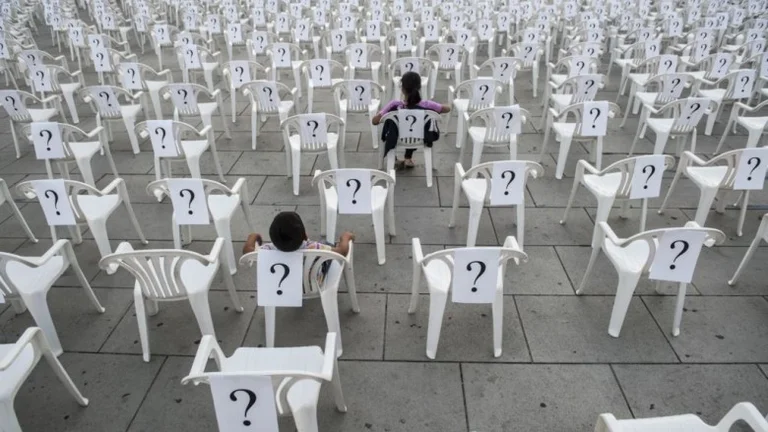
(6 years ago)Eddy Dylhas from Gjakova, for years, wants to know about the fate of her husband, Myrtezza and father-in-law Skender, who have resulted in the list of missing persons since the last war in Kosovo. Dylhas says she has protested dozens of times asking to know what happened to her family. [...]
Eddy Dylhas from Gjakova, for years, wants to know about the fate of her husband, Myrtezza and father-in-law Skender, who have resulted in the list of missing persons since the last war in Kosovo.
Dylhas says she has protested dozens of times asking to know what happened to her family.
As of March 27, 1999, she has no information about Myrtezaan husband and father - in - law Sk everyone.
She has grown hopes after Kosovo Prime Minister Avdullah Hoti has included the issue of missing persons in targets for the final agreement between Kosovo and Serbia.
He (Prime Minister Hoti v.j.) is promising, but we hope that something will be done in talks with Serbia as they are promising. There is no peace for us, nor for our children. It means we're not cool. Let's know where their graves are, that's what we want because we already know they're not alive”, Dylhas says Radio Free Europe.
Dylhas has lost hope that he can find family members without political will, first in Kosovo, and then in Serbia.
The missing have done very little, very little. It means we're 21 years looking for them, said Dylhas.
Dragan Stevic of Pristina's Badovci also has been looking for Brother Slavisa since August 1999.
He was last seen in downtown Pristina at the Grandi Hotel. Stevic says in a statement to Radio Free Europe that throughout this time, he has been trying to find information about the dawning of his brother's fate, but now he says they have all lost hope.
I don't think his fate can be white because 20 years have passed and nothing is yet known of him. I have no hope”, Stevitch said.
The issue of the found, meeting theme in Brussels
Since the coming to power, Kosovo Prime Minister Avdullah Hoti has declared that resolving the fate of persons found by the 1998-99 war is a key issue in the process of normalising relations between Kosovo and Serbia.
The prime minister highlighted this fact in what was called “The Paris Summit” that took place through the video connection on July 10th.
In the presence of French President Emmanuel Macron, German Chancellor Angela Merkel, EU High Representative Josep Borrell, EU special representative for talks Miroslav Lajcak, as well as Serbian President Aleksandar Vuciq, Prime Minister Avdullah Hoti said that missing persons, as well as justice for victims of violence, are the main concerns in the process of normalising relations with Serbia.
According to Hoti, the final agreement should include mutual recognition, addressing the issue of the property, war damages, the return of cadastral documents, regulation of economic relations between the two countries, and infrastructure ties.
“These are topics that will be part of the dialogue process from the Thursday of”, Hoti said.
Consultations Before Meeting in Brussels
Before leaving for Brussels, where the meeting between the Kosovo delegation and Serbia is expected today, Prime Minister Avdullah Hoti met with leaders of institutions working on finding missing persons.
Prime Minister Hoti used this meeting to obtain information before meeting with the Serbian delegation.
The head of the Government Commission for Missing Persons, Prenk Lorej, who was present at this meeting, says it was a co-ordination meeting in which the issue of the missing is asked to be discussed in Brussels.
As far as the commission's work is concerned with, the commission it heads says activity is severely limited due to the situation over the pandemic caused by the new coronary.
It's really got all the activities in the first place, but we're not stopping. We've been developing activities, visiting. We have collected the notes, so now we see what can be done under these” circumstances, says the Leaf for Radio Free Europe.
Talks, Last chance to impose justice
The head of the Fund for Humnitary Law in Kosovo, Bekim Blakaj, sees the launch of the negotiation process as the best chance to include the subject of the found in the Kosovo-Serbia final agreement.
That, according to Blakaj, would intensify work among the institutions of both countries to track and investigate cases that have not yet been resolved.
It is clear that it is impossible to whiteen the fate of missing persons before a final agreement. So all that remains is for this topic to be discussed in dialogue and in the final agreement the parties will pledge to be fully engaged in whiteling the fate of missing persons”, Blakaj says.
Should the issue of missing persons be brought into place in the final agreement between Kosovo and Serbia, according to Blakaj, it would pave the way for the creation of an organ that would monitor how much agreements are being implemented, as well as the question of whiteening the fate of missing persons.
Associations of family members of the unknown: Political Will Missing
Association leader, “Parents' voice”, Bajram Qerkini, says every government has given promises that they will discuss the issue of missing persons in Brussels, but according to him, this has never happened.
“E has a moral and political duty to say that (there is no agreement) without dawning the fate of the found, whose family cries night and day, and it's the terminal wound”, says Kerkeyny.
Neither Silvana Marinkovic of the Association of Undiscovered Family Members in Kosovo has any hope that the issue of the found can dawn.
“Neither side shows the political will to solve this issue”, Marinkovic said, adding that many initiatives have been undertaken in the past 20 years that have shown unsuccessful in whiteling the fate of the undiscovered.
Recent months have had fewer excavations at locations suspected of mass cemetery in Kosovo and Serbia.
During 2019, relevant institutions have conducted excavations at 26 locations within Kosovo's territory.
It was suspected of mass cemetery.
Excavations were also made at university campus in Pristina, which ended without any findings.
After the end of the war in Kosovo in 1999 resulted in about 6 thousand and 500 missing persons.
Since then, exhumations were carried out at mass cemeterys in Kosovo and Serbia, and up to now about 70 percent of those missing have been found.
According to authorities in Kosovo, some 1,600 people -- mainly Albanians -- still turn out to be found.