3 minutes ago
EU summit, in a climate of disagreement
Periskopi(6 years ago)
(6 years ago)The leaders of the European Union tried for the third consecutive day to reach a stimulus agreement to fight the consequences of the coronary, but German Chancellor Angela Merkel said increasing disputes over the level of spending would not be easy to overcome. Germany and France are seeking a package [...]
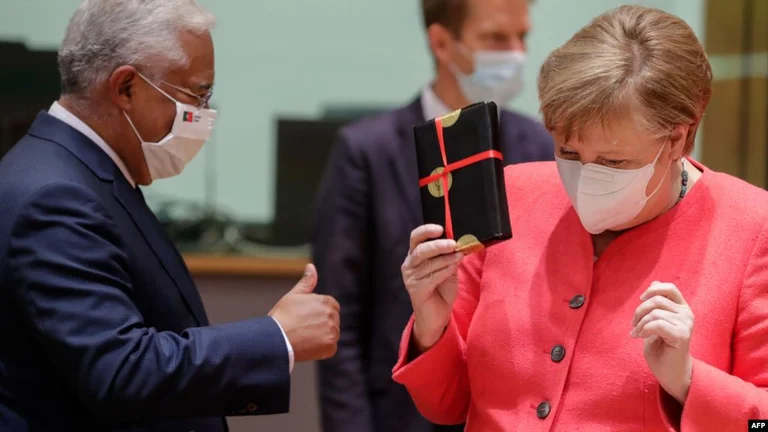
The leaders of the European Union tried for the third consecutive day to reach a stimulus agreement to fight the consequences of the coronary, but German Chancellor Angela Merkel said increasing disputes over the level of spending would not be easy to overcome.
Germany and France are seeking an economic recovery package of 1.8 trillion euros to save the bloc's economies facing the worst recession since World War II.
The most controversial issues are the size of the new recovery fund and of what ratios should be grants and creditors.
Some richer states like the Netherlands are demanding that the package be more limited, noting how deep the north-south divisions are within the European Union.
Meanwhile, the summit faces difficulty reaching agreement on the size of compensation the richer countries receive from the EU budget, as well as about a proposed new law-rule mechanism that could block EU funds for countries that violate democratic principles.
Greece's Prime Minister Kyriakos Mitsotakis, whose country had just begun to retake itself from the 10-year debt crisis when it was hit by the pandemic, called for unity, saying it is not in the EU's interest to look divided and weak. “I sincerely hope that today we will be able to break the deadlock,” he told reporters in Brussels.
Leaders who wore facial masks have called the summit a key moment for nearly 70-year-old European integration. Officials and experts have said that failing to reach an agreement, in an unprecedented economic crisis atmosphere, would pose serious questions about the bloc's stability.
There's a lot of good will, but many positions too. I will make every effort but it is possible not to achieve results,” said Mrs. Merkel.
Mo SMARUES BLOKUT BRENDA
Dutch Prime Minister Mark Rutte, who faces parliamentary elections in March 2021, spoke openly about divisions with France and Germany late Saturday. “They left upset”, he told Chancellor Merkel and French President Emmanuel Macro.
Meanwhile, Hungary, backed by its ally Poland, both with populist governments, has threatened to use veto to block the aid package as a result of a precondition that countries deemed to be violating democratic principles will not benefit by funding.
Poland and Hungary have created confrontations with Brussels because of judicial reforms, viewed by the rest of the bloc as a blow to judges' independence.
Hungarian Prime Minister Viktor Orban said Mr. Rutte has a personal grudge against him. I don't know what the personal reason for the Dutch prime minister to hate me or Hungary, but he's attacking pretty hard... I don't like the games to blame each other, but the Dutch is the real person responsible for this whole mess,”, Mr. Orban told reporters.
Confrontation prior to meeting followed by Italian Prime Minister Giusppe Ctete warnings that project The EU itself will be threatened if the richest northern countries do not generously assist the poorest countries in the south. In Italy, hostile attitudes and revolting against the EU have increased over the lack of support from other countries during the pandemic.
Instead of creating solidarity, the pandemic and its resulting economic impact have deepened internal rifts on topics such as defence, foreign policies and immigration. Economic inequality among member states is expected to increase, regardless of approval or not of the aid package.
The richest countries have approved national packages to support their businesses, giving them an even greater advantage of competition with poorer countries that have failed to provide similar subsidies. That, analysts say, will deepen the gap between the creditary northern countries and the poor southern countries.
Lackless economic recovery in some countries has promoted populist elements and anti - political emotions - The EU. The aid package can ease these feelings temporarily, but it can create revolt against EU policies in northern countries, where the population increasingly asks: why do our money run towards southern European countries?/voa/