2 minutes ago
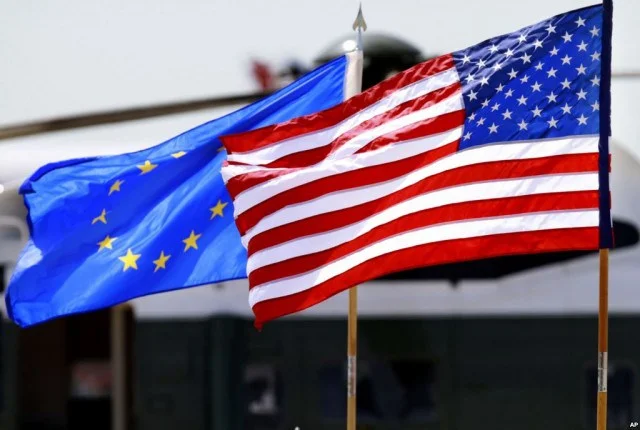
US and EU, with different approaches to dialogue, recognition or normalisation of relations?
Periskopi(6 years ago)
(6 years ago)The United States of America and the European Union both separate and common are engaged in completing the Kosovo dialogue, Serbia. What brings together these two powers is the fact that both want dialogue between Kosovo and Serbia to end with agreement, but divided the way [...]
The United States of America and the European Union both separate and common are engaged in completing the Kosovo dialogue, Serbia.
What brings together these two powers is the fact that both want dialogue between Kosovo and Serbia to end with agreement, but divided the way they see the dialogue and their approach to the final agreement, writes news.
Bilateral recognition and normalisation of relations on one side of the United States of America that through economics and mutual recognition tend to bridge the centuries-old enmity between Kosovo and Serbia and the EU with unclear statements about normalisation of relations.
The European Union's special emissary for Kosovo dialogue -- Serbia, Miroslav Lajcak -- during his visit to Kosovo, where he met with heads of state and representatives of political parties where it has been discussed restarting the dialogue has also talked about the final agreement.
Asked about the issue of mutual recognition between the two countries as the main part of the final agreement between Kosovo and Serbia, Lajcak has declared that “is not in Kosovo to speculate and that his mandate is normalisation of relations”.
I'm not here to speculate right now, I can tell what my mandate is, it's normalizing relationships. The agreement implies resolution of all issues, dialogue has a history of 10 years, there is a string of agreements that have been implemented, some have not been implemented, at the end of the process we must have resolved all issues. I want this process brought to a successful conclusion, I'm talking about a few months if the two sides are ready. Our goal is to help the parties agree, rather than force them to accept something they do not want”, he said, adding that the EU cannot be left behind because it offers a European future.”, Lajcak said in Kosovo.
But unlike Lajcak and Borrell, who as High Representative of the European Union for Foreign Policy and Security claims that between Kosovo and Serbia should have normalisation of relations, representatives of the United States of America think.
US President Donald Trump's Special Envoy for Kosovo Dialogue Serbia, Richard Green, cites economic growth and investments in both countries and a mutual recognition agreement between the two countries.
Similarly, US Secretary of State Mike Pompeo in a letter of congratulations to Kosovo's prime minister for taking office at the top of the executive, says the United States of America supports the idea of agreement with mutual recognition.
“We continue to support Kosovo in advancing the process of full normalisation of relations with Serbia, focused on mutual recognition”, writes Pompeii, adding that this is essential for Kosovo in terms of global integration and achieving its full potential.
In terms of this issue, policy connoisseur Shkodran Ramadani for news.net has indicated that the European Union has such approach that allows for agreements that within themselves may have trouble bringing about discomfort.
The European Union has launched a dialogue with its predigma allowing agreements within them to be reached that have ambition, which agreements can be adjusted within their political structures”, Ramadani said.
Furthermore, Ramadani has claimed that “normalisation” is an ambig term and allows interpretation, while on the other side The US according to him have indicated that dialogue between Kosovo and Serbia should end with mutual recognition.
But until now, no deadlines or mutual recognitions from the European Union are mentioned only normalization, and that term is ambing, and on the other hand The US so far have declared that dialogue between Kosovo and Serbia must end with mutual recognition. The EU has no clarity, until the end of the United States has given time terms. But now recently he's not wanting to give the impression that there's a rush in this direction. Until Greenell's recent interviews, the United States has been talking about a quick deal”, Ramadani said.
Ramadani has also indicated that the US is more consistent than the EU in the dialogue between Kosovo and Serbia, and especially now when two persons coming from the non-recognising states of Kosovo lead the dialogue.
“So far, the United States has been much more consistent with dialogue and this is normally because the EU is clear because 22 countries do not know and 5 do not know it but because of the way of voting there cannot be taken a firm stand, and now the dialogue will guide two people from non-recognising countries, and that has damaged the credibility of the European Union very much because the institution that is taking sides with the Serbian state .<1>, Ramadani told news.
As for dialogue, everything has changed the fact that a unconfirmed indictment linking these two names with war crimes has been published to the president of Kosovo and the leader of the Democratic Party of Kosovo.
The illegal publishing of the indictment has sparked major reactions in the country and abroad and has prompted the planned June 27th meeting at the White House, between Kosovo and Serbia, to be annulled.
Immediately after the publication of this indictment, a acceleration of the European Union has been noted in the post of relaunching the dialogue led by Brussels, but currently appears to have no atmosphere to happen.