6 minutes ago
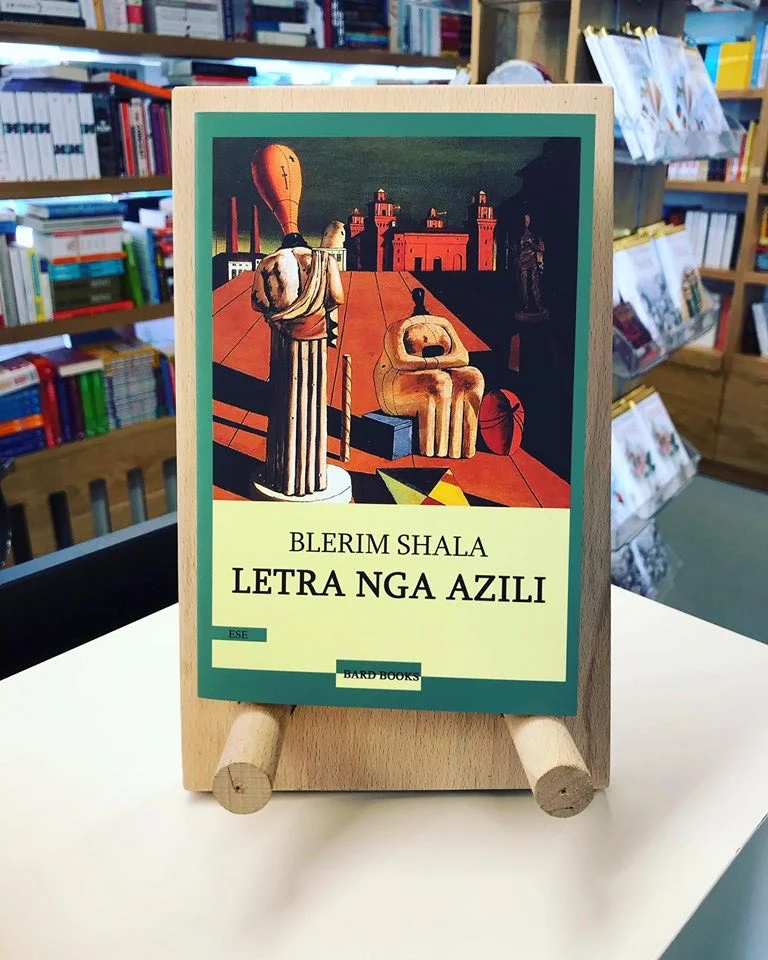
Blerim Shala brings the book “Letra from Asyli”, written during 100 days of pandemic
Periskopi(6 years ago)
(6 years ago)The book Paper from Asylum, written by Blerim Shala, as a diary during a hundred days of pandemic, is not simply a realistic recording of the pandemic situation from an apartment in a Pristina neighbourhood, but a calyidoscopic record and philosophical reflection on this situation. On the subject, this is a book of pandemic; to [...]
The book Paper from Asylum, written by Blerim Shala, as a diary during a hundred days of pandemic, is not simply a realistic recording of the pandemic situation from an apartment in a Pristina neighbourhood, but a calyidoscopic record and philosophical reflection on this situation. On the subject, this is a book of pandemic; for the time, it is a book of quarantine; in its form it is a diary; it is essays in the zhanr; in its type, it is philosophical.
Ag Apolloni
The transition from the common to the extraordinary is usually due to traumatic events that always disrupt the linearity of living. Such events are wars, pandemics, or terrorist attacks, which, while transitional, differ in different ways of life and thinking in countries affected by them, as they did, both world wars and Spanish flu in the last century, or even terrorist attacks on the Twin Towers in the new century. These traumatic events, in addition to endangering, damaging, and transforming human life, influenced literature. As they were happening, they were written mainly journals (Mary O'Neill, Anne Frank, Patton, etc.) as they finished, and they served the authors as impulses for literary works such as The Water Land (T. S. Eliot), A Farawell to Armes (Ernest Hemin-gway), Slaughter-house Five, Exit Ghost, Falling Man (Don DeLillo) etc.
Literature has been on the subject since ancient times. He is also spoken of in Iliad and the Bible, as well as in the King Edith tragedy. Tukididi and Lucrez also write about it, and later Bocaccio, Chaucer, Defoe, Poe, Manson, Camus, and so on. So pandemic is an old subject, but the pandemic with acronym and birth figure, Coddy-19, is a new subject.
Books written along the pandemic are classified as oazionallal books, which means that without the pandemic context, they would not be written. This is where all quarantine books, like “Panctic!” (Slavoj '%ek), “This virus driving us crazy” (Bernard-Henry Lévy), or “Letra from asylum” (Blerim Shala). All of a sudden, these books are linked to the alarm that appears in the title: the first awakens panic, the second alarms at the risk of madness, and the third adopts panic, pan-demin and madness, playing the ambition of the word “azil”.
The book Letter from the asylum, written as a diary during the hundred days of the pandemic, is not simply a realistic recording of the pandemic situation from an apartment in a Pristina neighbourhood, but a calyidoscopic record and philosophical reflection on this situation. On the subject, this is a book of pandemic; for the time, it is a book of quarantine; in its form it is a diary; it is essays in the zhanr; in its type, it is philosophical.
The Philosophy of Fear
It is difficult, perhaps impossible, to talk about existentialism, ignoring fear. The dog is always afraid of being unbecoming, so it is anxious to find salvation, whether in the form of faith or in the form of a search. As Keerkegaard says, we fear death, because it is unknown. The unknown scares us because we do not know what lies beyond. So when the corona virus appeared, fear (panic) swept over them from their potential encounter with the unknown, which is death. Although in the world afflicted by pandemic, there could be many people who, because of poverty, or other reasons, their soul had come to their nose, no one had gladly received this disease, that, after all, even the most depressed, would have thought it was really bad, but it could be worse there; because, you know, heaven is promised to no one, but the human ethics many or corresponds to the divine library.
Why not? Pan émos and demos ʹo), Blerim Shala, and themes throughout the book, reflecting on life, sickness, death, anxiety, emptiness, art, science, sport, religion, and so on. Since life turned into isolation and inaction during the pandemic, the author, as Barthes suggests when he speaks of signs in his study of the third meaning, uses this pause to analyze the representative poems of the film, where we are all equal characters before the mercy of an invisible director.
The Art of Associations
This journal of hundreds of days is packed with ideas related to the general gloom of days of isolation. And if the movement, which is the sacredness of the film, is the sacredness of the essay. Blerim Shala, not only in this book, is noted for the connection of ideas and phenomena she deals with. It connects the cyber virus to the pandemic virus, the bacterial crown to the crown, terrorism disease, or the Bible decalog to “decalogu” Pandemic.
Also, such essays are related between mythology and virtuality, between types of masks, between literature (Milton, Shakespeare, Kafka, Borges, etc.) and philosophy (Plavon, Aristotle, Pascal, Rousseau, Kant, Nietzsche, etc.). The reference network also extends to other areas, such as film (Scose, serials) and music ( Bob Dylan, Andrea Bocelli, Freddy Mercury, Michael Stipe, Zucchero. Through such a discussion, the author gives meaning to the triviality and gives him a reputation for genius.
The museum of this book is an inspirational synthesis, since themes come from all sides: reality, books, television and the Internet (Social Networks, Online Media). This protein and productive muse brings a variety in monotonous and uniform days, taking from some realities: metaphysic reality, material reality and virtual reality, which forms hyper-reality (sulacrum), as Jean Bautrillard would say. And when all the topics appear to have been discussed, the author topics the writing process.
Even though the pandemic made life very poor, it also produces ideas from the “mate”. Each essay offers new ideas, deep reflections on unusual everydayity. We cannot disagree with the idea of walls created by the pandemic, or with the fundamental change of life after the appearance of the disease, after which bonton has changed because we have changed to normal signs, which will be such after trauma: sneezing, coughing, and touching. These signs can certainly lead to the creation of a drama, as suggested in one of its essays, since it is always a situation that produces a drama, much more when this situation is global. The testing also appears to combine permanent anxieties and dilemmas with modern terminology: spam, Murtaja 2020, Earth 2.0, as well as comparison of the disease with serials, the public's comparison with patients respectively. The links between phenomena, domains, times, ideas preserve their authenticity, such as the concept of the modern-day Golden Vichi concept, the Sherlock Holmes joints with Franz Kafka and Covid, “The replacement for real trips through memory, etc. And there is no such thing as ironic comfort: “We'll pass. We're going to forget”.
In these essays it is seen that isolation has eroded the author, as it eroded us all, but since most have only eroded, he (author) has eroded, dug up, and found ideas and meanings: <x0) Life is meaningless. But those who live like this don't know that. But life without looking for meaning doesn't have”.
The author's (acceptation) existence in the story makes “the most familiar and relatable of all, in the sense that readers see him as a witness, a survivor, a reflector, but not an external narrator, since the context of soçia gives that luxury. So, being the author, “personalityes” and reader within the pandemic district, confession equates everyone, just as this virus equated people.
In a creative and significant way, concepts for decentralisation of competencies, the transition of competencies from state to individual, and the change of social contract have been addressed.
Of course, at this time of the virus, the treatment of Ulysses (connection to Itakka) claims our relationship to the mythic origin - going home. Life has changed, the road has changed, death has changed, but home has remained the same, it is shelter from the storm, as Bob Dylan says. Death, burial, mourning, has already become more personal since the possibilities of collective assembly and comfort have been removed. And the treatment of all of this on these essays shows that an autopsy has been made to a past life and an invertem of indemecibility.
These hundred essays for the pandemic period are like a weave (text), with various motives captured for a poem. Intersexual reactions have been added from chapter to chapter, handling all fields and filling the structure with exfiling.
These essays make them attractive not only thematics but also the techniques. A circular model is seen in them at first, and the line goes around to meet at the end at the same point, or the topic), sometimes a spiral model (plays an idea at first, and it goes about bringing expansion). Thus, from the way these essays have been conceived and written, these essays are of dual value - aesthetic and documentary.
Escape and Refuge
The book is written as the author's under-understanding dialogue with the reader. This is also seen by the repeated use of the reader's essay. Since both the author and the reader are locked inside four walls by the same invisible enemy, this form of isolation imposes both the form of communication, meaning the Baudelireian similarity: a herbble, a free creature (like my brother).
The similar one, this “brother”, the author writes them from the asylum. Not by rabble, but by madness. Of course, this is an intersexual game with the overexplored saying at this time of total isolation, when each isolated one, frustrated by the monotonousness of life, says: I went mad. But, according to Michel Foucault, the one who says “I'm crazy”, plays cogito bullshit. Hence, according to the same philosopher, the language of these essays can be called the psychox4 - language psychiatry, which is a monologue of reason on foolishness”.