8 hours ago
MPB'S report: Svechla left the safe open with confidential documents when she left
Periskopi(6 years ago)
(6 years ago)The safe with classified state documents bearing the stamp of privacy and which directly relate to national security was left open in the former office. of Minister of Internal Affairs Jedal Svechla, where they should be under the lock. Because of the importance of these confidential documents, only certain persons will [...]
The safe was found open on 4 June 2020, when Agim Veliu returned to this office after the change of government, to succeed Jedal Sveclen, who until that day exercised the post of MPB minister. In addition to being left open, these important and confidential documents for state security were found untapped. Legally, criminal sanctions are presented not only to those who release it but also to those who do not protect the flow of these documents to the public.
A closet that, except closed, should be well secured, located within the cabinet of the Minister of Internal Affairs, was found open on June 4, 2020, when Minister Agim Veliu and his guards returned to the office.
It's about the safe in which the Ministry of Internal Affairs' confidential documents are stored.
A host of classified confidential documents containing important security data for the state that their flow outside this safe, as well as their non-secret, is punishable even by law, except that they were left unkempt by lock, were also well - arranged.
Each document has the stamp of security classification because of its importance, which therefore contains information directly related to national security, in which there should be no access to unauthorized persons, which leaves open the safe box open, and thereby jeopardises their flow to at least the members of the former minister's cabinet whose approach in these documents is not provided with a provision for classified physical information security, and is punished with a 50th article in the Law on Information and Security Information Vernification.
The same article in this law envisions the sentence of up to five years in prison even for those who do not defend classified information, as may have happened in the case of the deposit with MPB confidential documents.
That safe was found open on the day Minister Agim Veliu returned to the MPB, states a report that the Ministry of Internal Affairs compiled four days later, whose work began the very day Veliu again took up the post of MPB minister.
Until that day, Jedal Svecla, who was deputy minister of his, had been dismissed by last government, the move that became the executive crash, after just over 50 days of work.
Veliu had refused to stay in the office that day, without acquiessing and recording the state of the safe that was found open, so he ordered the establishment of a Commission for the Entity of Lende in the Ministry's Cabinet.
The “Commission finds that the safe in which confidential documents are stored in the MPB Minister's Cabinet has been found open at the moment of admission of MPB's office. Agim Veliu, dated June 04th 2020”, says in the document provided by Online Reporter.net, which explains the commission's findings.
The key to opening this safe, according to the regulations in power, is preserved by the head of the institution where it is located, in this case the interior minister, and can only be carried to other persons with his authorization and since the other person has passed security verification.
The safe that was found open is classified as the “Second Class Security Zone”, and unless it stays open, it should be well secured.
The MPB report provided by Online Reporter.net shows that more than 170 documents are stored within this safe, containing various memorandums of this ministry, along with decisions by the Interior Minister for the Kosovo Police.
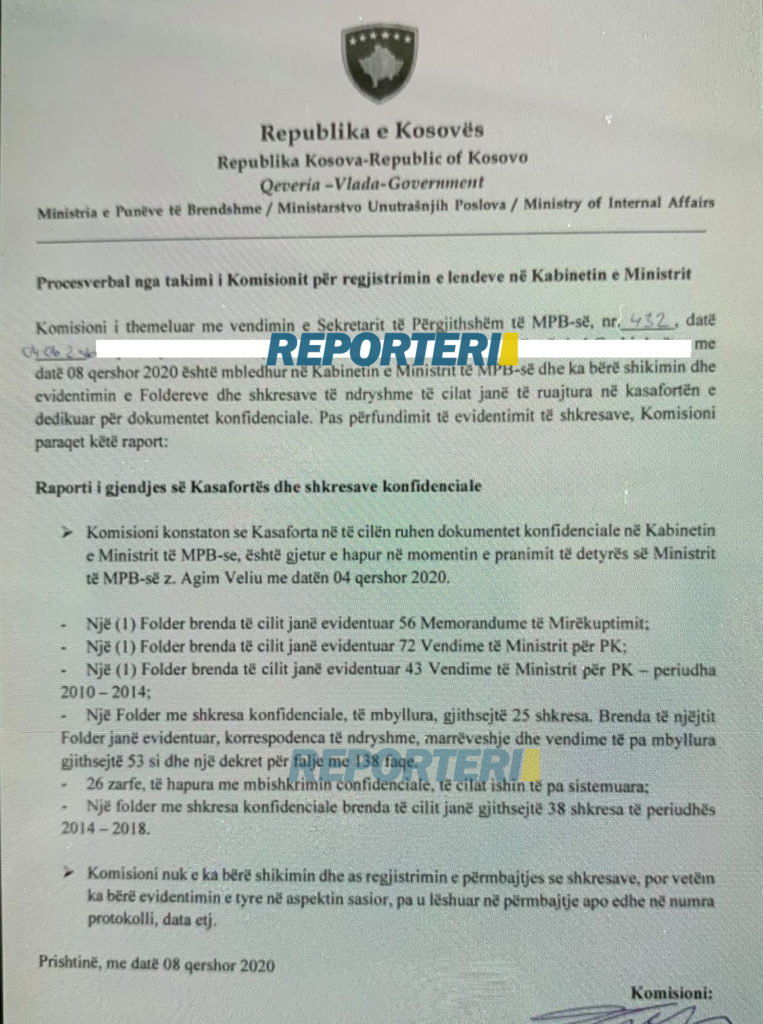
As within the vault that was found open, according to the report provided by Reporter.net, there are various corruptions, agreements, and unfinished decisions, and a decree of forgiveness, classified as confidential letters to the State.
In the same safe, several open envelopes were left with no lock and other fuses bearing the seal as confidential documents from the country's security organs. The same ones, highlighted in the document, were also disorganized.
The Commission has not made the view or the registration of paperwork content, but it has only made their identification in quantitative terms, without being issued in content or even in protocol numbers, dates, etc.”, says the June 8, 2020 report.
This document does not clarify whether any confidential documents have been missing within the vault or with the highest security rankings stored in the Office of the Interior Minister.
As for the fact that the contents of classified documents do not have to flow to public, the MPB document speaks of over 170 confidential seal documents, but avoids their content because in that part it is not authorized to access either the Ministry of the Ministry or the commission, in this case, to register the subjects in the Capt of the MPB Minister's Cabinet.
Minister Agim Veliu has not responded for several days in the newspaper's calls, nor on Monday, to questions sent with SMS to explain how he found the safe in his cabinet and if he considers national security at risk with the flow of these confidential files and for the measures he has taken.
And ex.d. Interior Minister Jedal Svecla's, during the moon, has been calm to show if he left the safe open when he left the office and who she handed her key to with leaving office. Svechla has also been asked with SMS if she has translated documents inside the safe and if she has taken copies of them with her.
Neither has AKI, which is involved because most of the documents inside the safe are their paperwork, have returned to email-sent questions last week.
How the safe should be stored and the key kept from it
Under a regulation that was issued by Kosovo's prime minister in October 2011 for the Fisc Insurance of Classified Information, the safe that was found open in the cabinet of the MPB Minister, is classified as the “Second Class Security Zone” and is “Zona, which preserves and manages classified “condencial” and the highest level of”.
Access to access and access to authorized persons is checked in this area, said the regulations.
In case in question, the key to the safe at the MPB is held by the minister, and there is a security procedure for transferring the lock to open it to other people.
The directors of public institutions, where they are produced, processed, distributed, transmitted, and stored classified information, are assigned to take measures to provide these facilities in line with the volume of classified information. They take steps for safe and automatic facilities as well as the use of separate keys and locks from those used by ordinary”, the regulation says.
In addition, Article 5 of the same regulation, regulating “Maintaining classified information according to the classification level”, specifys that for COFIDENCIAL level information, stamped documents that are stored even in the safe that was found open at MPB “should set up mechanical barriers as well as electronic security alarm<3>.
At one point on Article 6 of the Classical Information Insurance Center, which regulates “The minimum security standards” specify that in such areas “the logins should be provided with lock-up combinations with three positions built, or in particular, other leads approved by competent authority, only for the rooms that store information “SERVANT SEKRET”, SEKRET” and “K O NFIDENCIAL””
It regulates that the keys to the confidential files should be provided and that these keys should not be taken outside the building's offices.
The knowledge of the combinations is allowed only for individuals authorized in writing by the title of the public institution which are properly certified”, the regulation says.
“1.11. Work keys and reserve must be kept on different metal shelves; 1.12. The envelopes where the keys are placed and the combinations should be stored at the level of the information level where access to” is available, says the regulation, which also requires that keys and combinations should be changed to time intervals no longer than 12 months.
Law envisions prison sentences even for those who do not defend classified information
In Kosovo, classified information is protected by special law aimed at establishing a unique system for classification and preservation of information concerning Kosovo's security interests, as well as for verifying the security of those who have access to this information.
Article 50 of the Law on Classification of Information and Verification of Security provides criminal sanctions for public flow of documents as stored in the MPB safe.
Furthermore, the same article in this law envisions the sentence of up to 5 years in prison even for those who do not protect classified information, as may have happened in the case of the MPB's confidential documents safe.
“characters which, without authorization, publish classified information under this law as” K O NFIDENCIAL” and any authorized host of such classified information, who does not defend classified information as required by this law, commits criminal acts and is sentenced to imprisonment of one to five (5) years”, the law adopted in August 2010 by the Assembly of Kosovo.
This law, in Article 40, envisions the Security Regiment for every person who has access to classified documents, like preliminary verification by security authorities for those who see classified documents.
“Every director of a public institution regularly creates and updates a security registry, which contains information about the name, overname, position and rank of persons authorised to access classified information held in the relevant public institution”, says the first item of the 40 Law Article for Information Classification and Security Verification.
At the following point it is specified that “Fingerprint holds a central name registry, surnames, position and rank of all persons in Kosovo authorised to access classified information as “K O NFIDENCIAL”, “SEKRS” or “T SEKRET””
In the three articles above, in that 37th of this law, the Interim Access to Classified Information is regulated “, the chairman of the Public Institute can grant permission to a person who has no security verification required for access to the information class after it has given the verifiable authority before reporting.
There are also specific conditions for such cases: “1. Let the person have valid security permits but not for the classification level for which access is required; 1.2. The verifiable authority not to object in writing within 15 days by accepting the announcement. 2. Permission for temporary access to classified information is valid for an unrenewable period that does not exceed six months”.
To get access to confidential documents, as stored in the MPB safe, authorized persons, according to Article 30 of the Law on Classification of Information and Security Verification, are subject to the simple Security Verification Process.
“1. The simple security verification procedure applies to persons who need access to classified information as “K O NFIDENCIAL” 2. The verifiator authority confirms whether the information given to the security questionnaire is complete and accurate. To that end, the verifiable authority inspects civil status records, files on criminal acts and any registry or other national or international official databases. 3. The simple security verification procedure ends within three (3) months of the start of this procedure”.