3 minutes ago
JAVA: LDK downloaded Vjosa Osmani, it “la” Rugova for Demach?
Periskopi(6 years ago)
(6 years ago)Another exciting week politically ends today. A week where the conditions of a political future for Kosovo were briefly shown. The White House's special minister for Kosovo-Serbia dialogue, Richard Green, announced this week that a very important meeting would be held between the two countries in Washington on 27 June. If [...]
The White House's special minister for Kosovo-Serbia dialogue, Richard Green, announced this week that a very important meeting would be held between the two countries in Washington on 27 June. If neither side agreed to submit to this dialogue, then the remaining remains are envisioned in the current “patus quo”.
By that date, the parties agreed on how much they agreed to stop diplomatic respective campaigns. Kosovo by the 27th will not lobby for membership in international organisations, while Serbia will not lobby for the revocation of recognitions for our independence. Of course, although an unnecessary drama in daily politics was created, the truth is that our diplomatic campaign was comparatively weaker and more inefficient than that of Serbia.
However, the nature of dialogue and that of the final evental agreement was promoted by Mr. Richard Green as <x0economic”. This makes “status Quo” look economical. The reaction in Kosovo was naturally nationalist. Our problem with Serbia was not <x4economic”, but <x6-political” was said. So Kosovo faced with an extremely weak economy was refusing to see the problem with Serbia as an economic problem. Ironic!
Also this week, the EU's emissary for Kosovo-Serbia dialogue, Miroslav Lajcak, arrived in Pristina after much trouble. He met with all relevant political actors in Kosovo, including Hashim Thaci, who had criticised him for his vague positions. He offered no guarantees for “liberal visaisation” for Kosovo, while he did not respond even if the purpose of the EU dialogue was the “recognition of Kosovo by Serbia” as it was on the part of the American administration.
Kosovo is in Europe and not in America, but Kosovo would be nowhere without America it is fair to say.
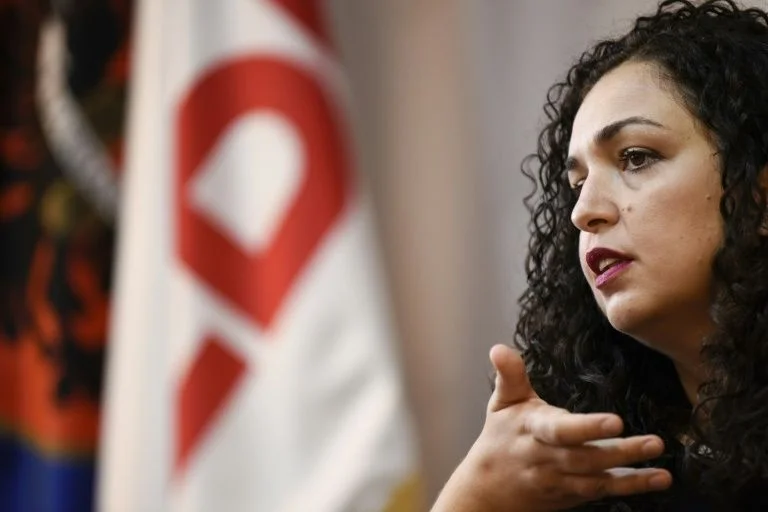
Meanwhile, a significant development occurred even in local politics. Isa Mustafa, the LDK chairman, proposed that his party vote for Vjosa Osmani's dismissal from the post of deputy speaker. In a process of “garging-definition”, Osmani fled that majority vote position while being appointed Avdullah Hoti. From now on, the LDK will not have a deputy speaker as speaker of the Parliament, but will have a prime minister.
The move took place after Osman turned against and even damaged the LDK through political positions that favoured Vetevendosje. Osman was not done with her party even when former Prime Minister Kurti had dismissed Agim Veliun of her party from the position of Interior Minister, thus violating the agreement for co-governance.
But what will Osman's political future be?
As political divisions have narrowed too much over the past year, thus increasing tensions, Osman is not left with much space of action. Its political stances have been in full accordance with Vetevendosje a party which, ironically, can be said to be known for “determining freedom of expression”. Osmani has remained in the dilemma of creating a new political party or crossing into Vetevendosje. Both options are expected to be very problematic to maintain the current popular support Osman has. If it creates new parties, then its offer should be better for the Kosovo electorate even in terms of attitudes in daily politics. If it passes to Vetevendosje, “Rugovism” as its central value would have to be removed and embraced in a form “demacism” (Adem Demach).
While today, Sunday, Serbia's elections in northern Kosovo are under way. Our government is justified in allowing them to be called into previous practices. /Periscope