 8 hours ago
He created the best-known tracker of Coved-19, learn who Lauren Gardner is.
Periskopi(6 years ago)
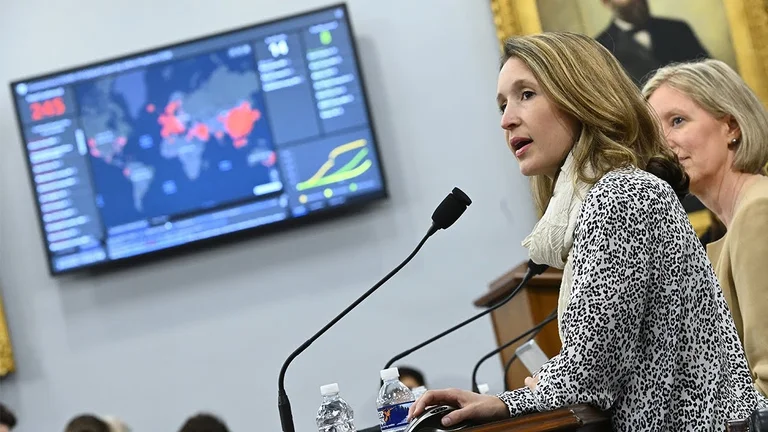
(6 years ago)Lauren Gardner, the woman who stands behind what may be the most famous tracker of the new coronary, is not a health professional, she's an engineer. Due to the report of the first cases of the Coronavirus, the sign of Johns Hopkins University, black and ashes, with red dots, pointing to cases of touch, of [...]
Lauren Gardner, the woman who stands behind what may be the most famous tracker of the new coronary, is not a health professional, she's an engineer.
Due to the report of the first cases of the Coronavirus, the table of Johns Hopkins University, black and ashes, with red dots, pointing to cases of affected, healed, and Coronavirus dead in 188 states and regions, has been placed at the centre of efforts to fight pandemic by health authorities, researchers and policymakers.
This project, quoted also by the White House, has become a source of information for journalists and the public, counting over 640 million daily clicks.
Gardner, associate professor of civil engineering systems at Johns Hopkins University, and creative of the interactive map, has said he didn't think the tracking project, created overnight, would receive such attention.
However, it has spread quickly, enabling people to pursue real - time pandemic after reporting cases in China.
So far, more than 9 million cases of Covid-19, which causes Coronavirus, have been recorded worldwide, until 469,000 of them have died.
I've seen it as something that could fill the need for research, so the fact that this thing has touched everyone's lives on the planet is parallel to”, says Gardner, who is co-chairman of the Center for Scientific Systems and Engineering at Johns Hopkins University.
I think it has resulted in filling the huge emptiness that existed in offering information to the public”, it said about the American magazine, U.S. News & World Report.
How did it get into the tracking table?
The project was born on January 21st, when Gardner and her two graduating students had met in a café. During the discussion, they were focused on the unprecedented coronary by then, and which by that time had infected about 200 people in China, where the two students were from, and in three other countries.
On the same day, American officials reported on the first case of Coronavirus in Washington, a man who had just visited the province of Hubei in China.
The World Health Organization had not yet declared the eruption of the coronary as the pandemic, and the disease, which causes the Coronobrus, had not yet been named Covid-19.
During the conversation, Gardner and one of her students, Enseng Dong, had decided to track the virus, and the map was published on January 22nd.
The project had gained so much attention that Gardner's team had left everything behind to focus on trackers. By the end of January, this interactive data map has provided about 200 million daily interactions.
By the end of March, it had been clicked over 1.2 billion times.
“has been very difficult in the first few months”, Gardner said, while referring to her team.
In April, she has said her team has not slept much and that walking from her house to campus has been her only free time during the day.
How have the data been recorded?
Initially, her team has recorded the data by hand, based on media reporting information and a Chinese medical community, but now it has shown that the data is automatically provided by public health centres worldwide.
Dozens of people are currently engaged in this project, including public health schools, data servants and communications teams.
Although Gardner still supervises the tracker, she is now working on projects that enable her to analyze the data for Ovid-19, and not only their collection and publication.
On June 12th, Johns Hopkins University reportedly joined scientists from the California University's Scrips Research and those in the project aimed at showing why and how diseases that turn into pandemics spread.
The project has won $1.3m from the National Health Institutes in the United States.
The team plans to create massive international air traffic databases, reflect weather worldwide, national demographics and information for patients who are sick, to understand more about the new coronary.
Through data, scientists aim to inform leaders and the public of how complex systems in the world cope with such explosions or infectious diseases. Scientists have said they hope that governments will be able to use the find as tools to improve their response to the Devid-19 disease, or to minimize the damage to the eventual explosions in the future.
Tracker shows <x0patitis existing for”
Professor Gardner designed in the past the spread of viruses such as Zika, or birds. Last year, it predicted that the United States would be able to return to the spread of fruit, based on international air travel and non-meditary exemptions of child immunization, which it used as a signal for the community's reluctance over the vaccine issue.
“I am very interested in issues about dezinformation, mismanagement and communication of science”, she said.
She believes the tracker has enabled each person to follow the spread of the pandemic “through authentic and transparent resources”.
Gardner believes the tracker's popularity confirms the existing appetite for offering data, which may be key to fighting other global health threats.
I'd like to state that we won't have to create something like that anymore, but I feel it's inevitable”, she said, as far as projects like this are about diseases in the future.
I have a feeling that such information tools will now be offered forever, because it is seen that there is a request for them”.











