9 minutes ago
Blakaj says Kurti was not willing to discuss unpopular topics
Periskopi(6 years ago)
(6 years ago)For these two decades of post-war efforts, there has been no proper treatment of the past on the part of institutions and media. As a result, the culture of impunity is silently promoted and the right of victims and their families to justice is being denied. So says Bekim Blakaj, who is executive director of [...]
For these two decades of post-war efforts, there has been no proper treatment of the past on the part of institutions and media. As a result, the culture of impunity is silently promoted and the right of victims and their families to justice is being denied. So says Bekim Blakaj, who is executive director of the Humanitarian Law Fund in Kosovo.
Interview conducted by Shkodran Hoti.
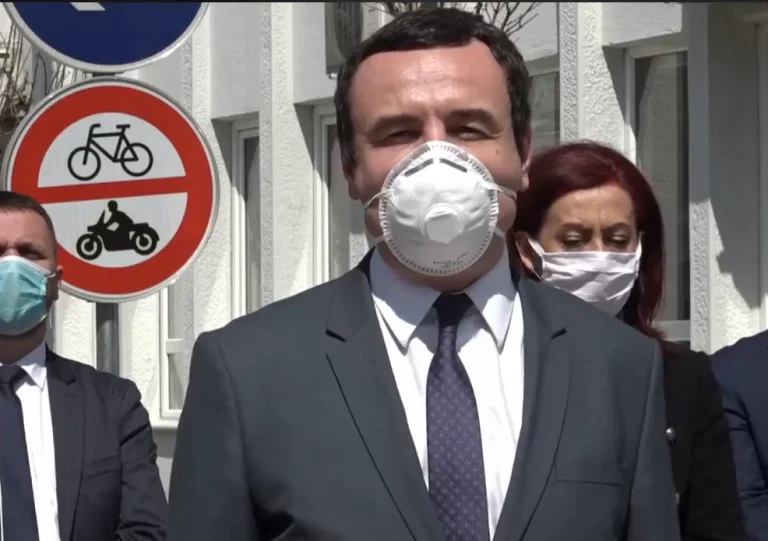
A while ago, the acting prime minister, Mr. Albin Kurti fired, following public pressure and his party's people, one of his advisers because of the statement that “ka members of the Kosovo Liberation Army (UÇK) who committed crimes against innocent civilians”. In his download reasoning, Mr. Albin Kurti said there are things “that he does not agree with past” with his adviser and that he considers that he considers this debate “not to do from the position of adviser”. What does the prime minister's reasoning mean to you in relation to the subject raised by his adviser?
Bekim Blakaj: The prime minister in office found the easiest way to bypass an important topic that his adviser promoted in a television interview. Indirectly he said he disagrees with what his adviser stated, adding that he can continue this debate, but not by the councillor's position. This shows the prime minister's unwillingness in office to address topics that may be unpopular.
The debate caused by the prime minister's former adviser's statements to the incumbent has re-opened discussion on war crimes in Kosovo, topics about pure war and fair war, liberation and conquering war, state and individual crimes, collective and individual responsibility, etc. Not rarely are those who seek justice for the victims, especially those with other ethnic affiliations. What does this and this argument (against) mean for you today, twenty years after the end of the war in Kosovo?
Bekim Blakaj: It is a pity that still, even after more than 20 years after the end of the war, such topics cause fierce debate in our society, where one-sided discours dominates and notes a pronounced tendency to deny, or minimised, victims caused by former UCK members, which a large part of them are not of ethnic Albanian affiliation. This lets us understand that for these two decades of post-war, there has been no proper treatment of the past by institutions and the media. As a result, the culture of impunity is silently promoted and the right of victims and their families to justice is being denied.
There are rumours in Kosovo that there are attempts to relate crimes committed by Serbia's state camera, wanting to be “kept equal to “those with other crimes, in the function of “equalising the aggressor with the victim” and building another truth/narration for war in Kosovo? How do you respond to these statements?
Bekim Blakaj: It is true that we can often hear such claims, where it is said that during these years there has been a tendency to become a revision of the recent war history in Kosovo so that all sides can be presented equally, as perpetrators of crimes and in this way equal to crimes. As a promotion of this process, the international community has often been mentioned, especially with the establishment of Kosovo Specialised Chambers. No matter how limited the number of court processes committed in Kosovo and in the absence of an official crime registry and war victims, however, they could not be equal. Even those few ongoing judgments, especially those before the International Criminal Tribunal for the former Yugoslavia (The Hague), show the extent of crimes committed by Serbian forces, which are planned and organised by the highest carriers of Serbia's political, military and police institutions. Therefore, for all six Serbs convicted before The Hague Tribunal for crimes committed in Kosovo, their crimes have been described as war crimes committed in a Joint Criminal Company. On the other hand, civil society organisations have largely documented serious human rights violations, as well as long-standing and post-war crimes in Kosovo. The results of this record show the crimes committed by Serbia's institutions and those committed by former KLA members in no way can be equal.
As for the creation of accurate narration, here an important role could play a truth commission that would have regional character and would have to make the registration of all victims of war during the breakup of the former Yugoslavia. This would affect the approach of counterproliferation and acceptance of all victims. The initiative for KOMRA promotes this approach.
Kosovo- Serbia
Facing the past in post-conflict states is a very difficult process. In this context, how much has Kosovo built capacities over these two decades to establish justice for war victims, and how does it stand compared to countries in the region?
Bekim Blakaj: In general, we cannot be satisfied with the steps taken by Kosovo institutions in establishing and implementing conventional justice mechanisms. One of the main mechanisms of conventional justice is the prosecution and criminal judgments of those responsible for crimes committed during and shortly after the war in Kosovo. If local judicial representatives are asked often, without hesitation, they blame international missions in Kosovo, UNMIK and EULEX, saying war crimes judgments have been the exclusive competence of internationals. In fact, this is not entirely true because local judges and prosecutors are involved from the beginning in these judicial processes, and both international missions in its mandate have had the component of establishing local judiciary capacities. The fact is that local prosecutors and judges have not shown a great will to be involved in war crimes classes, and their performance has been weak. Several hopeful steps have been taken in recent years on the part of the judiciary in Kosovo, such as the establishment of the War Crimes Department under the Special Prosecutor of the Republic of Kosovo, as well as the Special Department at the Foundation Court in Pristina.
Have you recently declared that no justice has been imposed for 1% of the victims of war? What are the reasons?
Bekim Blakaj: Unfortunately, statistical data makes me right in that statement. For more than 20 years after the war, in all judicial processes that have been conducted against those who have been suspected of committing war crimes in Kosovo and that of all courts, including The Hague Tribunal and the Special War Crimes Chamber in Serbia, have been sentenced with an overwhelming conviction of about 70 persons. On the other hand, according to the registry of those killed and missing during and after the war in Kosovo, compiled by the Fund for Humanitarian Law (FDH) by headquarters in Serbia and the Fund for Humanitarian Law in Kosovo (FDHK) are over 10,000 civilian victims killed or missing, not to mention here people who were subjected to sexual violence during the war, or those who were subjected to inhumane treatment, or were subjected to other abuses. All these people, and their families, are right in justice.
Of course, the capacity of the judiciary is limited and we cannot expect all war crimes culprits to respond one day for crimes committed. Especially the war crimes trials have big challenges. One of them is that two decades of these crimes have already passed and it is impossible to find forensic evidence. The prosecution has no written evidence available for these crimes. The prosecution is now largely based on the testimony of eyewitnesses who have lost their memory, even when they are reluctant to give their testimony. However, I think the main barrier to bringing justice to victims of war crimes in Kosovo is the failure to co-operate law between respective prosecutors in Serbia and Kosovo. As it now stands, on one side of the border there are victims, while on the other, perpetrators of crimes for which a suitable environment for impunity has been created as a result of mutual co-operation.
The establishment of the Special Court has polarised Kosovo society. We have even once had statements from the current prime minister that, with his coming to power, he will not hand over the accused, or even the initiative of former powers' parties to abolish him? How would you have explained this resistance to the Special Court?
Bekim Blakaj: I think that, like any other topic, even Special Chambers (special court) have been strictly politicised in public discourse. I also remember the debate in the Republic of Kosovo Assembly when the Law for Specialised Chambers was brought to the polls, with which there were numerous and fervent speeches, some of which even sounded pathetic. Even then, down to this day, there have been charges against those who have voted the establishment of the Special Court and tried to win political points on the issue. So part of those who oppose the Special Chambers do this for conformism, while another part opposes it even more strongly, because there is fear that they or their relatives may be subject to investigations by the Special Prosecutor's Office.
You have suggested the creation of the Room, or Specialised War Crimes Department, as a permanent institution, led by local judges. Why do you see this institution necessary knowing that the Special Court already exists?
Bekim Blakaj: Kosovo's Specialised Chambers have a limited mandate. Its wounded jurisdiction is limited to alleged crimes that have been subject to the Council of Europe Assembly Report, as well as subject to the investigation of the Task Special Protection Force (SITF). That's why this court will not be able to prosecute with all cases of war crimes and crimes against humanity that were committed in Kosovo in 1998-2000. Even if he had this jurisdiction, a temporary court would not have the capacity to deal with all possible war crimes subjects. Therefore, in the Kosovo Humanitarian Law Fund (FDHK) we believe that only a Chamber, Department or Special Local Court, permanent, established in Kosovo and with local courts, without political and professional integrations established could bring a new quality to the war crimes trials and would likely bring justice to a greater number of victims.
Culture of Undesirableness
It is known that one of the determining problems for justice has been witness protection. Some media have claimed that some persons recently found dead in unlightened circumstances in Kosovo were witnesses at the Special Court. Do you think the Special Court is proving effective in protecting witnesses?
Bekim Blakaj: It is true that there has been fear and threat of witnesses in many judicial processes, including various subjects even before courts in Kosovo, but also before The Hague Tribunal. Many key witnesses in these processes have changed their statements given in the preliminary procedure, and in at least one case the witness has refused to give his statement in the main review. As a result of these cases, in some court proceedings the prosecution has failed, and the court has brought about a free trial.
Apparently, the Special Court has taken that into account and, at least so far, it has shown special care in protecting the identity of potential witnesses. The very fact that there is no record of crimes to be tried before this court so far suggests that witness identity is not known, and therefore they are less exposed to danger. Also, it seems the Special Court will deal more seriously with cases of acts involving obstructing justice administration. We can expect that the sentences to the persons who will influence witnesses, or by other actions will prevent justice from being brought to justice will be punished with far more serious sentences than those given by The Hague Tribunal for the same acts.
Last but even earlier, was the idea of bilateral “amnist” mentioned in a future agreement between Kosovo and Serbia? How did you comment on amnesty as the political agreement between Kosovo and Serbia?
Bekim Blakaj: I think the amnesty inclusion option in a package of Kosovo agreement Serbia will not be possible for many reasons. In the first place, such an agreement would face strong opposition in both countries, and that would seriously jeopardise the final signing of the final agreement. Even if it happens, then implementation of the final agreement would be jeopardised. Also, such an agreement would be rejected by the international community, because that agreement would automatically and directly affect the outcome of the Special Court's mandate. And in the end, I would say that it would make no sense to assume that a real, lasting and historical peace is being established, as its own performers wish to call it, which essentially establishes the culture of impunity for the most secular crimes.
) Minister of Justice in charge, Mrs. Albulen Haxhiu, has signed a decision on forming the Workers' Team for preparing analysis for the establishment of the Institute for Investigation of Crime Research committed during the war in Kosovo? What do you expect from this initiative
Bekim Blakaj: Basically, FDDK supports any initiative aimed at creating mechanisms that help our society cope with the past properly. In the past, there was an Institute for Investigation of War Crimes, which later disappeared and then established a Transit Justice Department under the Justice Ministry. It is important that there is no overlapping of competencies between different mechanisms. Even though we don't have any high expectations from the Working Team, like the FDDK we have expressed readiness to make our contribution to this team, and if there is a need for constructive criticism.