8 hours ago
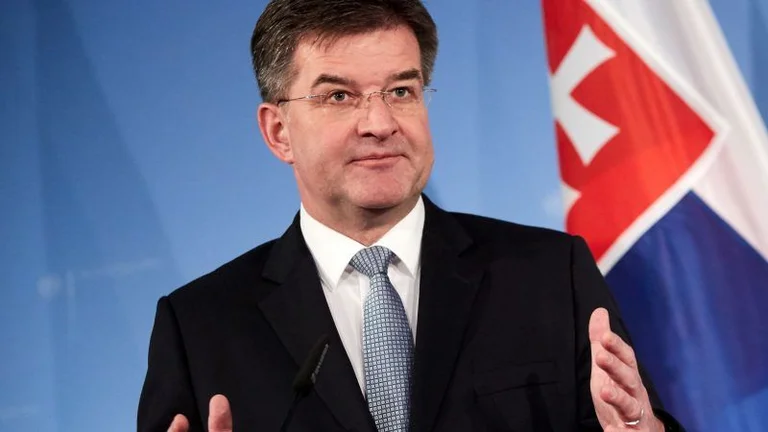
Who is Lajcak, emissary I EU, which Thaci is refusing to talk to about dialogue
Periskopi(6 years ago)
(6 years ago)The EU has appointed Miroslav Lajcak as a special emissary for dialogue with Kosovo-Serbia. Lajcak comes from a state that has not recognised Kosovo's independence, and as a result, the same is being seen with scepticism by Kosovo leaders. Miroslav Lajcak is not as desirable as the special minister of dialogue with Serbia. President [...]
The EU has appointed Miroslav Lajcak as a special emissary for dialogue with Kosovo-Serbia. Lajcak comes from a state that has not recognised Kosovo's independence, and as a result, the same is being seen with scepticism by Kosovo leaders.
Miroslav Lajcak is not as desirable as the special minister of dialogue with Serbia. Kosovo President Hashim Thaci said during yesterday he would not participate in any process led by Lajcak, whose country, Slovakia, has not yet recognised Kosovo's independence, writes the news.
Such a statement by the president echoed internationally. “
But is Lajcak's past the reason for Kosovo leaders' opposition except his background?
The news.net below brings a profile of the EU special emissary.
He is a Slovak politician and diplomat, minister of foreign affairs of Slovakia, and in addition, he has served as president of the United Nations General Assembly in 2017-2018, writes the news.net.
Lajcak has studied law at Comenius University in Bratislava and has conducted an international master at the Moscow State Institute for International Relations. As a student, he joined the Communist Party of Czechoslovakia. In 2018, he received the title Good Doctor of the Moscow State Institute for International Relations.
Lajcak has good knowledge of languages, except Slovak, Lajcak speaks well English, German, Russian, Bulgarian and Serbian-Croatian.
He as a member of the Communist Party joined the Czech Foreign Ministry in 1988. Between 1991 and 1993, Lajcak started working at the Czech Embassy and then only Slovak in Moscow. He was Slovakia's ambassador to Japan between 1994 and 1998. In 1993-1994 he served as the head of Slovakia's Foreign Minister's cabin and later Prime Minister Joseph Moravek. Lajcak worked and in Belgrade as Slovakia's ambassador to the Federal Republic of Yugoslavia (later both Serbia and Montenegro), with competence also for Albania and the Republic of Macedonia.
In 2005, EU diplomacy chief Javier Solana called on Lajcak to be the overseer of Montenegro's 2006 independence referendum, which was adopted closely. Serbs and Montenegrins remember him as a strict but fair negotiator.
On June 30th 2007, Solana again chose Lajcak to succeed in Christian Scherz-Schiling as a double High Representative for Bosnia and Herzegovina/ EU Special Representative for Bosnia and Herzegovina (OHR/EUSR). It was quickly praised as “the person of the year” by both. Lajcak during 2007 and 2009 acted with an average strong role of the OHR using the Bonn Powers more than Scherz-Schiling, but less than Paddy Ashdown; critics of Bosnia's international oversight; and major institutional changes; and change the framework of the Dayton peace agreement without ownership or internal legitimacy. Lajcak is estimated to have achieved results on the ground, but at the price of risking the credibility of EU conditioning, simply accepting cosmetic legal changes. The reasons for his surprise departure from Bosnia in January 2009 also remain unclear.