5 minutes ago
Education expert: It's still early to talk about opening schools.
Periskopi(6 years ago)
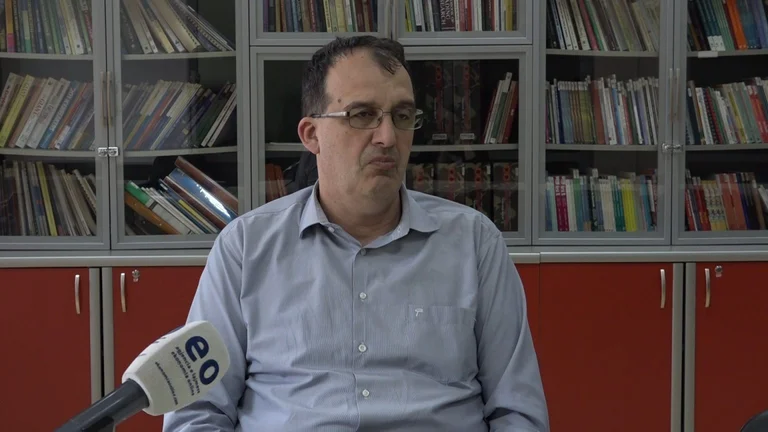
(6 years ago)Dukagjin Pupovci, education expert, has indicated that it is still too early to talk about opening schools, though the softening of measures against Coronavirus's pandemic has already begun in Kosovo. epidemiologists must speak on this subject. He said in an interview for Online Economics in this situation that schools are potential grounds for [...]
Dukagjin Pupovci, education expert, has indicated that it is still too early to talk about opening schools, though the softening of measures against Coronavirus's pandemic has already begun in Kosovo.
epidemiologists must speak on this subject. The one in an interview for Online Economics, schools have said in this situation, are potential grounds of infection and their opening into the current situation, could result in an increase in the number of cases infected with Coronavirus.
The opening of schools is a question for epidemiologists because it depends on what strategies they choose. Kosovo has chosen the conservation strategy from infection, as opposed to some countries that have chosen the collective immunization strategy and have not closed at all”.
“under these conditions schools are potential grounds of infection and opening them in the current situation, I think it would have resulted in increasing the number of cases. That's why all I've heard so far is that schools if the conditions are created to open during September, while during the month, open up for prom exams and arrival tests, where students can come in smaller numbers and organise in smaller classes and also open universities for taking exams”.
And students being an older population can keep their distance and save themselves from infection. School openings should be talked about by field experts, but if it's thought not to spread infexon, it may be a little early to talk about this work”, he told EO.
Asked whether Kosovo should follow Albania's example and open schools for seniors, Pupovci has said that there the pandemic started earlier and is ahead of us.
The teaching of seniors has already been completed, but in Kosovo it is envisioned that seniors and students of the ninth classes have access to schools. Whether any form of prom training will be organised with them, respectively, I don't know, but these tests will probably be submitted to you in schools with the smallest number of students in class”.
The same thing about faculty. That will happen, but it will happen if things go well after June two. In Albania, I don't know if the lesson is still continuing, but have they finished it, but Albania is just ahead of us and little ahead of us has started pandemic there”, he said.
Meanwhile, Popovci says schools would do well to organise preparations for seniors during June so that these students can mobilise. This, he said, would greatly help prepare them for Matura's testing.
As far as I've followed it, the ministry has said that no questions will be asked as long as students were in children, they will avoid those questions on the test, but there's obviously been psychological impacts on students”.
This situation has affected, and it can easily happen that some of them have been more passive during this period for almost three months and that can certainly affect their ability to submit to the test, but the fact that it has been postponed for the beginning of July gives little time for students to return to normal”.
I consider that schools would do well to organize preparations for seniors during the month so that these students can mobilise with smaller numbers of students but would do much to help prepare them for the prom exam and that then considering that the material developed from March 16th has no reason to be in a separate situation than in previous years. So if they get back to normality in June, he said.
He also talked about learning from a distance. According to him, keeping teaching in distance is a success.
“The child is a social being, and learning does it in a particular context, so it's not like learning in a classroom where there are two people or themselves or in a classroom where there are 15 to 25 where you interact with other students. That's one reason that for young age, elementary school and distance learning is nowhere in the world except in areas where children really don't have access to”.
“Therefore not Kosovo but no country in the world has been prepared for such a situation that there will be a need to organise distance instruction. According to U data NESTO's over 90 percent of the world's students are in this situation in which Kosovo students” are located.
The fact that distance learning is organised is a success far. It is a farce of success that has compensated to some extent the inability of students to go to class”, he said.
Professor Pupovci has said that online instruction on the part of teachers is smaller and the role of parent increases.
There are other circumstances at a distance lesson, supervision from the teacher is smaller because there is no supervision, and the parent's role is greater because the parent should exercise that duty at home. This in all contexts does not function correctly”.
There are environments where parents simply don't have that knowledge to help their child, and usually communication with teachers is more difficult, usually lack of technology, not known for its use, and this affects students”
Fortunately, this situation is not lasting a number of two months three, and this can be compensated for plus distance learning has fulfilled some of the vacuum that could be created if students were not at all at school. At the moment, we don't know for sure that the student's connected and didn't turn off the camera. Teachers have made a maximum effort. We have a slightly upside down situation in relation to what we're used to and this normal situation that could have left some of the consequences of”, he added to EO.