20 minutes ago
What happens if the Constitutional Court decides in favour of Vetevendosje?
Periskopi(6 years ago)
(6 years ago)The political scene in Kosovo is under way, awaiting the Constitutional Court's verdict on the decree of President Thaci nominated for prime minister Avdullah Hotin, the candidate of the new parliamentary majority. But beyond the interests of political parties, the decision will be of utmost importance to the way we think about elections, democracy and life [...]
During yesterday, many Vetevendosje officials reiterated and reiterated that the Constitutional Court had the right to only take “wrote” The constitution but not to “constituted” it, since the deadline offered to the first party to name the mandate following the successful no-confidence motion has not been determined.
In fact, even if the Constitutional Court were to decide in favour of Vetevendosje, it would mean that the <x0 time limit would be defined” because the non-determination of this term would take anti-unconstitutional meaning.
But Vetevendosje is putting great pressure on the Constitutional Court constantly and has already stated openly that they will not respect the decision of this institution, which will be considered anti-constitutional.
However, the issue is so important that it exceeds specific names such as Albin Kurti, Avdullah Hoti, Isa Mustafa and others, or even the names of their parties, writes Periscopi.
The Constitutional Court's decision will determine the way political parties will behave, the way elections, democracy and all political life will be thought of in the country.
Only first party voters are worthy, others are not
The first direct consequence on democracy would be the equal non-representation of Kosovo voters in the country. The party voters, who would come first, even if they received only 20 deputies, would essentially become more valuable than voters from other parliamentary parties.
Elections would be effectively reduced to <x0Worm autogars” (support from Kurti) where the first even if there was only one more vote, there would be extraordinary political favour against other parties.
Only the first party would be able to form Government in addition to the fact that this party is only automatizedly offered to the head of the Parliament.
Block after block
Kosovo was in institutional blockades for 119 straight days, from 7 October to 3 February, as VV and LDK were not reaching power-sharing agreements.
Kosovo was in a blockade all summer of 2017, as the winning coalition (PAN) was failing to reach agreement on forming the government, which it did only in September of that year.
But, Kosovo was in the blockade even in 2014, for six consecutive months (June-November) following the formation of the coalition V later on. LAN.
There is no study on the missing millions because of these political blockades, but if the Constitutional Court gives justice to Vetevendosje, that would mean that the blockades would increase.
The exclusive right to government formation that is offered to the first party cannot afford political agreements among parliamentary parties with a spirit of trust and understanding.
Early Elections - More and More Often
The last four parties of elections in Kosovo were early. This, of course, seriously damaged democracy in our country, making four out of the last ten years like election years. In fact, from 2014 to 2019, each second year was an election year, unable directly to access long-term non-populist policies and giving way to short-term and damaging policies for the country.
But if the Constitutional Court ruling gives Vetevendosje rights then early elections could become annual.
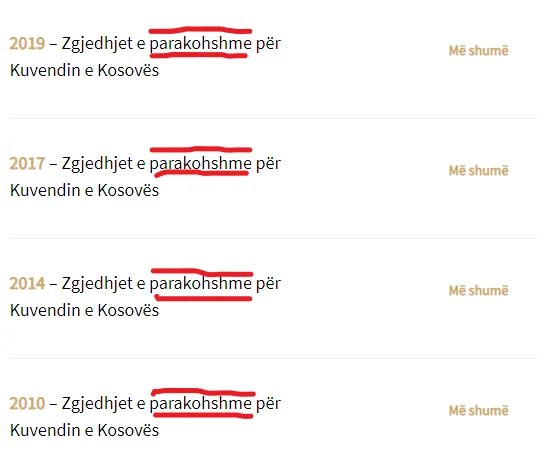
That is due to the fragility of the agreement on forming government between other parliamentary parties and the winning party. Each parliamentary party, at any given moment, dissatisfied with any decision by the prime minister, could withdraw from the coalition, prompting new elections.
Kosovo citizens vote for a government that would last four years. But that would never be possible.
Suppose, even opposition parties, P DK, AAK, the Initiative, without even being part of the new government would have been able to bring down Government through a no-confidence motion by joining the Serbian List.
Political warfare, not representation
Such a decision would turn the election race into an ongoing political struggle with hate and non-compliance languages and slander, other words of violence, and so on. But citizens would be forgotten because of the great polarisation of public debate.
Any minority social category would be considered invalid due to electoral consequences.
Instead of representing specific issues, certain social groups, parties or coalitions would try to represent everyone thereby not representing anyone.
Every word of every political speech, like any status of any television presentation, would become virtually electoral and for electoral benefits. /Periscope