7 minutes ago
EU: Quitting Corona Crisis Must Be Co-ordinated Among Member States
Periskopi(6 years ago)
(6 years ago)Small steps are needed to exit the Corona crisis and co-ordinated, the European Commission recommends. He has no concrete plans, but very good ideas. “The good neighbours speak to each other”, Ursula von der Leyen, president of the European Commission at the virtual press conference in Brussels, said. This is appeal to 27 member states, [...]
Small steps are needed to exit the Corona crisis and co-ordinated, the European Commission recommends. He has no concrete plans, but very good ideas.
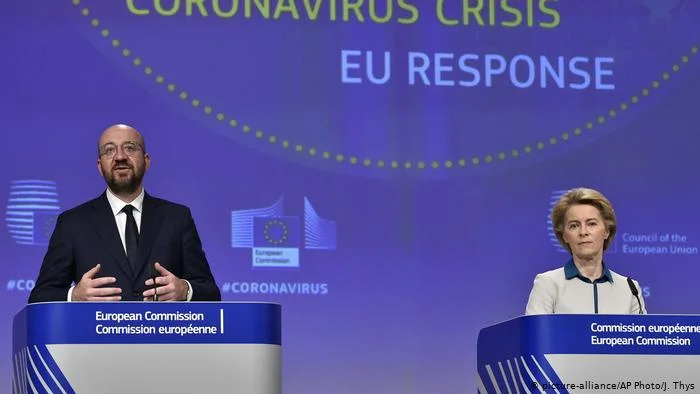
“The good neighbours speak to each other”, Ursula von der Leyen, president of the European Commission at the virtual press conference in Brussels, said. This is appeal to the 27 member states to co-ordinate the slow abolition of Corona's restrictions. The least “is for states to inform member states and the European Commission of the way measures will be removed”, said a strategic European Commission document presented by von der Leyen and EU Council President Charles Michel in Brussels.
It doesn't make sense to open shops on one side of the border while on the other, in another location, they are closed. This would cause people at the border to cross the border to buy by causing new human movements”, says von der Leeyen of the difficulties in opening EU internal borders. The “E is in the interest of member countries to quickly have an internal operating market without borders and invest for this”, notes von der Leyen, DW.
Recommendations, not binding instructions
The European Commission cannot make mandatory guidelines for health policies because they are the competence of member states that decide on their own. Brussels thus makes recommendations, without deadlines, that releases from restrictive measures will depend on epidemiological views -- the decline in the number of infections and its stabilisation. If the health systems of the respective countries are able to cope with the number of infected, and the possibility of following infectious chains and cutting them off. The release of measures must be taken step by step, and it must be aimed at isolating more weak groups, such as the elderly and the sick, while the rest of the population will return carefully to normal life. The EC recommends adding tests and possibly a joint application for its virus tracking -- the same for all member states, not 27 different countries.
Ursula von der Leyen also advocates the idea of removing travel restrictions on the EU's internal borders one after another and allowing movement into the European internal market. This will take a few months. The EC requires a co-ordinated action in order for even EU external borders to be opened again for EU travel and cargo transport with the Balkans, America, Asia and Africa.
EU Council President Charles Michel promised that the EU heads of state and government next week at the EU summit would draft a plan for economic recovery. “How much money will be needed at the end, no one can say this”, Michel said. Von der Leyen announced that member states and the EU have mobilised 3,000 billion euros to preserve jobs and the economy. This is financed at the moment through new debts.
EU member states act in different ways with restrictive measures. Denmark, for example, has opened schools for lower classes. Stores have been opened in Austria again. All remains closed until May 11th in France. In Sweden restaurant bars have never been closed. In Germany on Wednesday, it is set for the next steps. The EC does not have a clear answer if masks should be kept under compulsion as in Austria in public environments. What's clear is that employees in the health system first need to have” masks, Ursula von der Leyen said. In other sectors, masks play a role, if they can be secured, they say. But this too is the competence of member states.